Occasionally during the FAQ portion of my slideshows, and frequently at the start of every winter, I receive questions about vapor barrier liners (VBL’s). The content and tone of these questions suggest a general misunderstanding of and slight mystery about them, so in this article I’ll attempt to offer a comprehensive review of VBL’s based on my understanding of and experience with them – basically, what they are, how they work, and when to use them.
I believe that VBL’s can be a critical and pivotal component of winter clothing and equipment systems—and, to a lesser degree, shoulder-season systems. Unfortunately, there is not much information available on VBL’s—an internet search returns information that is mostly outdated, incoherent rambling, or mistaken. My hope is that this article will result in (1) a greater understanding of VBL’s and (2) increased use of VBL’s by those who recreate outdoors in winter conditions, especially those who go on extended multi-day endeavors. This includes backpackers, snowshoers, skiers (Nordic, backcountry, and alpine), alpinists, ice climbers, mountaineers, and even ice fisherman and hunters.
What are vapor barrier liners?
A VBL is a non-breathable material that does not permit the transmission of moisture through it. They are typically made of fabrics like silicone-impregnated nylon, polyurethane-coated nylon, or Mylar; and there are at least two multi-layer proprietary fabrics too. In a pinch a VBL could be made from a plastic trash bag or a foil balloon—I have done both; in essence, any material that does not “breathe” will work. VBL’s are available as articles of clothing—including socks, gloves, pants, jackets/shirts, and vests—and as sleeping bag liners. Later in this article I will address the pros and cons of the various VBL fabrics and forms.
To avoid any question, it should be noted that VBL fabrics are fundamentally different than waterproof-breathable fabrics or treated-breathable fabrics (e.g. acylic-coated nylon, or any fabric with a durable water repellent finish). It is fair to question how “breathable” such fabrics really are, but even the poorest performing will still have some degree of breathability, whereas VBL’s do not permit any transmission of moisture, i.e. zero breathability.
Commercial Availability
No major outdoor manufacturers—not even technical mountaineering companies like Mountain Hardwear or Arc’teryx, whose core customers could arguably benefit most—offer VBL products. There are just a few mom-and-pop cottage manufacturers: RBH Designs has the most “extensive” product line; and other manufacturers like Stephenson’s Warmlite, Integral Designs, Forty Below, and Western Mountaineering also have a limited assortment of VBL products.
The limited commercial availability of VBL’s, I believe, is a function of two factors. First, VBL’s are optimal for just a narrow range of conditions—namely, multi-day outings in frigid temperatures—and so the potential customer base is very small. After all, how many people do you know who go on winter trips for a week or longer? And second, the defining characteristic of VBL’s—their lack of breathability—completely contradicts what consumers are regularly told they want in outdoor performance equipment—breathability—and thus the lack of intuitiveness keeps organic demand low.
I believe that there are a few excellent lightweight VBL products—most notably the Backpacking Light FeatherLite Vapor Mitts (manufactured by RBH Designs) and the RBH Designs Bonded VaprThrm Liner Socks—but that overall consumers are vastly underserved. In fact, I resorted to making my own VBL pants, jacket, and balaclava because I was not satisfied with what is commercially available.
A case study: Why I began using VBL’s
In the winter of 2004-05 I snowshoed 1,400 miles of the North Country Trail through both peninsulas of Michigan, northern Wisconsin, and northern Minnesota as part of my 7,800-mile 11-month Sea-to-Sea Route trek. With temperatures as low as -20 F and a consistent snowpack of 2-4 feet, this was unequivocally the most difficult part of the entire hike. It was my first serious winter experience, and a problem that became immediately clear was that my clothing and sleeping system failed to adequately manage perspiration. For example, my sleeping bag (a top-of-the-line model rated to -5 F with premium 850-fill down) would become more damp—and less lofty—with each long night curled up in it. My running shoes and Forty Below Light Energy overboots were frozen stiff each morning due to trapped foot-sweat from the days before. And sometimes I would perspire so much at night—without noticing it—that my clothes would steam when I emerged from my sleeping bag in the morning.
If not for being invited inside 1-2 times a week by generous locals and having the opportunity to dry my things, I definitely would have shivered through more nights than I actually did. The complete compromising of some of my most critical equipment was unstoppable with the system that I had.
Fast forward two years to January 2007, when I decided to revisit northern Minnesota in the depth of winter, but this time better equipped. Among the objectives of my 380-mile 16-day “Ultralight in the Nation’s Icebox” hike was to perfect my deep-winter gear list, or at least approach perfection. That meant bringing a VBL jacket, pants, socks, gloves, and balaclava. I intended to complete the entire trip without a night indoors, or at least feel that I was capable of doing so. (As it happened, I spent one night inside, about 5 days into the trip, with one of my favorite trail stewards, Ken Oelkers of Silver Bay.) After the trip I made a few small adjustments to my winter clothing and sleep system, but generally these systems were spot-on—they led to a tremendous improvement over my Sea-to-Sea experience.
Having realized the value of VBL’s, I also began experimenting with them in other situations, including during the shoulder seasons and on done-in-day skiing and snowshoe trips. In February and March 2008 I even used VBL’s while removing ice dams off of rooftops in Frisco, CO, including some windswept 7-story buildings at Copper Mountain.
In sum, I have become convinced of the value of VBL’s and have attempted to find the limits of their applicability. They are definitely most critical on multi-day trips in frigid conditions, but they are valuable for both shorter and warmer trips too.
Effects and Benefits
The principal effect of a VBL is stopping the transmission of insensible and sensible perspiration, i.e. sweat, away from your body, effectively creating a microclimate between the VBL and your body. (Without a VBL, perspiration would move away from your body and through outer layers (if applicable), and then hopefully evaporate into the atmosphere.) This entrapment of moisture has three benefits:
First, perspiration will not reach outer layers like a windshirt, insulated parka, or sleeping bag. This is hugely important because in cold conditions your perspiration will often stay in these layers: the dew point is somewhere between your body and the outside atmosphere, and your perspiration will condense from water vapor into actual water, thus wetting the layers. This will cause down and synthetic insulations to ultimately collapse. And it will cause unwanted evaporative heat loss with other fibers like polyester, nylon, and wool.
Second, the wearer is always keenly aware of their rate of perspiration, and they are better able to thermoregulate properly as a result. Without a VBL, you might begin to overheat and sweat profusely without fully realizing it. This will soak layers and cause dehydration, which will lead to poorer circulation and lower respiratory efficiency; you may also waste more time and fuel melting snow to get water. With a VBL, however, this scenario is far less likely to happen: you will notice the rainforest-like humidity level in the microclimate—or, if you really overdo it, the sweat dripping down your back—and you will react by removing layers or increasing ventilation.
Finally, evaporative heat loss is minimized. All forms of heat loss should be carefully managed in cold conditions, and a VBL is an effective way in which to manage evaporative heat loss. (The other types of heat loss are conduction, convective, and radiation.) To illustrate this point, imagine how it feels to work up a sweat while snowshoeing up a mountain and then resting for a few minutes at the cold, windswept summit. Brr…
Applicability: When to use VBL’s
There are no set rules, just guidelines, about when you might consider using VBL’s. In deciding whether to use VBL’s, and which exact items to use, I consider four factors:
1. RealFeel Temperature®. I do not necessarily use AccuWeather’s patented index, but I think the idea is useful—it is a measure of all of the environmental factors that affect how warm or cold I am. This would include ambient air temperature, wind, sun exposure, precipitation, humidity, and ground cover. I find that I can begin to wear VBL gloves in temperatures below 40 degrees F, a jacket and socks below 20, and pants below 10. If it is windy and/or cloudy, if precipitation is falling (particularly cold rain, sleet, or wet snow), and/or if I am walking on or through snow or ice, then I may be comfortable wearing VBL’s in warmer temperatures. If the conditions are opposite (no wind, lots of sunshine, no precip, and dirt or grass ground-cover), then it may have to be colder before VBL’s can be worn comfortably.
The maximum temperature at which a sleeping bag liner can be used is very dependent on the warmth of the sleeping bag. A liner will add about 5-10 degrees of warmth to a bag (not including the warmth preserved by preventing loft loss).
2. Trip length. The longer the trip, the more critical VBL’s become in maintaining the integrity of my clothing and sleep system. On a weekend trip, for example, loft loss will not be significant. On a week-long trip (or longer), however, the loss of a few degrees of warmth each night—due to perspiration entering the sleeping bag and wetting the insulation—would be much more noticeable and consequential. Without VBL’s, I would either need to dry my things during the day or bring an excessively warm sleeping bag so that by the end of the trip it would still offer enough warmth.
While the use of VBL’s is most critical during long-term endeavors, they can still be very valuable during shorter efforts. For example, towards the end of a full day of alpine skiing, when the sun disappears and the temperatures begin to drop, many skiers feel chilled because their boot liners, gloves, and clothing have become damp with sweat during the day. By wearing VBL layers skiers could avoid the compromising of their insulation and the sucking of heat away from their bodies by this trapped moisture, allowing them to catch one more lift at 4pm.
3. Type of insulation. Down is more susceptible to loft-loss than synthetics when exposed to moisture. Synthetics are still vulnerable in the long-term too, but the rate of degradation is less. Therefore, it is possible that I can stretch an all-synthetic system a few days longer than I could an all-down system. Ultimately, the all-synthetic system will fail too, but perhaps not before I finish the trip. Since down is significantly superior in its thermal efficiency, it’s debatable whether the all-synthetic system would be lighter—for example, I could put together a lighter weight all-down system that is unnecessarily warm at the start but that would still be adequate by the end.
4. Effort intensity. In order to avoid over-sweating while using VBL’s, I must be attentive to body heat generation and be willing to regulate it. This is fairly easy during steady, low aerobic activities like hiking, snowshoeing, mountaineering, ski touring, snowmobiling, ice fishing, etc. The task becomes more difficult for activities like alpine skiing and climbing, when periods of intense exercise are followed by periods of sedation, e.g. leading a pitch and then belaying a climbing partner up to the anchor. For high aerobic activities like running, skate skiing, or alpine touring (AT) racing, I find it almost impossible to avoid sweating and therefore VBL’s are probably inappropriate in this context.
Developing your own VBL system: Insider’s Tips
By this point in the article you hopefully understand what VBL’s are, and why and when you should use them. In this final section I hope to explain how to integrate them into your clothing and/or sleeping system, and to point out the pros and cons of various VBL fabrics and forms. All VBL’s are not created equal, and I have developed preferences for what I think is my optimal VBL system.
Layering. VBL’s are typically worn directly against the skin or with a base layer between the VBL and the skin. Personally, I prefer the latter approach, which I believe has a few key benefits. First, the base layer creates a small buffer that minimizes discomfort (i.e. “clamminess”) but without reducing sensitivity to perspiration, which I need in order to make informed thermoregulation decisions. Second, by wearing a base layer I protect my skin from direct contact with the frigid air, which would happen otherwise if I needed to ventilate my “next to skin” garment by unzipping it. Finally, the base layer seems to keep my skin dry enough that moisture-related skin issues (e.g. maceration)do not arise. I like to pair VBL’s with lightweight, form-fitting polyester base layers (like those made by CW-X), not wool. Polyester can be knitted thinner and does not absorb moisture like wool does, which may result in decreased sensitivity.
Forms. An effective VBL system needs to consist of either a sleeping bag liner or a full multi-piece VBL clothing suit. It is redundant and unnecessary to use both a VBL liner and a VBL suit. Personally, I prefer to wear VBL clothing, which has a few advantages. First, I can use a lighter sleeping bag because I can sleep with all of my clothes on—a base layer between my skin and VBL, then all of my other layers outside the VBL. With a VBL liner I can only sleep in my base layer garments; otherwise all of my layers would get wet. Second, I already have all of my clothes on in the morning when I wake up, which saves time and body warmth. Even if I brought all of my non-base layer clothes into my sleeping bag but outside of a VBL liner, I will lose a lot of heat when I try to change into them. And third, I keep all of my clothing dry at night and during the day, except for my base layers, which may become slightly moist with perspiration. If I were to rely exclusively on a VBL bag liner, perspiration would enter and become trapped in my insulated jacket and pants while I wear them during rest stops or in camp. The one downfall with VBL clothing is that I need to have a complete VBL suit, which is heavier and more complex than a bag liner. In the long term, my sleeping bag could be compromised if I am not completely covered with VBL’s. A complete suit would include socks, pants, jacket, gloves, and a hat or balaclava.
Fabrics. The ideal VBL fabric would be a non-slip, 1-layer, 4-way-stretch ultralight fabric with a good hand. To my knowledge this fabric does not exist. Until it does, we have sub-optimal options. Silicone-impregnated nylon and reflective nylon (e.g. Mylar) is slippery, crinkly, and noisy. RBH Designs’ VaprThrm® fabric is three layers and designed to be worn “next to skin”; it feels like a softshell fabric, minus the breathability. This fabric is heavy, and it offers less adjustability than a 3-piece system consisting of a thin base layer, VBL shirt, and an outer layer like a windshirt or ultralight insulated parka. Without stretch, these fabrics are impractical for pants because they are so constricting. The only option is to make baggy pants, which are not conducive to creating a small microclimate next to the skin.
Features. It is very uncomfortable to sweat while wearing VBL’s and so I am constantly trying to regulate my body temperature to avoid it. Regulating can be done quickly and efficiently via features like zippers (e.g. front chest, abdomen, pit, arm, and full leg zips), removable parts (e.g. arm sleeves), and easy on-off adjustments like integrated hoods or mitt idiot cords. During periods of rapid warming or cooling, like during or just after a rest stop, these micro adjustments may be inadequate and entire layers may have to be added or removed.
Conclusion
Vapor barrier liners can be a pivotal and critical addition to wintertime and shoulder-season clothing and equipment systems, especially for those who are outdoors for long periods of time in frigid conditions. VBL’s prevent loft-loss, encourage better thermoregulation, and minimize evaporative heat loss. There seems to be a good deal of confusion and mystery about VBL’s, and through this article I hope that I managed to improve general understanding and inspire more widespread use by explaining what they are, how they work, and when and how to use them.
Vapor Barrier Liner Slideshow: the technology put to use
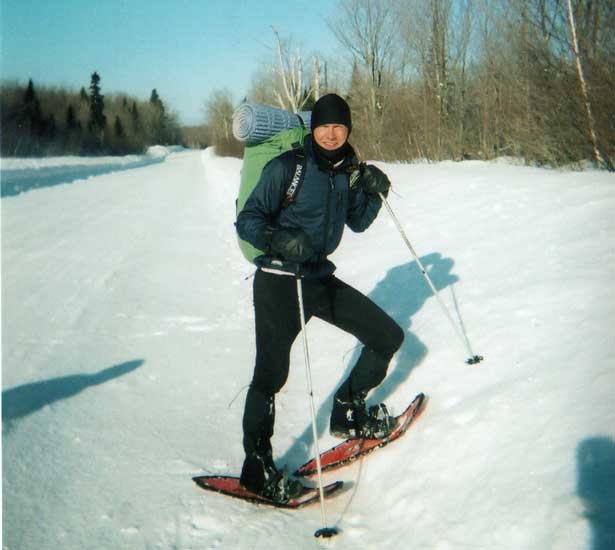
My first winter experience was during my 7,800-mile Sea-to-Sea hike, during which I snowshoed 1,400 miles through Michigan, Wisconsin, and northern Minnesota (pictured) in the first three months of 2005. It became immediately obvious that my sleeping and clothing system, which was simply a warmer version of a conventional lightweight setup, failed to adequately manage perspiration and loft-loss.

I returned to Minnesota in January 2007 in order to perfect my winter system, which included a complete VBL suit: jacket, pants, socks, gloves, and balaclava. The system was an enormous improvement over the Sea-to-Sea experience – the VBL system eliminated loft-loss, improved thermoregulation, and minimized evaporative heat loss. Notice the accessory carabiner on my shoulder strap, which is one of the ways I make fast and efficient adjustments to my layering system.

During my Ultralight in the Nation’s Icebox hike, I was joined for a night by Backpacking Light staffer Sam Haraldson, whose clothing and equipment system lacked VBL. After hiking for several hours, Sam removed his waterproof-breathable jacket to discover a layer of frost inside it, due to his perspiration turning from vapor into water as it reached the dew point, which was inside his clothing system. If he had been out for more than a night, the moisture inside of his system would have caused his insulated jacket to fail.

Without a VBL, it is necessary to dry clothing and equipment frequently. This is difficult in cold conditions, but possible. Even though I had VBL, I took advantage of a relatively warm and sunny day to dry two sleeping bags and a bivy sack, which had become slightly damp due to snow-covered ground and frozen moisture from breathing.
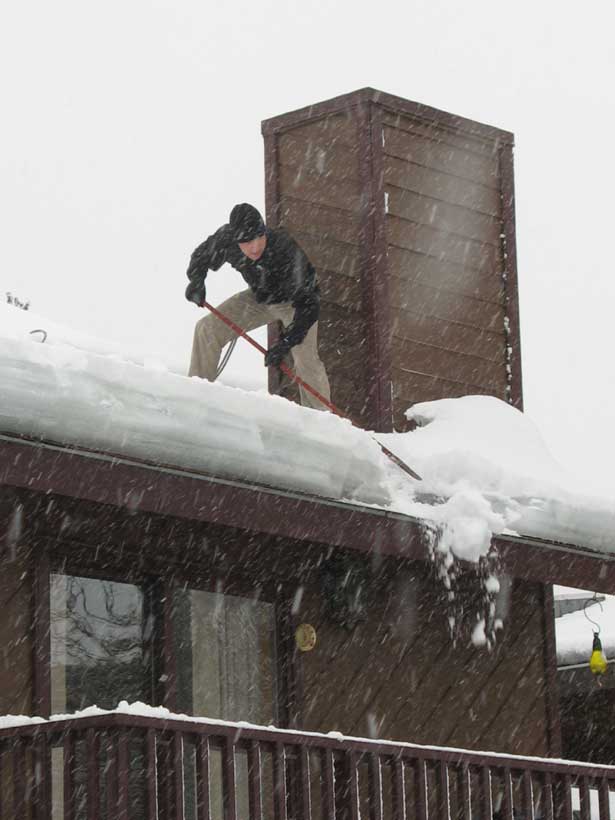
VBL are most critical on long-term trips in frigid conditions. But I have also found them useful during the shoulder seasons and done-in-a-day winter efforts. My favorite example of the latter is when I used them while removing ice dams off rooftops in Frisco, CO – the VBL helped to minimize evaporative heat loss and kept my insulation dry, which prevented me from getting chilled by the end of the day.

Steady, low-aerobic activities like hiking, snowshoeing, mountaineering, and ski touring are most conducive to the use of VBL because your heat output is consistent and can be managed easily. Stop-and-go activities like climbing and backcountry alpine skiing are challenging for VBL use because your heat output is more erratic.
[…] trips and especially if it is not too cold (like it was on the first night), we wanted to test the vapor barrier line technique in our sleeping […]
Really enjoyed the article. Great review and expansion of what i briefly read 20+ years ago. What are your thoughts of using a 1mm or 1.5 mm wetsuit shirt and pants as a VBL and first layer of insulation? Modern high end “superstretch” wetsuits from surfing companies like Rip Curl, O’Neil, Billabong, etc…with glued and blindstitched seams for surfing are basically waterproof and allow for amazing mobility. As a surfer who uses such 3 mm wetsuits I was thinking of using a 1-1.5 mm shirt and pants as a base layer for my occasional alpine skiing outing. I just want to stay warm but not bulky and am used to the clammy feeling of a wetsuit. For your more rigorous needs I can see how a shirt and pants combination would cause perspiration to escape between pants and shirt and not be a complete barrier. The shirt should also have a zipper to regular heat since wetsuits are very efficient with heat and moisture retention. i would also have to make sure that the seams are completely water proof for the 1-1.5 mm suits. Fur my skiing needs, it may not be so important.
I have a friend who tried wet suits material on Denali in the 1970’s and lost his fingers due to it. At altitude your extremities swell and your feet often spread a bit when distance hiking. This swelling caused the loss of circulation and the damage to his hands. IDK how it would be on the rest of the body but seems like it would be heavy and awkward to get in and out of relative to available garments.
I used RBH products with great success on Denali. Back in the 70s when skiing the JMT we had huge problems with condensation in our clothing and sleeping bags.
Hi Andrew- I am hiking up Mt. Kilimanjaro this Dec. I get cold easily (actually get hives when I am cold). My concern is for camping/sleeping at night when it can get cold. What would you recommend for general warmth sleeping versus the actual summit push where there is more exertion, it’s even colder/windier and it’s much more difficult to shed layers easily. Having a hard time figuring out what my system should be.
I’m not a high-altitude mountaineer-type, and can give you an answer based only on shoulder-season and winter backpacking. Typical sleeping warmth solution is: nearly all daytime hiking clothes (minus rain gear, and sub’ing insulated booties or high-pile socks for normal hiking socks), plus puffy jacket and puffy pants, and then a warm sleeping bag and sleeping pad.
[…] better than being soaked and freezing from the rain or snow. The rain-pris function much like a vapor barrier trapping the warmth against your body instead of letting it evaporate to the outside and chill […]
I say to each his own. However, I only use breathable water proof or water resistant laminate fabrics with varying thickness levels of polyester fleece and taped or non taped seams. (depending on weather, temp, wind etc) I spend most of my time skinning, bootpacking at high altitudes and extreme weather. I personally disagree with the use of VBLs. The micro-environment creates a pseudo 2nd skin that you can never remove without going indoors (think literal sweatsuit). Moist micro-environments create fungus issues. Mold likes to grow in cool, damp places. Fungus breeds a whole derivative set of issues for the solo trip enthusiast. Hello VBL 2nd skin void. People think I’m crazy because my glove collection at times can be worth more than my car. Different gloves and mitts for different times during the day. This can be more difficult to manage on long treks. I live work, play year round at 10,300′ elevation. I spend well over 150 days a year from 11,000-14,000′ outdoors. Just my opinion. oh, and I make outdoor gear which is worn by the highest based Search and Rescue team in North America.Again, to each his own…
I have never had fungus problems with VBL’s. Wearing merino wool base layers and socks — as opposed to polyester, which isn’t naturally anti-microbial like wool fibers are — may help with this. I also don’t find that the system is as sweaty as most people would think — VBL layers only become a sweatsuit if you don’t ventilate and/or regulate your output.
I’ll also point out that I don’t need to carry numerous glove systems and that my clothing system is versatile across a very wide range of conditions. The VBL layers are a cornerstone for this system.
What is your current glove system please? I get cold hands even in mild temperatures and am always looking for a better glove/mitt system for warmth and dexterity. I currently use Possum Down combined with the Showa 281 gloves you recommended I think around 2017 and albeit the best I’ve used so far, I still get cold hands. At night when sleeping I’ve been successfully using down mitts when cold.
For temperatures consistently below freezing, I use a DeFeet Duraglove Wool Blend Liner (which have the perfect balance of warmth and dexterity) with the RBH Designs Vapor Mitts (which are expensive but which will compel you to thank me later).
Thank you Andrew. Good thing I’ve got a birthday coming up.☺️
What Vapor Mitt liner did you order/use?
I always buy the Altitude liner, because it’s not much more expensive or heavier than the other versions, because it gives you the option to go lower than the others, and because there’s an easy solution when you don’t need such a warm liner (you take off the gloves and clip them to a carabiner on your shoulder strap).
Also, and this is the one criticism I have of this product, the liners use synthetic insulation, and over time that will flatten out, relative to down. So by buying the warmest liner, you are giving yourself some buffer when it starts to be less warm.
I’m thinking about trying latex gloves as a first layer. What do you think?
Could be uncomfortable having a clammy layer immediately next to skin. It’s better to have a thin buffer (like a liner glove) and then the VBL.
What fabric did you use to make your own VBL? What sort of patterns did you use for the clothing?
For a top, you can use any shelter fabric, e.g. sil-nylon, Cuben, PU-coated polyester or nylon.
I haven’t found an ideal material for pants, because as far as I know there is no non-breathable fabric that stretches, and I really like my pants to stretch, since otherwise they restrict movement. My homemade VBL pants are made from sil-nylon.
Re patterns, consider trying to replicate the dimensions of your favorite shell/raingear pants and bottoms.
Hello.
I have ordered the AMK SOL Emergency Bivvy, just for emergencies, and now after stumbling onto your great site am contemplating on maybe using it, when needed, as a VBL liner.
There is some videos and reviews on youtube of this ultra-light bivvy bag, and it just might be what you are looking for to put into pants to create a vapor barrier, since it looks just stretchy enough that it might work…
Just a thought… Stay safe and enjoy the great outdoors…
God bless.
H.
Beware, justifying gear decisions on the grounds of “just in case” can be a slippery slope. Make sure the scenario you are concerned about is actually likely, and that the “solution” to this scenario is actually a solution.
Will check out the product you referenced. Thanks for the tip.
Perhaps you could look into PVC for pants material. It’s spandex covered in a layer of PVC. It’s not the most durable fabric, but given that it would be used just above your base layer it should be fine. I have a hoodie made out of it that I used as a raincoat for eight years (with proper care) before it started to wear out, and I can tell you that thing did not breath at all.
Have you considered using pleats and gussets to achieve freedom of motion in slim-cut pants? Gussets require extra seam length, which may not be desirable for vapor-tightness, but pleats seem like all win.
Just to potentially inspire some options: materials such as rubber, urethane, latex, and silicone can be air-tight and flexible. Very thin urethane films are amazingly resilient and puncture resistant, too. Perhaps a good VBL could be made with these flexible materials in some areas and traditional shelter fabrics in others?
You might consider adding a diamond gusset to the armpits & crotch. Could be as simple as opening the seam, and sewing in a diamond. Could even put them at elbows and knees.
I used to include these in my juggling costumes, to keep the fabric from pulling when I raised my arms over my head! Got the idea from a costuming book, and it’s always irritated me that athletic clothing basically lacks this feature. (To be fair, there is often somewhat of a gusset, but they never feel like enough to me.) I’ve occasionally spotted them in vintage clothing, and I’ve heard they used to be the norm (before stretch fabrics and ready-to-wear clothes).
Searching for “underarm gusset” seems to yield useful results.
Thanks for another great article!!
Hi Andrew,
Always love to learn from you.
Just a quick question:
Have you ever tried to use the VBL clothes as your wind/rain/snow clothes?
I am sure they would have to have ventilation zips. Do you think that would compromise the VBL function?
Unless the seams are taped, VBL clothing will fail long-term in wet snow and medium-term in rain. The fabric may be waterproof, but liquid will work its way inside the garment eventually, even if it’s a more water-resistant seam like flat felled.
and for the ‘typical use’ – multi-week trips in the cold, did you tape the seams on your DIY VBL gear (pants/balaclava/jacket) and did the bought VBL gear have taped seams? If you tried both taped and non-taped, was there a difference?
It is amazing you still keep up this treasury of information alive.
In conditions where VBL’s are most needed and helpful, VBL products don’t need seam-taping. The product is meant to prevent the transmission of water vapor, and taped seams aren’t necessary to fulfill that purpose.
Andrew,
First, thanks for your time researching, experimenting, and publishing your findings. I am new to hiking, two years, and section hiking the AT. I seem to be gravitating to off-season hiking avoiding the crowds. I hiked the first weekend in March at around 1500′ in sleet and slept in a 30 degree down bag, REI Bivy, with my synthetic base layer and woke up 3:00 in the morning because I was damp and very cold. The bag was wet on the outside, my base layer was damp on my skin and inside of the bivy was slippery wet. Luckily, I was near a town and was able to make it to a laundromat and dry everything that morning. Last year, I hiked Vermont for a week in late August under wet conditions, feet were wet the whole time but was wearing wool socks and I never felt uncomfortable. Getting to the question now, :), it seems that wearing a thin wool base layer next to the skin would be more comfortable than synthetic next to the skin. I say this because, as soon as you climb out of the VBL\sleepbag, the cold air is going to hit your base layer and you will be immediately chilled but with wool’s inherent insulation properties while damp or wet, would reduce this effect. Also, based on your findings, if I had slept in a VBL that weekend, I assume the down bag or bivy inside would have been dry, correct? Thanks for your response and time Andrew.
To summarize your experience in March:
* Polyester base layer
* Down sleeping bag
* Bivy made of waterproof/breathable fabric
…combined with…
* High humidity
* Cold-ish temperatures
* Sleet
I would not recommend this system in general, regardless of the conditions. And for the conditions you experienced, this is a particularly bad setup. Here’s what happened:
* The breathability of the bivy fabric is limited even under the best conditions. And in this case it was completely negated by the high ambient humidity — since it was very humid outside the bivy, there was no where for the moisture inside the bivy (from perspiration) to go, so it stayed trapped within.
* The cold temperature put the dew point inside your sleep system, causing water vapor to turn into water liquid inside your system. For example, if it was 35 degrees outside your bivy and 80 degrees inside your sleeping bag, and if the dew point was 45 degrees, then the transition point between water vapor and water liquid would be somewhere inside your system.
* Down absorbs ambient humidity, as well as water. In this case, it was getting wet from both. And wet down does not insulate very well.
Having a merino wool base layer would have helped some in keeping you warm, but I think the conditions degraded your system so severely that you probably still would have been very cold and would have needed to head into town the following day.
If you had a VBL bag liner or clothing, your sleeping bag would not have become wet from perspiration, which would have improved your situation. But the down still would have absorbed ambient humidity, causing loss of warmth.
In the situation you described, my preferred setup would have been:
* A-frame tarp, which offers great ventilation and ample working space underneath
* Water-resistant bivy, which doesn’t have the breathability problems of the waterproof/breathable bivy
* Synthetic-insulated quilt
* Synthetic insulated parka and possibly pants
* Merino wool base layers
This system would not be immune from moisture problems but would be much more resistant to them. This is a fairly standard go-to setup for me when hiking in the cold and wet conditions you have described.
A Warmlite bag would solve your sleeping bag issues.
I started using Stephenson Warmlite gear in about 1972. It’s the best for winter use. I’m about to turn 60 now, avoiding winter camping and only encountering “winter” high in the Rockies in summer when it snows occasionally. For me, vapor barrier is most useful for sleep when you are generating the least body heat and are protecting the most important insulation, your down sleeping bag.
Mexico’s Copper Canyon, where I guide, is so deep that there are some orange and banana trees in the bottom -and occasional snow on top in winter. So I carry light clothing but risk coming up to meet a snowstorm. I wear sandals but carry plastic bags and heavy socks just in case, to avoid frostbite in the worst case scenario.
Andrew, I’m pretty much at where I’m going to stay as far as gear goes, partially because I’m quite satisfied with what I have, and partially because I have no more money to spend on it. That said, if/when I have more money, I think I’ll take a look a VBLs. Seems like a good system. Sleeping with down has some compromises, and it sounds like the VBLs solve these.
Not sure if you’ve tried out jackets from Buffalo Systems UK, but I think they’d be right up your alley. They use shelled micro pile to create that same kind of microclimate. Keeps you warm even if you’re soaking wet, and they don’t weigh that much. Hard to find in the states, but if you’ve ever used Marmot DriClime, that’s basically what they are, just at a higher level I guess. Windproof outer, and interior with minimum contact. Basically creates a wetsuit affect.
Also, I’m sure you’ve heard of it before, but you should try a bivy made with NanoShield. It’s a really water resistant fabric that breathes a lot better than a rain jacket. I have a tent made with it, and I like it a lot. A windshell made with this would weigh very little, but be seriously useful.
Thanks for being a gear nut. Makes me feel less weird.
I am a gear nut only to the extent that being one keeps me safer and more comfortable during my trips. Geeking over gear in the interest of gear has never done much for me.
Many people are not that aware of their thermal regulating mechanisms. Use of a vapor barrier can increase that awareness and the experience gained and increased skill will help users stay safer and more comfortable. I am reminded of the plastic bags we put inside our snow boots as children.
Being in the business I think of the concept, Breath-ability for comfort and resistance for warmth* It is all about that balance. There are new materials out now that give down a run for it’s money and mitigate moisture issues much better.
[…] Vapor barrier liners: In the mountains and later in the season, we both use a vapor barrier liner (VBL) which adds a lot of warmth to the system, but can be left at home in warmer weather. For an exhaustive explanation of VBLs see the Rivendell site or this excellent article by Andrew Skurka. […]
Hello,
Long ago, when doing a 6 day spring ski expedition across the Sierra Nevada in Central California the group I was with was advised to use VBL. Being poor I used small plastic bags for my socks and larger plastic bags for my sleeping bags. It was warm during the day, so I only used the VBL at night, except for the socks. I wore a thin layer of polypro (this was 25 years ago) and put the plastic bag with holes for my head and arms on. If I thought I would be cold I would add another layer of fleece. Around my ankles I would position the other plastic bag. As I cooled off I would pull up the bag. The VBL made a big difference in warmth, at least 10 degrees F I think. It is also very light and very cheap. Our guide advised us to remove all layers of clothes once a day, so in the morning I would take the VBL off and change the underlayer. It is definitely the cheapest and lightest warmth you can get.
On another topic, the night I ate a cube of butter was the warmest and most comfortable night I have snow camped!
I’m a recent VBL convert. I’m using RBH socks and shirt extensively while winter biking where balancing ambient (20 to -20f), windchill (5-20 mph) and effort (sweat) can be tricky. My first experiences with the NTS shirt was I was getting very cold on my front, where the shirt was touching my skin. SoI used a fancy patigucci polypro with which I got too warm (read sweat). On a whim I tried a mesh shirt made by Wiggy’s and had outstanding results. The mesh helps establish a layer of dead air space between myself and the VBL without any conductive heat loss. It worked so well I paid nearly three times as much for a Brynje shirt from Norway. Even more outstanding. I believe the mesh is the missing element in VBL systems.
I figured that mesh base layers would work really well underneath VBL’s, so it is good to know that they in fact do. One problem to expect, however: mesh is not worthy as a standalone base layer, since it does not offer protection against UV or wind. So if you expect that sometimes during your outing you may need to strip down to your base layer due to relatively warm temperatures, mesh may not be a good choice — more of a concern on longer trips than short ones.
Hi Mike,
I am also a winter cyclist and commuter. I live in Minnesota, so similar temps of 20F to -20F. I have been considering the same VBL setup for some time now; specifically, the RBH NTS shirt. My current setup – Westcomb hardshel (breathable, “waterproof”), mid-weight fleece, and light or midweight wool baselayer depending on temperature – works for me down to about -5F. Below that, things get pretty uncomfortable (largely because I’m still figuring out my facemaks setup).
I would be very interested in hearing your specific experiences in this application. My main concern would be sweat regulation. Obviously you’re going to be a bit chilled at the start. But do you think it’s possible to show up to work without being drenched after a mild-paced 8mile commute?
I am also interested in using it for more athletic, fat tire trail riding. But I don’t really care about being sweaty after those rides.
Finally, do you ever use the NTS shirt causally? For instance, as an alternative for a mid-weight insulation layer?
Thanks!
P.S. – would be willing to take this side converstion in a P.M./email format if preferred
For such a short effort and for such a relatively high aerobic activity, I don’t think that VBL layers make sense. I thankfully don’t have to commute to work, but I do run throughout the winter, and for really cold conditions like that I find that breathable but warm layers — like merino or fleece sweaters, and expedition-weight tights — work best, possibly combined with a wind-breaking layer if needed (probably in your case, not always in mine).
If we are normally loosing moisture through our skin that is causing our gear to loose it’s insulating qualities and we stop that loss with a VPL where is that moisture going? It seems the quantities of moisture must be fairly large. Is the inner liner layer able to handle it all or will I end up will pools of sweat on my socks?
The quantity of moisture is large over the long-term. Think about how much you perspire over the course of a week — now imagine if your clothes trapped all of that moisture.
VBL’s make you more sensitive to your perspiration (because you’ll notice “pools” long before they happen) so you dial back your effort or peel off layers so you sweat less. Some of the moisture will collect in your base layers, which you can dry through ventilation, sunshine, or a quick fire. Other moisture may freeze to the inside of your VBL, and it can be simply dusted off.
You say: “Some of the moisture will collect in your base layers, which you can dry through ventilation, sunshine, or a quick fire. Other moisture may freeze to the inside of your VBL, and it can be simply dusted off.”
If moisture that freezes in a baselayer can be dried through ventilation or sunshine, then why is it that moisture frozen in a insulating layer worn without a VBL system cannot also be dried through ventilation or sunshine? Wouldn’t the same drying methods used on a VBL baselayer also be effective for drying the damp/ frozen non-VBL insulating layer?
Insulated layers are thicker and more removed from body heat, this absorbing mote moisture and lacking an additional drying factor.
I think Ben twisted your statement around ….
“If moisture that freezes in a baselayer can be dried through ventilation or sunshine, then why is it that moisture frozen in a insulating layer worn without a VBL system cannot also be dried through ventilation or sunshine?”
Moisture doesn’t freeze in base layer – unless you are dead
Base layers are designed to wick and dry quickly. Wet down is not designed to dry quickly – just the opposite. It takes forever to dry wet down.
Yes, wet down takes forever to dry. But without a VBL the down is just likely to get damp. Depending on daylight temperatures and solar strength, you may or may not be able to dry the insulation. I wouldn’t count on it on a trip in MN in January, but AK in April, that is more likely.
Thanks for this article.
questions:
cuben fiber or silnylon for vapor barrier cloth MYOG?
> Skurka: Both would work since they are both non-breathable.
if cuben, .51 or .74 cuben?
> Skurka: Given the anticipated level of abrasion, I would go with the heavier stuff.
rutalocura raft river jacket a good option for VB jacket?
> Skurka: It’d work, but personally I prefer a VBL shell that is more like a rain jacket (in terms of fit and material weight) than a windshirt.
“waterproof “zipper or normal zipper,change something?
> Skurka: If you want to fully embrace the VBL concept, then you’ll want a waterproof zipper. But given the minimal amount of moisture that passes through a zipper, I think you’d be okay with a standard zipper too.
pit zip a good option for medium activity?
> Skurka: Yes, a very good option. Ditto for arm vents. And a two-way zipper. There are many situations where you want some of the warmth and wind protection of a shell, but not all of it. If your VBL layers do not have good venting, you’ll hate them during these times.
thanks
J-F
Replied in-line to your questions.
VBL for a sleeping bag?
Andrew, I’ve seen a couple mentions of a cuben fiber / down filled sleeping bag.
The trip I’m preparing for is a Gates of the Arctic Traverse in August, you know the terrain & weather I’m sure. The cuben/down seems to me to be a great idea, very light, very warm, waterproof on both sides, reasonably comfortable.
My problem is I’ve never liked sleeping in a sleeping bag with even a waterproof breathable shell because it feels noticeably clammy to me. I sleep much more comfortably in breathable nylon shelled bags. I don’t like sleeping in bivies for the same reason. I can feel the humidity build up and don’t like it. Thinking about it, I’ve experienced the same thing sleeping in a small car with the windows closed. Ugh.
It also seems that one would need to carry a warmer (and heavier) waterproof down quilt in the first place being reduced to wearing only a thin base layer under the quilt.
In other words, with a cuben/down quilt, I can’t quite see wearing my pertex / climashield apex insulating pants & anorak under my quilt for added warmth as I do now with a synthetic quilt.
Your thoughts?
p.s. I don’t track this sight so would appreciate it if you could copy me via email if you reply.
Best regards,
Monel
I much prefer VBL clothing over a sleeping bag liner:
I can wear all my clothes to bed, not just a base layer, and
I get out of my bag in the morning with all my warm clothes on, instead of having to put on cold clothes that sat outside my bag all night.
Sleeping bags with marginally breathable shells (e.g. “waterproof-breathable”) or non-breathable shells (e.g. cuben fiber) are a bad idea. The former will cause a lot of moisture to get trapped inside the bag, thus wetting the insulation. The latter will make it very difficult to get moisture out if it ever manages to get in (e.g. through untaped seams, or directly through older fabric that has lost its waterproofness). This would be more of a concern in wet places. Another problem with this construction is that again you can only wear a base layer to bed.
I spent 8 days in Yosemite recently with a down bag camping in the same spot each night, in 14-35 degree weather, with snow. My down did get compromised somewhat where the footbox accidentally touched the tent wall, and around areas where I was breathing. There was some loft lost too. I was somewhat concerned that compressing the bag to move to new location might clump the down in future long winter trips.
Using a VBL inside the bag seems to be a good solution, but it got me thinking about something I’ve read elsewhere, that the use of synthetics inside a bag might bring the dew point into the insulation.
I guess I never quite understood why that would be the case, is that adage suggesting that if one were to sleep in a bag with only baselayers on, that the temperature in the bag would be higher than if a person was wearing synthetic layers? What’s the significance of synthetics? Is there another mechanism at play here, and does the use of a VBL fall into that scenario too? (to a smaller degree of significance of course, since perspiration in the bag would be minimized.)
In those conditions — cold and snowy — for that length of time, I’m certain that your bag lost some of its loft, unless you took action to prevent this from happening, e.g. dry the bag in mid-day sunshine. The degradation would be more severe if it had been colder or wetter, or if you’d been out for longer.
You must have read some incorrect information about synthetic versus down insulation with respect to dew points. The mechanics are the same for both types of insulations:
Your core temperature should be about 98.6 degrees. The temperature of your skin is probably a little colder, say 90. By the time you move through your base layer and puffy jacket, the temperature is about 60. By the time you move through a winter-worthy sleeping bag to the bag’s external shell fabric, the temperature is 10 degrees. The dew point was probably between 60 and 10 degrees; the precise temperature is a function of ambient humidity — if the air is almost completely saturated with moisture already, the dew point will be higher. (To better understand dew point and humidity, visit Wikipedia.) As you sleep you perspire, insensibly. As this moisture moves away from your body towards the drier ambient air, it hits the dew point, converts from vapor into liquid, and wets your insulation.
So I’m starting my NOBO Appalachian Trail thru-hike around February 15th of this year. I have an ultralight REI 0 degree 800 fill down bag that has served me very well over the years. Ive gone winter camping with it many times in the Adirondack mountains of NY but nothing longer than a few days.
Did you find VBL’s a welcomed necessity during your AT thru-hike?
I see you prefer VBL clothing over a bag liner…is there a particular setup you recommend that might work best given my scenario?
I anticipate encountering the wet/humid conditions typical to the southern appalachians and certainly I’ll be facing winter weather. Is it inevitable that my bag will become compromised without the use of VBL’s or do you think I’ll be okay with preventive sun drying?
Thanks,
Greg
In general, temperatures on the southern AT in mid-February will not warrant VBL’s.
Thanks for the advice. I had been reading some conflicting posts on whiteblaze, good to have an expert clear things up.
I’ve also heard that VBL socks can help to prevent boots getting damp due to perspiration and can be especially helpful with leather boots, which retain moisture longer than synthetic. Is this true?
I’m concerned about maintaining good foot health throughout my trek, and especially since I’m looking to keep an average pace of 25-30 miles per day I know my feet will be taking a beating.
What techniques or gear have you found work best in keeping healthy feet?
That’s the problem with whiteblaze and a lot of other community sites — too much misinformation and conflicting information, and a terrible signal to noise ratio.
VBL socks can help prevent shoes from getting wet due to perspiration. This becomes a problem on cold mornings because your footwear will freeze. Not the end of the world, but highly uncomfortable. Yes, leather boots typically are more difficult to dry than those made of synthetic materials, though “waterproof” synthetic boots won’t be much better.
If you don’t know how to take care of your feet (which is a book-worthy subject that I won’t even try to address in this comment) and if you’re asking about boots, I might advise you to be more conservative in your mileage goals. That clip is generally achievable only by experienced backpackers and endurance athletes who have figured out the gear and skills they need to move fast and efficiently.
Is there a particular book on long-distance foot care you might recommend? I think I should have been a little more specific with my question, although you answered it for the most part. I’m trying to figure out any adverse effects long-term winter hiking might have (frozen boots namely), but given what you said it seems more like an issue of comfort rather than necessity.
Perhaps 30 miles is a little ambitious, although in my 12+ years of hiking I’ve found the asolo TPS 520’s work well during my multi-week outings, especially in rugged terrain such as the Rockies. Did you find the terrain on the AT in the mid-Atlantic region demanding enough to require boots, or will my Salomon trail runners suffice?
In the interest in keeping these comments related to the article, I’d ask you seek another article or resource on AT-specific footwear.
On my last snowshoeing trip, I solved my frozen boots in the morning problem at temperatures around 20 degrees. I simply put some cheap pocket warmers inside my socks, stuffed them in the toes of my boots, then stuffed my mittens inside. 12 hours later, my boots were still warm.
That’ll work at 20, but not at -20 or probably even 10, depending on whether you keep your shoes near your body at night.
Andrew,
It is interesting to read the critics of the vapor barrier approach who have never actually experienced the remarkable performance at sub zero temperatures. In all it offers the benefit of preserving the insulating capacity of down by keeping it dry, and reducing the amount of insulation needed overall by preventing the cooling effect of insensible perspiration. Using a light layer of synthetic long underwear, then a light rain suit, followed by heavy fleece my summer weight down bad provided more than enough insulation to keep toasty warm at zero degrees. An impressive performance. For those people with cold extremities, feet and hands, even something as simple as a bread bag over a liner sock and then a heavier insulating sock will make your feet feel like they are being warmed by a wood stove. For your hands plastic disposable gloves will work, or alternatively exam gloves from the pharmacy will do the trick. There is no need to buy expensive gear to outfit yourself. In fact if you can find someone handy with a sewing machine a few yards of the lightest silnylon will serve to fabricate a rudimentary pair of pants and tunic top. In the final analysis that setup will weigh far less than a winter weight down bag and all the accumulated moisture of days out in the cold.
[…] “non-traditional” insulation options for extending my hammock camping in cold weather: vapor barriers, hammock socks, and top and bottom covers. This season I spent a lot of time designing and testing […]
Andrew,
Great article and fabulous info! Thanks so much for getting it out there. I have been pushing into the winter camping more and more and have found incredible benefit to using a VBL. I have only experimented with clothing VBL’s while hunting and have found that I really have to be careful and regulate myself as you have mentioned.
Recently, I purchased a sleeping bag VBL made by Western Mountaineering and LOVE IT! I have tested it out in a 32 degree WM Summerlite bag in -9 degree weather… Here is the link to my videos if you care to take a look. My sleep system weighs in at less than 3 lbs and I have slept under the stars in below zero weather with no problems. All thanks to a VBL!!!
Sleep system test: http://youtu.be/lcJI_puPHfc
Follow up video: http://youtu.be/ZZ349q3qsAA
Actual field use: http://youtu.be/-oAJPhJbl-g
Sorry for all of the links, just super excited to share about a product that perfoms when applied correctly! Thanks again for all that you do!
Bobby Quick
Armchair Outdoors
Thank you very much for an informative article. I could find no relevant information on VBL usage anywhere, so truly appreciate you sharing your knowledge in this area with the rest of the world.
Thank you for writing this comprehensive and informative article on VBL’s. I am currently doing a bit of research on how to stay warm at night for an upcoming trip to Nepal and I have found your posting to be very helpful.
Andrew,
What a tremendous article . 10 Stars all around!
Were the heck were you 40 years ago when I lived in Michigan, had no understanding of any of these concepts and absolutely no money to test things besides garbage bags and cheap plastic K-mart lose-weight work-out suits? So poor that cotton long underwear (Collon long underwear under a plastic suit was nearly an actual killer) and cotton insulated, used bedrolls or Military surplus was all I could afford.
For 25 years I have lived in Texas but hope to do a Canadian week with only VERY moderate physical effort goals next year (in my 60’s). When you make you VB clothes such as the jacket do you make elastic “sealers” so to speak to prevent vapor loss at the waist, neck and wrists or what?
Thanks very much again.
Paul
Great article Andrew,
After the success of a VBL in my sleeping bag last year, and plastic bags on my feet I’m taking the RBH VBL jacket and socks out to play this winter :). My only concern is damp feet 24 hrs a day for the longer legs (1-3 weeks).
Time will tell 🙂
So long as you are not a prolific sweater, and so long as you take steps to avoid excessive perspiration, you should be fine, especially if you take every opportunity to dry out your next-to-skin layers, like when you build a fire, when you get an abnormally sunny and warm day, or find a shelter to get inside out of the cold.
For the damp feet issue try using an actual paste antiperspirant for several days prior to your outing. You can do the same for your hands. As for your torso and legs meticulous exertion control and venting are necessary. One benefit of the vapor barrier is early detection of overheating for the level of exertion and insulating layers being worn. Fortunately that moisture never reaches your insulating layers.
Best regards,
Duncan
Great article and very informative!
I will be climbing Elbert or Massive in January/February and anticipate lows around zero degrees F or possibly below. I have a 5 degree 800 fill down Marmot bag that I have taken down to the 5 degree rating wearing only midweight synthetic long underwear and was quite comfortable. Based on your article it appears that a VBL could be applicable to my trip as the temps will be cold with very low humidty and dew point. Would/could a VBL help close the small gap in temperature?
Would the VBL in the link below work? I live in Texas and I don’t go on many winter trips so spending $100 on something I might use once every few years seems like a waste.
http://www.campmor.com/vapor-barrier-liner-long.shtml
Thanks for your help,
Andrew
For how many nights will you be out there? If just one or two, I would not bother with VBL clothing or a sleeping bag liner, as the moisture accumulation will be minimal over that time period. Plus, if you are in a big group shelter it may be warm enough in there to dry out your stuff.
I would still consider VBL mitts — sweat-soaked mitts get really cold by the end of the day.
We will be out there for 2 nights, 3 at the most but I will be in a 2 man mountaineering tent. On my last winter climbing trip I noticed that ice had formed inside my sleeping bag and was freezing even though the outside temp was only 10 degrees and I was in a zero degree bag. I ended up taking that sleeping bag back to REI but now I’m curious if this was my sweat freezing in the bag? I guess this is my main thought behind going with a VBL as that was a truly miserable night. Also, I will definitely check out the VBL mitt.
Hi Andrew,
Thank you for this article. I did want to point out one issue with your discussion of dew point and condensation. Dew point is a function of two variables: the actual temperature, and the relative humidity. Unless RH is 100%, the dew point will always be LOWER than the actual temperature. Because the temperature across your sleeping system is not constant, but rather a gradient, the dew point will likewise be a gradient, and whether or not condensation will take place inside your bag will depend both on that gradient and on the amount of moisture entering the system (i.e. how much you are perspiring), as well as the porosity of the outer sleeping bag fabric.
Just as VB requires careful thermal management, it’s also quite possible to manage the amount of moisture buildup in a non-VB sleeping system by avoiding overheating. In that regard, your point about wearing extra insulation layers under your sleeping bag is well taken: that extra layer creates an additional temperature gradient between you and the insulation in the bag, making condensation inside the bag (or even in your layers) more likely. I’ve found that, for the most part, trusting the bag to keep you warm down to its “comfort rating” with minimal or no layers, as daunting as it may seem when you first get into a frigid tent, pays off in the end, and will usually result in a comfortable night’s sleep without having to deal with a damp VB liner, and with little or no condensation inside the bag.
Our bodies are designed to shed a certain amount of moisture, even when sleeping and not overheating. Thus, in my opinion, the optimal sleeping system is one that allows for such “routine” moisture loss without compromising its insulating properties.
I have us
Could a very thin (0.5mm) neoprene wet suit like NRS Hydroskin be used as a VBL?
Even the 0.5mm socks are thicker than you might think because they have a fleece liner fabric. But a very thin neoprene wetsuit in theory would make a great VBL. Might be a bit heavy but it would also be providing insulation and have stretch. You would have to seal the seams.
I know this article is old but the information is timeless – hoping you may still reply…
In the article you said you prefer a polyester-based base layer because it absorbs less moisture. In some of your replies to comments, it seemed like you had an argument for wool because it’s anti-microbial. Can you help clarify? Are there different situations / conditions where one is preferred over the other?
Also, reading between the lines it seems that on a multi-day cold-weather excursion, you may never take the VBL off? Is that correct? Do you ever air out your base layer? How long can you go without getting trench foot?
Re wool versus synthetic. A synthetic base layer will dry faster; a merino layer will smell less. They’ll both work underneath VBL’s. Personally, I use wool, and I’ve used up to 195 g/m2 weight with satisfactory performance.
Re multi-day use. Your VBL top and bottom should have vents (e.g. front zip, forearm zip, side hem zip) so that you can air out easily and quickly; VBL’s without such vents are a disaster waiting to happen. Also, much of the moisture accumulates on the inside layer of the VBL, so when it’s cold enough you can quickly take off the VBL, let the moisture freeze, and then shake off the frozen moisture.
Socks are harder since they can’t have vents and since you can’t take them on and off easily. For me at least, it worked fine to remove them at the end of the day when I arrived at camp. My liner sock usually would be damp, but it would dry out overnight. Yes, I’m aware that moisture probably ended up in my sleeping bag, but overall it was a minuscule amount, especially since I could usually dry them out some before going to bed.
Thanks for the quick reply. Regarding the sock liners – I guess they’ll dry pretty quickly if you can build a fire. Otherwise – worst case – I suppose changing out and carrying a few pairs of frozen liners is better than having wet feet for multiple days and nights.
Thanks again – very informative.
[…] VBl liners are designed to keep your insulating layer dry at all cost. That is why you wear it next to the skin or a very light liner. Truth is for what we are talking about it's less important. Relatively short uses starting and ending at a warm home is not as crucial to a multi day or say 8-10 hour excursion in the very cold. They really shine when ski touring, mountaineering etc. where you can regulate your temp during a non-aerobic scenario. If you are using VBL's just for a winter bike ride to stay warm it doesn't matter if they are your inner or outer layer that much. Do what works for you and your footwear. Here is a good article I found. Vapor Barrier Liners: Theory & Application // Andrew Skurka […]
[…] If you care, here’s some more good reading on winter clothing systems. […]
Hi Andrew,
Thanks for all the great info. You’ve done a wonderful job at explaining something I, as a seasoned backpacker, just heard about for the first time in preparation for my first mountaineering trip.
Like others, I too have winter camped and experienced dampness on my down sleeping bag and wondered why it was soaked in the morning.
For my upcoming trip, I will be sleeping in a two person, 4 season tent (well ventilated, but heavy nonetheless). Previously when I winter camped with my -20 Mtn Hardwear down bag, the moisture accumulated on the outside of the bag, not the inside. Temperatures will likely be hovering around zero F, maybe lower. Humidity will be mild. Should I use TWO VBLs in my system or just one? I won’t be using a bivy in addition to the tent. If I just use one, should it be used inside or outside my down bag?
Thanks for lending your helpful experience! 🙂
Two VBL’s will not do anything more than one will.
The VBL should be on the inside of your bag, so that insensible perspiration (aka sweat) cannot pass into your bag’s insulation. I recommend VBL clothing worn outside of your base layers but inside of everything else, so that you can wear all of your clothing to bed. If you use a VBL bag liner, however, you can only sleep in your base layers, and at best you can keep your clothing inside your bag but outside of the VBL.
Hi everyone,
I have just come across this extremely interesting article and discussion … I am completely new to the concept of VBL and as such I would like to say thank you for this great article which has definitely helped me understand better the principles of VBL.
However there are still a few things that confuse me, and I hope you won’t mind if I ask a couple of questions…
So I get that the idea is to prevent any insulating layers of clothing (or sleeping bag) from absorbing the water which comes out of my skin, which is what will eventually compromise my gear’s ability to keep me warm. I also understand the need to manage the whole body temperature principle, and that one needs to learn to adapt and regulate the body temperature accordingly. But here’s my question: isn’t a layer of VBL against my skin going to make me sweat even more? Even if i make sure to remove layers so I don’t overheat, I have the feeling that the plastic layer would cause a lot of sweat to accumulate between my skin and the VBL itself, and then where does this water go? Sure it won’t penetrate my fleece or down jacket, but what happens to it then? I get that VBL is best suited for very cold environemnts and situation, but take the Ski example. This was very well described, I have experienced it all my life as a Skier, once the sun drops down behind the mountains, the temperatures fall dramatically, and you get really cold very quickly as your clothes are all wet from a day’s intensive skiing…. but if i had been wearing a VBL, while skiing, I’m pretty sure it would have caused me to sweat a lot too, if not more, then where would all this sweat go? Or is the idea that basically we assume that I would have removed enough of my gear during the day that I wouldn’t have sweated?
This is all really fascinating though, I know that I will try and learn properly about VBL so I can put it to test as soon as possible….
Thanks in advance for your help!
Three things.
1. The VBL will make you more sensitive to your perspiration, and you’ll adjust your layers to minimize it. If you have adjusted your layers are much as possible and you’re still sweating, then you’re probably wearing VBL’s when you should not be, i.e. it’s too hot for them. So so long as you manage them properly, you’ll sweat less, not more, with VBL’s.
2. Even if you manage your perspiration closely, you will still sweat, and it will still collect inside the VBL’s. To avoid excessive collection, you need to air out your VBL’s occasionally. For instance, if I notice that my hands are overheating in my VBL gloves, I remove the gloves and clip them onto my shoulder strap, and ski instead with just my liner gloves, which will have collected a little bit of moisture. But within a few minutes, this moisture has evaporated and I can put my hands back into my gloves.
3. Don’t wear VBL’s next to skin. Instead, wear a lightweight layer between your skin and the VBL. This will add comfort without reducing your ability to sense excessive buildup of perspiration.
Great, I see what you mean, I’ll try and put that into practice.
Thanks a lot for your reply, and thanks again for sharing your knowledge!
Thank you for your writings on VBL. I think I first came across a basic statement of the concept in a magazine over 40 years ago. I am surprised that it has not yet become mainstream in the recreational equipment industry. Instead, all these decades later, you are a pioneer. Thank you for that.
I am remembering, from what I read over 40 years ago, a claim that there is a bodily feedback mechanism that reduces perspiration output (even of insensible perspiration) when high humidity is sensed on the skin. That is in addition to the conscious adjustment of clothing and the regulation of effort which you describe as methods to control sweating. Such a bodily feedback mechanism seems plausible from an evolutionary perspective (no point sweating if it’s not going to cool you off). If such a mechanism exists, then VBL would conserve water and electrolytes, as well as body heat.
Obviously from what you report, under heavy workload this putative feedback mechanism is not enough on its own to control sweating sufficiently. Perhaps, though, such a mechanism could make a significant difference during low effort times such as sleeping.
Best regards,
David, who has not experimented with body-wide VBL but likes neoprene socks
Markum;
you bring up a very interesting topic (to me at least). I loved Andrew’s article for several reasons. Long ago I read very carefully Stevenson’s and others description of how VB works. Some people throw up their hands in horror at the mention of it, but others, especially in very cold climes seem to swear by it. One thing early articles said was that the high humidity envelope created by VB “…discouraging or even halting the production of insensible sweat.” I spent considerable reading scholarly articles on the subject and I never found anyone who even suggested that our body regulates insensible sweat (or any sweat) based on the humidity outside the body. This field is intensely studied by anesthesiologists. I was very happy Andrew didn’t say that was the case.
To the best of my knowledge, I agree, there is no such physiological mechanism. After all, humans sweat when overheating whether they are in the desert — where doing so is productive — or in a midsummer swamp, where sweating cannot facilitate evaporative heat loss. That’s because the physiology is less relevant than the physics here. Air has a limited capacity to contain gaseous water. In other words, the concept of a maximum humidity is real and at such a point, it is thermodynamically unfavorable for water to leave the surface of a droplet to behave as a gas. And energetically unfavorable events do not, on their own, occur in this universe.
As such, while it was inappropriate for your early reference to cite that “that the high humidity envelope created by VB ‘…discouraging or even halting the production of insensible sweat,’” it would have been appropriate for that reference to state that at a sufficiently high humidity, though the production of insensible sweat continues, its evaporation is halted, and so long as body temperature continues to drive the production of such sweat, it will continue to accumulate in a pool.
Of relevance to cold temperature camping, the maximum humidity (the air’s maximum capacity to hold gaseous water) decreases with decreasing temperature, causeing the risk of sweat accumulation to rise. Of course (1) it isn’t the ambient but the intra-VBL temperature that is relevant to this conversation and (2) all sweating is best regulated by the behavioral choice to shed/modify layers as necessary, so the problem should generally be easily avoidable.
Andrew,
I am looking at materials to make a hybrid sleeping bag/quilt.
The bottom of the bag will be unlined. I am looking at a 30D silnylon material due to its waterproof nature. An air or foam half mattress will provide for insolation for the torso.
For the top:
Insulating material will be 990 fill down.
I was thinking about using eVent or HyVent material on both sides. This should prevent moisture from passing thru the material into the down. It in theory would also allow for any moisture that did reach the down to pass thru the material when I hung it up to air and dry out. Both are three layer materials which make them slightly heavier (1-2 oz per square yard). Weight is not the primary concern.
In an emergency this setup could be used alone as a bivy or an injured person could be put in the bag and onto a sled for evacuation.
I enjoy and do a lot of cold weather solo (not many people want to have this much fun) hiking.
One concern is this may lock in too much vapor. I normally sleep in just a base layer and vent the bag when I get warm. Clothes, and water bottles are kept in the bag to prevent freezing at night. Leaking water bottle a potential but so far has not occurred.
I need to add vapor barrier socks between liner and insolation layers.
Please any advice/thoughts are greatly appreciated.
Very respectfully
“I was thinking about using eVent or HyVent material on both sides. This should prevent moisture from passing thru the material into the down. It in theory would also allow for any moisture that did reach the down to pass thru the material when I hung it up to air and dry out.”
Your understanding of these fabrics is inaccurate. Both are classified as “waterproof-breathable,” which is a smoke-and-mirrors term for a fabric that supposedly prevents moisture from passing through it while also allowing moisture to pass through it. Huh, what? That’s called marketing.
In reality, these fabrics do breathe, albeit not nearly as well as, say, a base layer shirt or the lightweight shell fabrics you see on most sleeping bags today. So when you perspire at night, this perspiration will pass through the inner fabric, into and hopefully through the insulation, and through the outer fabric, where it will evaporate. This assumes that your perspiration doesn’t hit the dew point as it is passing through the bag, in which case it will condense onto the insulation or the shell fabric.
Fabrics that breathe as such, even at a restricted rate, do NOT function as vapor barrier liners. A VBL fabric performs more like the 30D silnylon you are planning to use for a floor — it is waterproof but not breathable.
Personally, I prefer bags that use highly breathable nylon or polyester shell fabrics. They are lighter and less expensive than WP/B fabrics, and MUCH more breathable. I’m not concerned about the lack of “waterproofness” — my shelter serves this function extremely well, and WP/B fabrics aren’t that waterproof anyway.
When I first started using a VB sleep system several decades ago, it was a coated nylon liner, summer down bag, and a homemade bivvy sack under a flat rectangular tarp. After a few years I changed into VB clothes and haven’t changed the concept since, just added a few tweaks; warmer lighter bag, VB headgear,sometimes a ‘shaped’ tarp. The combo of VB layer and biv sack keeps the sleeping bag or quilt dry and clean, even if you bump against a frosty tarp.
So, I have been reading that insensible perspiration does not stop with VB use. And I am reading that it can not be regulated, it is a constant.Then does anything decrease insensible perspiration? For example, body temp? Can it be regulated by body temp?
When I get too hot, I sweat, VB or no VB. (of course, VBs warm me up, so I might sweat at a lower ambient temp). But when I sit around the house at about 70F, in the air conditioned house- as long as I wear no other layers- I do not get damp when wearing my SWL VB shirt with Fuzzy Stuff liming. Same if I sit outside on a coolish day: as long as I am not wearing too many- or perhaps any other- layers, I do not accumulate moisture inside the VB. Same when I sleep outside in winter in my hammock, inside quilts, wearing my VB shirt: though I feel much warmer than without it, unless I add enough layers to actually over heat, I am not aware of sweat. Usually, with the SWL VBs and their lining, I am not even aware of that famous VB clammy feeling.
One exception is my feet. They are usually so warm I feel like they are sweating. As opposed to so many who complain of cold feet while hanging in a hammock. I normally ignore it and just sleep with overheating feet. But when I take off the VB socks the next morning, though my feet do indeed feel toasty warm to the touch, there is usually no perceptible liquid. It just feels super humid and everything dries very quickly.
Now, I have produced sweat while exercising in VBs. So, I know what that feels like, actual liquid. (still, my outer layers were dry)
But my question is: if insensible perspiration, assuming I vent or remove layers as needed to avoid over heating and outright sweat, continues unabated and regardless of body temp of humidity at the skin, why don’t I wake in a pool of liquid after 8 hours in a VB? Or why don’t I get soaked in sweat while sitting around at room temp, or a bit below, or outside in the 60s? Why am I not finding little pools of water even in my VB socks after a nigh of sleeping with the feeling that my feet are overheating and actually sweating? (that last is- except for exercise- my worst case example, but even that is not very much- if any- liquid. Thanks in advance for anyone’s thoughts!
Andrew,
thanks so much for this really detailed and informative article. I’m heading to Lapland then Svalbard in 10 days, and trying to prepare for the conditions.
[…] keeps the down from picking up body moisture. The provides (to an extent) a VBL effect, which Skurka has also written about and is worth […]
Hi
How about using a space blanket as a liner for sleeping bag? There is possible to buy it as a sack. It is very light. If needed, using lightweight pack tape, you can built in some cord for tightening around a neck.
We can also make a suit from the space blanket. Just using pack tape. And some bungee for tightening around waist, for pants and/or shirt.
Everything will be light, and cheap. It looks like it will not last for a long time, but maybe enough long.
Mylar, the material from which “space blankets” are made, is non-breathable and will therefore is suitable for use as a VBL. However, as you pointed out, it’s not very durable and will not last as long as, say, polyurethane-coated nylon.
So why not a down sleeping bag where the down is enclosed in a non-breathable waterproof shell?
In such a case, moisture produced by the body would not enter the insulation (in the morning, the accumulated inner moisture could be wiped dry by a lightweight towel to then be frozen followed by a defrosting-by-shaking). Moisture from any source outside of the bag’s external shell could not enter insulation.
…just speculatin’.
At least one side of the bag would need to be breathable, or else the bag would resist lofting after being compressed, or compressing after being lofted (because a non-breathable fabric does not allow air to pass through it, so basically air flow would be limited to the seams).
This breathable side could not be on the inside, adjacent to the sleeper, since moisture would accumulate inside the bag against the non-breathable layer.
The breathable layer could go on the outside, and the non-breathable layer adjacent to the sleeper, but the problem here is that the sleeper would not be able to wear any clothing to bed besides a base layer. Otherwise, perspiration would collect inside their clothing system, e.g. puffy jacket.
Thank you for your erudite and concise feedback – nice!
Your input, combined with my initial – and trés naive – speculative suggestion, I’m going to employ a sleeping bag manufacturer who can customize a bag to incl. some of the following design and material specifications (barring further developmental suggestions, admonitions, tweaks and mods)
-Mummy bag w/ allowance for extra clothing layers that include a base layer, a VBL suit, and a top ‘n bottom ‘puffy’. (Per VBL cothing: a ‘stretchy’, durable, lightweight, and waterproof material just has to be out there in this Age of Obama.)
-Non-breathable and waterproof inner & outer shell fabric. Light weight and reasonably durable à la a Pertex Quantum et al.
-Vent panels (for the purpose of compression & lofting) comprised of an eVent-type material, mapped perhaps to be integrated with the outer shell on each side of each baffle. Given, these side ‘apertures’ will impinge on the absolute protection of the insulation from water but it should reasonably reduce the volume of water that the insulation is exposed to such as is seen in a ‘breathable’ bag. (Sea To Summit employ a variant of this construction in their eVent Compression Dry Sack).
-Order a tailored VBL suit that doubles as both a daily wearable and a sleeping garment when extra clothing is to be worn in the sleeping bag.
I believe I’ve found a European-based cottage industry manufacturer of sleeping bags to construct the bag once I’ve chosen materials and settled on a rough design. Given, Im still in round Naive.0 of my open sourced conceptualizing but I can’t shake the urge to both theoretically and practically tinker about with the vision of VBL and non-degradable sleeping systems in the context of extended forays in to the freezing wild.
But sure – nano-technology will probably come along and make the above line of reasoning a completely irrelevant approach before I come anywhere near achieving an ultralow-degrable cold weather sleeping solution. At least the down i invest in this little project can always be recycled into something actually useable.
Just one more question apropos your, “Otherwise, perspiration would collect inside their clothing system, e.g. puffy jacket.”
Would it really, considering that the dew point would be somewhere within the sleeping bag’s insulation? I would surmise that the vapor would ‘want’ to travel right through the clothing system and outward along the temperature and humidity gradients to some (dew)point found deep within the sleeping bag.
Unfortunately for Mr. Vapor however, the outward bound water vapor would speed right in to a proverbial brick wall when it reached the sleeping bag’s waterproof inner shell. Perhaps then a VBL-suit would not be needed at all–just an outer shell on the puffy that was breathable yet markedly ‘waterproof’, e.g. Pertex Shield+, a Gore-Tex, et al. This then to prevent back-travel/absorption of the accumulated liquid at the bag’s inner face back into the clothing’s insulation from whence it first came. Certainly the humidity in the milieu between the puffy’s breathable yet ‘waterproof’ shell and the truly waterproof inner shell of the sleeping bag would not become so great during a night’s sleep that the body’s outward bound perspiration would be stopped from penetrating outwards through the puffy’s shell, i.e. the puffy’s shell stops breathing…or?
It’s perhaps getting rather esoteric here but I’m game to be corrected and educated if you can spare your time and wisdom to shape my understanding of these mysteries.
Here is my problem. My feet are always cold when I ski. I have had three ski boots and at the end of the day my feet are wet or dam. I presume its due to sweat which makes my feet cold. Which is a better solution to warm my feet.
Vapor barrier linings or hotronics foot heaters?
How will vapor barrier liners work in a ski boot which is totally enclosed?
Thanks for your help
Hi Jeffrey.
Why not try out both your suggested solutions (VBL and Hotronics) and see what works best, if at all, for your feet? Nothing like field tests to move beyond metaphysical deduction.
[…] trips. For detailed descriptions of vapor barriers and how to use them, please read Andrew Skurka’s post and the Stephenson’s Warmlite […]
First version of VBL-bag built (though it has yet to be placed in true harm’s way); silnylon inner and Pertex Endurance outer. Lofts well enough and weighed the same in the morning after I spent the night camped out on one of my balconies as it did when I hit the sack 8 hours earlier. I tried it out on a night I had a flash fever from some flu-ish bug.
I chomped down some paracatamol an hour after hitting the sack and sweated off the fever in the bag. The night temp was approx. -7C and the bag was filled w/ ca. 450 grams of CUIN 850 (Eur) down, with 65% distributed in the upper baffles per design specs. Sleeping on a Neoair Xtherm, I knew being warm wouldn’t be a challenge given the parameters of the test which included donning a lightweight merino wool base layer (top ‘n bottom).
Yes, I was damp come morning – but comfy so. Far from proof of concept to be sure, but not too discouraging either.A week in Svalbard next!
Hi Andrew,
Thanks for sharing your knowledge with those of us who are less experienced. I am currently in the planning process of making my own vapour barrier clothing. How do you close off your vapour barrier system so that the humidity doesn’t escape into your insulation layers? Are elastic hems sufficient? Or should I be using a slip lock buckle to obtain a tighter fit? I thought a slip lock buckle or piece of cord might be a good way to go, however, I was concerned that I might reduce my circulation in obtaining and adequate seal. How essential is this seal? Also, have you made yours so that your pants and top can zip together? Or is this somewhat unnecessary?
Thanks in advance,
Tim.
Hi Andrew,
After reading your article and doing some research of my own, I discovered that it’s possible to purchase chemical protection coveralls that are impermeable to water vapor as well as other gases. The suits are made out of a material called Tychem, which is Tyvek treated with some sort of gas-proof coating. I have a hunch that these suits would work pretty well as VBLs, but since they’re intended to be worn over clothing they’re very baggy. Do you think that would create any problems?
Thanks!
Wrt Tychem suits as VBLs, they’re certainly cheaper than most VBLs ($16 vs $40) and more roomy than a mummy. They take a bit more time to put on than if you were to just slide into a mummy. During the day, don’t forget to turn them inside out and dry them out.
For a cheaper, silnylon DIY mummy liner buy a silnylon tarp (e.g. http://www.aliexpress.com/snapshot/6361462776.html ) for $10 then sew it up into a bag. (Pretty simple.) Weighs about 150 grams.
I have been researching the idea of VBL use for extended sub zero existence and in doing so, I’ve read seemingly endless diatribe from educated contributors who all bring up very viable points, and the prevalent conundrum is always…”where does the moisture go?”
First, the fundamentals, without getting into the science of gradients and relative humidity n’ such: When existing in a perpetually frozen environment, one must remain diligent on a few things.
1) Your insulation (be it your clothing or sleeping bag) MUST be kept DRY in order to remain light and effective. Typically, in a frozen environment, rain will not be an issue, but it can rain in your tent… more on that in a bit.
2) YOU must constantly work toward the goal of being warm and dry. You can be wet, as long as you’re warm. You can be cold, as long as you’re dry. Don’t allow yourself to become cold AND wet. That being said, you will invariably fluctuate between being warm and wet to being cold and dry. So, here’s a scenario:
You begin your day with a thin layer of polypro or wool between your skin and your VBL. Throughout your day of exertion, you vent the best you can to keep your under layer comfortable and when you reach your camp, continue venting your VBL while you cook and set up camp. When you go to bed, IF your poly pros are still wet enough that you don’t want to sleep in them, change into a dry pair and place your wet ones in a plastic bag along with a reusable desiccant, and place it in your sleeping bag. When you wake up, you will have warm dry longies to change into. Put your wet “PJs” into the bag with the desiccant and put it in your pack. When you reach camp, you will have dry longies again. Repeat. Now the tent thing. Too many people think that your tent’s job is to keep you warm. I disagree. The tent is to keep you dry and out of the wind. So, if you have wet clothes inside your closed up tent, it will cause “rain” when your tent interior condensates. Even without wet clothes, your tent will become wet inside if you keep it sealed up in an effort to stay warm. Keep plenty of outside air moving through your tent, and rely on your fluffy dry insulation to keep you warm.
When the desiccant becomes saturated, spread it into a pan and dry it on your stove during your snow melting ritual. As long as the only thing that ever gets wet is your thin under layer, having a spare and a way to dry the wet ones will carry you for many days or weeks.
Even though this piece and many of the proceeding comments were made more than 18 months ago I’m surprised no one mentioned employing hydrophobic downs to mitigate moisture encapsulation in down pieces like sleeping bags/quilts and possibly apparel in relation to VBL use especially after reviewing some of the situations some commenters are considering employing VBLs. While not a silver bullet in itself it seems greater use of hydrophobic downs, which don’t hold moisture as much and tend to dry faster than non treated downs, with no significant wt penalty, could be employed in more situations lessening the need for VBLs in some rather non extreme situations.
Andrew, do you see yourself possibly doing some things differently in retrospect on some trips and in some situations had you greater employed hydrophobic down in a sleep system?
If this was addressed somewhere already I apologize as I may have missed it as I didn’t read every single word here.
In non-extreme circumstances, hydrophobic down may buy you more time, i.e. slow the degradation of your insulation, versus traditional down. Maybe more on par with synthetic insulations? The exact effect will depend on the down and the conditions.
I also don’t know the effect of hydrophobic down’s improved dry time. In conditions where I would consider a VBL, drying is usually not an option. It may dry faster in 3-season conditions, but we’re not in Kansas anymore.
Hello Mr Skurka,
Thanks for the excellent article. I have used bread bags on my feet for years now but every so often I am plagued with an annoyance that makes me steer away from going to a more high falootin’ system for my feet. As a geezer, nearing 70, my hands and feet are sometimes cold whilst snowshoeing here in Northern Ontario and Quebec. There is no question about it, using a vapour barrier is great and keeps the feet warm and insulation dry. Now whether I go foot/ bread-bag/ thin wool sock/ thick wool sock or foot thin wool (or nylon) sock/ bread-bag/thick wool sock, I frequently wind up with inner ankles that are so abraded they look and feel like they are sunburned. This is only after 7 hours of show-shoeing. Have you ever suffered from a similar situation? Any thoughts.
A second point I may mention is that although the dew point is somewhere on the way our of one’s upper clothing, sublimation occurs and this sublimation provides continual drying. The outside of a wool shirt-jacket may be white with frost, but it is drying. When I was a kid, everyone hung their wash out in winter here. Sure it would come in frozen but it would have much less water content because of sublimation.
All the Best in your Adventures,
Hut
I’m not sure I understand why your ankles are getting abraded? Is it from friction or moisture?
My own VBPL system is: foot, thin wool stock, VBL, thick wool sock.
Good point about the sublimination. However, it’s not substantial enough to reliably and quickly dry things out. You are better off preventing things from getting wet.
[…] for vapor barrier socks and sleeping bag liners. Andrew Skurka has a good summary of their use here. However, an independently unfortunate property of cotton is that it loses all insulation when wet. […]
Hi Andrew,
I just did my first “Deep Winter” camping trip this past March and the temps were 19F during the day and bottomed out at -17F during the night. I was interested in trying to incorporate your idea of a VBL to help extend my gear and reduce my overall pack weight. However, VBL apparel can be quite expensive and I’m not that talented when it comes to making my own clothing.
I was wondering if you’ve ever experimented with using that thermal workout a.k.a. “sauna suits” as a VBL, or if you at least had any thoughts on the ides of it. Many of them come with front zips and some even come with side leg zips. Thank you in advance.
Cheers,
Kyle
Hi Andrew –
What do you think about using 2 “emergency blankets” (that shiny crinkly stuff) sewn together as a sleeping bag liner? Aside from the noise issue, at least initially it seems like a good idea. Though I wonder if the fact that it reflects body heat will make me sweatier.
Thanks.
Terrible idea. Very poor durability. And as you suspected, it will trap all your perspiration due to it being non-breathable.
Andrew: thanks for the great article!
MB1 said: “ March 21, 2014 at 6:25 pm #
So why not a down sleeping bag where the down is enclosed in a non-breathable waterproof shell?
In such a case, moisture produced by the body would not enter the insulation (in the morning, the accumulated inner moisture could be wiped dry by a lightweight towel to then be frozen followed by a defrosting-by-shaking). Moisture from any source outside of the bag’s external shell could not enter insulation.
…just speculatin’.”
Andrew’s response gave several reasons why this would not work, including at least 1 layer would need to be breathable for packing up, and: “This breathable side could not be on the inside, adjacent to the sleeper, since moisture would accumulate inside the bag against the non-breathable layer. “.
I actually think MB1 was on to something, assuming some means on the sides(he later mentioned event) to allow compression, or the use of VB clothing or liner .
One of the advantages of VB’s on the inside is that it frees you up to use any sort of material on the outside, it does not have to breath. Because there will be little or no vapor or sweat coming from the body that needs to get to the exterior. As it will be stopped by the VB, or almost all of it.
I live way down in hot MS, but I have been experimenting with Stephenson’s Warmlite during our winters for several years, working outside, hiking in the woods and sleeping out as low as 6F. I have been amazed at the wide conditions I have managed to use these in, especially since I lack pit zips and such for venting. Just remove layers quickly!
But even before these recent experiments, I first started using Patagonia VB socks in the early 80s, and since 2006 I have been using the Hennessy Hammock Super Shelter(HHSS), which incorporates a waterproof sil-nylon OUTER shell/under cover, and some insulation such as an open cell foam (aka sponge!) pad and whatever else I might add in the middle, combined with a cheap 2 oz space blanket(SB) – a radiant block supposedly- that goes between me and all of the insulation, and which serves as a vapor barrier. Or sometimes VB clothes. Though the SB is not a perfect VB since it might allow some moisture to drip down the side of the hammock, as it simply lays on top of the pad under the hammock, it has done a fine job of keeping the OCF pad and any added insulation bone dry from the inside. While the sil-nylon outer layer/under cover has kept the rain and wind out. Net result: dry and warm due to a VB outer and inner layer. Worst case scenario, on the coldest nights, has been a few drops of water at the low point of the space blanket, which might have been sweat. But the insulation has been dry. Unless I have done away with the space blanket, which at least once resulted in the foot of the HH under pad and my bag being soaked with condensation. Naturally enough, since the outer layer was a cold VB, and body vapor loves to condense against a cold, WP surface.
So, I don’t see why the same concept would not work with a sleeping bag or quilt, assuming you always used an extra VB layer, or VB clothing, on the inside of a bag or quilt with a waterproof outer shell. But I can also see how that might be a big assumption. However, Warmlite has long made a bag with perm VB inside, though I don’t think the outer shell is WP. But I see no reason why it couldn’t be, unless I am missing something?
There was also mention by Kate of sewing 2 space blankets together to make a sleeping bag VB liner. Andrew felt it would not be a good idea due to lack of durability and because it would cause sweat and trap all moisture due to not being breathable. OK, I see that it would be fragile. But I thought the entire idea was to be non-breathable and trap any moisture that might occur(vapor or liquid sweat) in order to keep it out of the insulation? I think as far as a VB function, it would work just fine. They last for years in my HHSS, but probably would not last long as a bag liner, as pointed out.
Thanks for reading!
Bill
My experiences camping, Dec.-Jan., in the White Mountains, over 25 years ago, confirm your present recommendations.
Experimenting over several years with external sacks and interior liners led to ultimately sewing a pair of two-piece ‘pajamas’ made from reflective, VB material purchased from Stephenson’s. Can’t remember what my night time, light base layer was (probably cotton), but I wore wool socks inside my felt boot liners and, wearing my PJ’s, with below zero temps outside, was toasty warm in my 10-degree Hollofil II sleeping bag; a little clammy, but WARM! And my sleeping bag stayed dry and light.
Leaving the tent In the freezing morning temps, I’d hang the PJ’s on a nearby bush while quickly changing into clothes for the day’s hike. A quick, vigorous shake would dislodge the frozen perspiration (ice) from the inside of the VB PJ’s, rendering them ready and dry for the next night’s sleep.
Long live the Vapor Barrier!
Nice write up. I also think VBL’s are a game changer. I’ll be trying them out this winter. Thanks.
I go out in nice, cold weather, down to twenty belowish F, for fatbike rides. I’m out from two hours to all day and I work hard and sweat a lot (if there’s one thing I do well, it’s sweating). As long as I reach my destination or the end of my workout without incident, all is well, but I worry about crashing or having mechanical difficulties. I’d get hypothermic super-quick if I couldn’t keep working hard. As it is, lunch breaks can be dangerous if I’m not careful to stop out of the wind. I’m thinking a VP layer would be just the thing to keep my insulation dry, but you’re saying sweating in VP clothing isn’t fun. How do you stay safe if you’re sweating hard in the cold? Keeping my activity to levels down to where I don’t sweat isn’t doable.
Your situation reminds me of my winter runs, where my output level is beyond the threshold for not sweating. My solution is to carry multiple sets of clothing (e.g. liner gloves, headbands, base layer shirt), so that I don’t put myself at risk when I wet out a layer. Yes, you have to carry a little bit more weight, but that’s better than hypothermia or dexterity-less fingers.
VBL layers are not for activities where significant sweating cannot be prevented.
Hi Andrew…
Excellent article and thanks so much for all the effort comprising the information you’ve shared.
I was curious to hear your thoughts about VBL suit that the racing industry uses. It’s called Sparco, and it’s a clear full suit to wear over your karting or racing gear.
Unfortunately, I haven’t found a lot of spec on it but it might be of some use even if only in design.
Warmest,
Chris
[…] temps are well below freezing, they can be useful as a Vapor Barrier Liner (VBL). Once again, I’ll use them over the merino base layer, and under both the insulating mittens […]
Andrew, thanks for the in-depth explanation of the VBL technique. I winter camp in northern Minnesota, so the temps definitely warrant a lot of thought on gear, clothing, and techniques of keeping warm. I’m considering a VBL liner from Rab (link below). My question is about the morning after you’ve slept with a VBL bag or VBL clothes. Do you get so wet that your next-to-skin layers have to be changed each morning and dried out? Do you just wake up and jump into another change of base layers? Do you get wet enough that you have to dry off with something? Or do you kind of just stay in a perpetual state of moisture? Thanks for all the great info and responses!
http://www.campsaver.com/rab-hoodedvapourbarrierliner#tabshere
I prefer VBL clothing so that I can sleep with all of my clothes on and not have to change in the morning.
With my metabolism (which is about as efficient as a Prius) I’m moist in the morning, but not even damp and certainly not wet. You can control your perspiration somewhat by how warm you at night — if you’re wrapped in too much insulation, you’ll sweat more.
I saw some people are doing a work-out in a gym wearing a weight loss suit. Is it a good VBL suit for a wilderness ?
That’s just a literal sweat suit, and it just accelerates the loss of water weight, not body mass.
They could be a good option. Same principal. I’ve never looked at one close-up.
Andrew,
A very intersting article. In some ways what is old is new again. Your article reminded me of the clothing system made by Synergy Works in the late 1970’s/early 1980’s. The beauty of the Synergy Works system is that everything was integrated together. The pit zips on the shell matched up with the pit zips on the pile jacket which matched up with the pit zips on the vapor barrier shirt. You didn’t have to piece everything together, you could source an entire system directly from one company. In many ways this was ahead of its time.
In terms of developing a personal vbl system, would something like lighter rain gear work for a vbl jacket and pants? Something like Marmot precip comes to mind. Relatively cheap and an easy way to try out a system to determine if it suits a person.
Have you posted a gear list from your Superior Hiking Trail winter trip? I’d be interested in looking at your list as I am about to head out tomorrow to Wisconsin and have too much weight in my pulk.
Take care.
Alan
Since I carry waterproof clothing (e.g. marmot precip pant and jacket), what about using them ‘reversed’? Wouldn’t the outer shell work as a VB, and save weight (by reducing the # of garments I bring with me?)
Unfortunately, it does not work this way. Moisture passes through waterproof/breathable fabric depending on the relative humidity levels on either side of the garment. If it’s more humid inside the jacket, moisture moves out; if it’s more humid outside the jacket (as is the case when the face fabric “wets out”), moisture moves in.
Thank you Andrew. Beyond socks and gloves, there doesn’t look like there is a good commercial options for VB layers yet. I wanted something comfortable I could use for ten days, as a first layer.
Hey Andrew, i know I’m late to the party but this is really interesting stuff. I have a few questions. My application for this this sort of system would be multi day high output alpine climbing in cold and snowy conditions. Anyway, if i was to include a full VBL suit in my setup, would that mean that i could overlook the use of a fleece and instead opt for a lightweight down jacket as my active insulation layer? (with another higher fill jacket for a stop layer). I figure that since i don’t really need the breathability of a fleece in a scenario where I’m wearing a VPL, i can get more warmth for the weight by going with a down jacket. Another question/suggestion i have is this: Is it truly necessary to wear VPL pants while moving? my legs hardly ever get cold. As such, i seldom wear any insulation on my legs while moving (apart from some midweight base layer bottoms). I could imagine a system where i do all my high output activities wearing only a base layer and a breathable shell layer on my legs. As soon as i stop and find the need to put on my down pants or go into my sleeping bag, i could throw on a pair of rain pants as a VPL. This could potentially avoid all the mobility issues that come with a lack of stretchy VPL fabrics. I would appreciate your feedback on the subject. Thanks
1. Yes, if you have a VBL top, the breathability of the fleece is irrelevant, and a low-profile insulated piece would give you more warmth for the weight.
2. I relate to this. I’ve only worn insulated pants during the day in temps below -15 F, with a fierce wind. Otherwise, leggings and lightweight shell pants have been adequate. Rather than carry VBL pants AND shell pants, however, I just use the VBL pants as shell pants. To make VBL pants from a pair of shell pants, coat the interior with a PU-based coating, which will eliminate all breathability.
Hey Andrew,
thanks for the insight and a quick reply to my questions. I found your use of a PU coating on the inside of shell pants very clever. The only reasoning behind using breathable soft-shell pants and a separate VBL pant is that i tend to sweat profusely in my pelvic area and often run into chafing and maceration issues. Keeping my action shell and my VBL layer on my legs separate would be an attempt at maintaining as much ventilation in my legs as possible during the day; with the intention of avoiding excess perspiration while I’m moving. this would allow me to only use a VPL when I bivy for the night. I haven’t yet tried this; so the effects of wearing a VBL all day might not be as severe as i think. As such, i will need to do some testing this coming winter with a pair of non breathable rain pants. One more thing. Where is a good source for a PU-based coating like the one you describe? I have a training jacket from Mountain Hardware which weighs only 3 oz yet is non waterproof. Im thinking it could make a perfect ultralight VBL top if i were to add such a coating to the inside of the fabric. Many thanks
Try:
Gear Aid Tent Sure, or
Atsko Water Guard, which also comes in gallon containers
You need to use a coating, not a DWR or water repellency restoration treatment.
thanks for the help. i will check it out.
Why coat the interior of the pants instead of the exterior? Is it because it won’t get wet from my sweat? Wouldn’t it be more comfortable if some of my sweat was absorbed by the fabric? Thank you so much for this blog post and your support.
The exterior is more difficult to coat thoroughly because of the texture on the face fabric.
I was thinking about PU coating the exterior of a long sleeves polypro shirt, so 300g down filled jacket + 350g down filled quilt is enough to sleep below 20 degrees on a multi-day trip with little chance for drying out. Reasonable?
20 deg isn’t very cold, and I wouldn’t move to VBL liners until nights were at least into the single-digits.
300g jacket, sure about that? That’d be 11 oz of down.
I was thinking that VBL would be useful as soon as it’s subfreezing to prevent perspiration condensating as it reaches dew point, and then freezing within the quilt insulation.
290g actually so 10.23oz.
Re weights, I was thinking that you were referring to the insulation.
It needs to be quite a bit below freezing to justify VBL’s. If it’s a 20-deg low, it’s probably still above freezing in your shelter. And it’ll certainly be above freezing during the day, in which you can “reset” dry” your sleeping bag every few days if you do notice that it is accumulating some moisture.
Greetings Andrew!
I learned a lot on this page and want to thank you for that. I am writing you because I have a trekking honeymoon adventure scheduled this July in Iceland, and I care to be safe, comfortable and as prepared as is possible. Weather and temperatures can vary unpredictably on the Laugavegurinn and Fimmvorduhals trails we’ll be conquering. If you would please continue to be generous with your time and let me know if I learned as much here as I hope:
On sub-freezing nights, I am now planning for each of us to wear (1) tight, form-fitting synthetic pants and shirts, under (2) a VB liner, under (3) down sleeping bags rated to -5*F, under (4) a Goretex bivy [to prevent sleeping bag wetting by accidental touches to the tent wall], inside (5) a Dragontail MSR tent which I find is cleverly vented.
On nights closer to 40*F or 50*F, I plan to swap the VBL for a wicking liner.
Please let me know if any of this appears incoherent or naive. Thank you in advance for your time and attention!
Genuinely,
Dave
1. I dissuade you from thinking that you’ll “conquer” these trails.
2. Your system sounds WAY overkill.
Eliminate the VBL clothing. Totally unnecessary in the relatively mild weather of July.
Eliminate the Gore-Tex bivies. They will trap as much moisture inside your sleeping bag as they will protect you from.
The MSR Dragontail is too much. A double-wall tent designed for 3-season conditions would be a better choice: a few pounds lighter, and the inner tent will protect you from condensation that collects on the inside of the rain fly. If you want to stick with something from MSR, go with the Hubba Hubba NX 2. Big Agnes, Sierra Designs, and several other brands offer tents with similar features at similar weights and costs.
Bags rated to -5F are excessively warm. I would go with 20F bags at most.
What is a wicking liner? Modern sleeping bags wick well already. You don’t need this.
I appreciate the time it took to respond. Before I commit to your thoughts, may I please know what you believe “mild weather” is like during July nights in Iceland?
Regarding the set-up you describe as overkill (and it may totally be), I intended to use that for 10-20 degree (Fahrenheit) weather either near or atop a glacier.
Also, I was using the word “conquer” as a careless stand-in for “complete,” but I prefer your more humble phrasing.
Historical averages for July:
Rekyavik — 47 to 55 F; record low, 34
Akureyri — 45 to 58; record low, 34 F
You’ll be further inland, where the ocean has less effect (but still a considerable one) and where it’s higher. I would expect average low temperatures to be in the 30’s or 40’s. (Normally you can assume 3 degrees per 1,000 vertical feet of vertical change.) You could certainly see sub-freezing temperatures and snow, but that weather pattern won’t last long, and there are shelters all along your route where you can get out of such weather if need be. Consider, too, that you have 24 hours of daylight, so there is substantial radiant heat, even when it’s overcast.
I hiked your entire route in 2008, and afterwards traversed the entire island east to west. I don’t recall having a single night below freezing. The wind was a much bigger issue, at least in the Highlands; it’s more green and grassy where you are going.
Talcum powder
Maybe I missed it, but I believe I read somewhere that once you saturate the microclimate inside your VBL insensible perspiration through your skin (direct evaporation) stops. For sleeping when you are not generating heat that means the moisture level should reach a state of stasis rather than continuing to get wetter. It also means less moisture loss, though you still lose a lot through respiration.
I want to go snowshoeing in Minnesota ideally for about a week before heading to town. What kind of shell do you use with VBL clothing? Should I stick with the semi-breathable Gortex shell I have, or should I get a shell that also passes no water vapor? Would shell layers change if it was warmer and more humid, say just above freezing during the day with sleet?
For protection from external preciptation, a normal WP/B shell is fine. In really cold weather, however, you can get away with more of a windshirt because the snow is so dry.
One of the cheapest ways to get VBL garnments is to purchase a dirt cheap raincoat at your local supermarket that will be waterproof, and obviously for the price, 0% breathable. It covers some your legs as a bonus and you’ll be able to wear the down jacket, unlike with a bag liner, as Andrew said. Oh and it’s lightweight, mine is 58g.
Hey Andrew, do you think there would be much difference in performance if one were to PU coat the inside of wind shells to make vbls rather than wp/b shells? Thank you.
In terms of performance, no. Personally, I would use an older windshirt that has had its DWR scratched off; and a coating of PU would probably stick better on the untreated inside than the treated outside.
I went with a WP/B shells because they had features that I wanted, like pit zips, ankle zips, two-way chest zips, and durable fabric.
Thanks for the replies. I originally thought of using wind shells to save a little $ and weight but completely overlooked the lack of venting options.
Waiting for Andrew’s opinion, but IMO it should make zero difference except the windshell would probably be lighter I suppose. if it is coated, it is coated. Unless for some reason the coating stuck to one garment better than another? But I guess you could test a small area of the wind jacket and see if the coating seems to be working?
Hello. Having done some winter hiking/camping at RMNP, I am planning to do a few more higher altitude Winter hiking/camping in the USA before moving on to summits like Huayna Potosi in Bolivia later this year and Aconcagua in Argentina some time after that. Obviously these are easier to do than other mountains of the same altitude, but to me altitude will be the main concern (AMS/HACE/HAPE). My second concern is cold weather as I have been learning that many times some of the expedition clients cannot reach the top due to inadequate warming of feet and/or hands and the fact that you do feel colder at elevation for the same temperature at ground level. I am also considering obtaining a simple, cost effective sleeping bag liner such as the one offered by Equinox but now I am trying to think of ways to ‘create’ an economical VBL. What do you think about using light and semi-tight rain-wear as a VBL? BTW, I have used oven bags in the past while skiing for my feet and …it works! I also learned from poorer families I met in the NE USA that their kids would wear plastic grocery bags inside their boots/shoes and gloves for going to school, playing in the yard or the few times they went snowboarding. Thanks.
Modern rain wear is normally made of waterproof-breathable fabric. Even though the breathability is limited, it is breathable, and thus will not function like a VBL.
Fred: unless, of course, you get some totally non-breathable rain gear, which you can probably find and which might be inexpensive. but if you want inexpensive, maybe consider Stephenson’s Warmlite(SP?) VBs with fuzzystuff lining. This has worked great for me. I think it has worked a bit better than my previous VBs where I used a very thin Longjohn layer of polyester or polypro against my skin, I think it is even more comfy. But I don’t think I have tried very thin merino wool, that might be comfy also. Obviously, you don’t need Warmlite VB with fuzzystuff AND another thin layer, just one or the other.
Interesting article and thanks for the read!
How do you manage the moisture from your breath when you are sleeping? Sorry for a little off topic but I soaked my sleeping bag last night in -20C weather (feet and head area) and came here looking for moisture management skills!
Regards,
Kin
Respiration is a tough one. At one point I contemplated some type of breathing mask that would expel the moisture away from my gear, but never went through with it. Overall, I think the amount of moisture is trivial, and it tends to frost up on the exterior of your parka and sleeping bag, making it easy to wipe off.
For feet, VB socks. For breath, much tougher, what has worked well for me so far is something known as a frost bib. I usually am in a hammock under a tarp, with a nylon ridge line above me. From this hangs a piece of fleece with a head hole( put your head through the hole, then the fleece hangs loosely between you chin and the ridge line. Or, I have skipped the head hole and just more or less tucked it somewhere around my neck. At 6*F inside a hammock cover/sock, (no tarp)with about a 6″ diameter breathing hole a few inches from my face, using VB clothing, the next morning everything inside the sock was dry. The fleece frost bib was pretty soaked. Obviously you would have to rig something for this to hang from in a tent, but the idea is simple. Just have a piece of fleece hanging somewhere around chin level, drappe over or tucked into the neck area of your bag or quilt. So that the cold fleece is the 1st thing your breath hits, rather than the neck of your sleeping bag and/or inner tent walls.
I’ve enjoyed reading your detailed notes on VBLs. For better or worse, I’m now on a quest to make toe sock VBLs… I’m wondering if you have any thoughts or advice.
Here is the history of my question:
I’m trying to go super-light in my mountaineering, particularly for moderate climbs / long approaches. With this in mind, I’m hoping to eliminate boots and instead wear five finger vibram toe shoes (I run in these regularly). Vibram has recently released an insulated ascent model. Unfortunately, these aren’t waterproof, so I’m hoping a VBL will solve this deficiency. I would then pair these with Kahtoola KTS flexible crampons, and voila – a lightweight mountaineering solution for summer climbs.
Anyway, this then leads me to my need for a five-fingers-compatible VBL.
I’m considering taking a pair of injinji-style toe socks and just spraying with a rubber coating such as plasti-dip.
I’m hoping you might have some thoughts or suggestions. Thanks in advance for your advice.
A VBL lock with 5-finger design sounds extremely impractical. I’d look for a conventional shoe that is comfortable for long approaches and moderate climbs and that’s waterproof. Hard to believe that something from La Sportiva, Scarpa, Addidas, etc. wouldn’t work for you.
Great article, thanks for clarifying. Demystifying I should say…
It makes perfect sense that the suit would be better than the VBL bag. For a second, I thought about getting a western mountaineering VersaLight bag with the hot sack VBL for winter camping in Mammoth and Big Bear after snowboarding, but in hindsight, it seems a better system would be to get some kind of VBL suit in addition to down pants (Western mountaineering flight), down booties (feathered friends removable) and a down jacket (Ghost Whisperer) and simply wear that under my Z packs 20° quilt.
What do you think?
Alternatively, I had thought about getting the synthetic Mount Laurel Designs spirit quilt and either a 48 or 38° temperature rating with the head slot to trap the moisture.
Dying to know what you think of those differing choices.
-H
Yes on VBL suit versus a VBL bag.
The synthetic quilt option is not a sustainable solution to moisture build-up in winter conditions. It works for a few days, but it will fail long-term.
Coincidently I have the green versalite and red hotsac. Together with a thin base layer on an xtherm with no base pad I’ve used them in -29C weather with no wind. Thing is though the hotsac is not actually impermeable and may only reduce moisture transport by 85%. The feet area in the versalite still picks up some moisture with the hotsac as a liner. A true vbl is needed for extended winter camping.
Cool. Which products do you recommend for the suit? It’s been a while since you posted this article.
These still the best:
https://www.rbhdesigns.com/collections/apparel/products/vaprthrm-nts-pants
https://www.rbhdesigns.com/collections/apparel/products/vaprthrm-nts-jacket?variant=33385109572
I have seal skins socks, which I assume would work?
What about a balaclava?
I wear all clothes to bed and really just want to winterize my zpacks 20D quilt and setup.
Thanks!
-H
It’s been a while since I looked. You might check out some of the cottage companies, some of whom are making rain gear out of sil-nylon. The RBH Designs Vapr Mitts are probably still top of the mountain.
Seal Skins are breathable, they will not work.
I would skip the balaclava. Small surface area = little perspiration.
Theoretically wouldnt a full neoprene suit work? Stretchy, waterproof, and many have a fleece or light liner already.
Of course it would probably be heavy as all hell but aleast youd also get some insulation out of it.
Theres a few 0.5mm neoprene pieces out there (mainly NRS hydroskins) but unfortunately all the tops have polyster vents below the armpits!
If you were wearing it all day and all night though would the extra weight really make that much of a difference?
Theoretically it would work, but I think you’d wickedly overheat and find it comfortable to wear. Also, neoprene dries slowly, and it’ll dry even more slowly at VBL-worthy temperatures. So any moisture that gets into the material would probably stay in it.
Seems like there must be some sort of similar material that could be used. Maybe a custom made even thinner neoprene suit? Even 0.5mm is decently thick .
I’m also surprised there isn’t currently anything with 4 way stretch that’s highly waterproof- were starting to see more and more WPB breathable fabrics with stretch and I would imagine one of the face fabrics or the backer from one of those might be able to be made into a VBL.
I’ve also heard of people using a synthetic overquilt on top of their bag to try and move the dew point away from the down and into this outer layer – it seems like maybe this method could also be applied to clothing? Maybe your active layer could be sized up (thinking like a baggy nano air jacket and pants) that you could throw over your puffy also when stopped.
Well there are a lot of different ways to get it done. I have considered the high $ approach like RBH, mainly because it looks good enough to wear some place other than the woods, and I may still do that some day. But in the mean time, I don’t feel I have ever had anything more useful, in terms of $ or weight, than my Stephenson’s Warmlight(sp?) VB shirt(SWL). It cost very little, weighs 8 oz in XL including Fuzzy stuff liner, which means I don’t have to wear a thin long john top under it for comfort. If I have a thin LJ top with me anyway(probably do), that can be one more layer to go over the VB shirt for extra insulation, assuming it is large enough. Or added down below to my hammock insulation. And I find it very comfy and low odor.
What it lacks is vent options such as pit zips so hiking can really require a lot of VB skill for sure. But for low energy activity, or sleeping/sitting around camp, it has proved enormously beneficial. Only thing is I don’t have pants, they have to be custom made or you order the material and DIY. I do have their socks and gloves, and they work just fine also.
I credit these items with the ease of my all time personal low in a hammock of +6F . Using nothing more than the much maligned Hennessy Hammock Super Shelter(HHSS). When going below 20 with this set up, I have always augmented by adding/putting the extra 3 oz HH torso/kidney pads, plus whatever I was not sleeping in- down vests and/or fleece jackets, whatever I had- down inside the under cover under the regular HHSS open cell foam(OCF) pad, and done fine at 14F plus wind chill. But this time all I added was the 3 oz HH kidney/torso pads down below the usual OCF hammock pad. On top I used a down 21 oz Golite Top Quilt(TQ). They originally rated it at 20F, but a lot of folks said that was really optimistic, and I noticed their newer models at the same weight and size were rated at 40F, so who knows. I always thought of it as a 30F TQ for me. I also had the vented over cover for the HHSS, so I was in a sock more or less, but no tarp. I also had a “frost bib” fleece jacket hanging down from the hammock’s ridge line to catch some of the condensation from my breath.
Clothing was SWL VB shirt, gloves and socks as first layer, and thin long john pants with north face GTX clone/WPB rain pants over that to serve as faux leg VB hopefully, and my 8 oz BMW Polarguard pants over that. And a fleece jacket and a thin layer over the VB shirt. Also wool socks and PG booties over the VB socks. And a JRB down hood to go with my TQ. After a few hours, I added a torso length piece of Walmart blue CCF pad(sit pad that I always have with me) under my legs, to deal with a slight chill under my calves, but mainly to deal with an uncomfortable calf ridge that had developed- pad solved both issues.
It was not just that I made it to 6F OK, but the fact that I was very warm and dry! No condensation! (except on the frost bib as planned). There was no other condensation inside the sock. No weight added to any of the insulation from moisture. I was so warm I know I could have gone another 5 or 10 degrees or maybe more. A lot of folks complain of cold feet- as well as cold butt and back- in a hammock, even when temps are only in the 20s or 30s. But my feet were over heating. I felt like they were sweating. I thought about removing either the booties or wool socks, but in the end I just let it go. In the morning, all insulation and fabric inside the “sock” was bone dry, and when I removed my VB socks, my feet were not as wet as I was expecting them to be, and dried quickly from evaporation.
My previous record lows in a hammock, using either Pea Pods or down UQs, were about 10F. But, though I was warm enough, I was never this warm, even though I wore much thicker layers. Once, using this same TQ at about 11F, but wearing thicker layers under it, I had to bail out and get a thicker TQ. Part of the problem was a lot of breath condensation on my Golite TQ near the neck area. But I had never gone lower than 14F using my HHSS, and always had more added insulation below the hammock, and was never this warm. I credit part of this success with the HHSS over cover adding warmth on top, and also the frost bib catching a lot of the condensation. However, considering how warm I was- top, back, butt, and feet- at my lowest ever temp in a hammock, I have to think that the SWL VB clothing was a big, big help. In both warmth and dryness. I was also very comfy with no sensation of damp inside the VB, except for my over heating feet. I don’t think I ever heard any one else complain of over heating feet at 6F in a hammock. Anyone? The SWL VBs may not have been the entire reason for that warmth, but I am convinced they were a MAJOR factor.
In case you’re still looking for a stretchy fabric for VBL trousers:
Would any of the Chillcheater Aquatherm fabrics used for kayaking work?
Waterproof, thin (some are “less than a millimetre thick”) & stretchy I believe. As I understand the unlined versions have about the same insulation as 2mm neoprene.
Very “functional” looking though – certainly won’t win any fashion contests.
A link:
https://www.chillcheater.com/fabrics/superstretch-aquatherm/
P.S. I have no interest in promoting this fabric – I just thought it might provide a solution based on my (limited) knowledge about and experience with the stuff. I bought some Aquatherm 3/4 leggings for summer windsurfing in the Southern Portuguese Atlantic, but found them a little too cold and haven’t used them since. I also have some Aquatherm wader socks. Maybe they’d be worth dusting off for use as VBL socks?
Great link! Awesome looking fabric… I look forward to seeing some testing
wow. That’s exactly what I was looking for!
I think I’ll order some of their socks to test – it’s great they have a tall version and it’s already seam sealed!!
Highly suspect of the durability of polyurethane but time will tell…..
The website says “Breathable”, which is counter to the concept of vapor *barrier* as Andrew has pointed out several times.
I’m a winter fat biker. I’m new to vapor barriers. I found them to be remarkable in my boots. I use RBH liners. I’ve started using disposal surgical gloves under lightweight wool gloves, along with handlebar pogies, and the difference is amazing. So, what about the rest of the body? I recently tried my first ultra race. 80 miles of snowy trails. Start temp was 18 below with humidity about 90%. I made it 20 miles and quit. Temp at my end time was 8 below. I was soaking wet. And I generally do sweat a lot and easily. Everyone says to dress lightly to allow the sweat to evaporate. Not much luck at those temps and humidity. I was soaked. Baselayer, second wool layer, puffy vest, and then a breathable jacket. I feel like I would be better off containing the sweat. Maybe a light baselayer, followed by a full vapor barrier for upper and lower body. I’d be better of containing the sweat instead of being soaked and freezing. I had a fresh baselayer at the 40 mile checkpoint, but didn’t dare continue. Do they make a vapor barrier for the torso and legs that would work for me? Do you have any recommendations not only on where to get a set, but also if you think it’s a good idea. Thanks so much in advance for any help you could give.
Matt,
18 below Fahrenheit or Centigrade? Either way, wow, that is a cold bike ride! I’m not Andrew, but if you don’t mind my comment: thanks for making my point, one which I have often made when discussing VBs with people who don’t like the concept at all! And that point being: no matter how breathable, with enough activity I am going to sweat, even when it is very cold. Especially when carrying a pack. And that does not even count the small amounts of sweat that I don’t even notice, and the insensible perspiration, i.e. the small amount of moisture your body puts out 24/7 even when we are not over heating, and which we do not even notice. But still makes it’s way slowly but surely into our insulation. Where we hope it keeps on going through our breathable layers into the air, but where it sometimes hits a cold spot and condenses into liquid. Your example for all of that- even at 18 below – is a great teaching point.
So, for me the question became long ago: which is worse? Feeling soaked inside a VB as it contains the liquid I am going to produce anyway? Assuming I overheat and produce sweat, which is now even much easier to do with the VB? Or to allow that sweat to soak- or at least dampen- my insulation? If the most important goal is to avoid hypothermia, the answer for me is obvious.
VBs add so much warmth that I find it extremely tricky to even walk during this cold snap(single digits in the south) without sweating. I have been trying to learn the art of ventilating at first sensation of moisture, but it is tricky. The other day I went out with the layers I thought I would need, and when I realized I was sweating on the last mile of a 2+ mile walk at 3-4 mph, I started zipping open layers, but I was still noticeably wet when I got home. The next day at similar temps, I started out at similar temps but with fewer layers, really didn’t have on much considering temps and wind chill(about single digits plus zero F wind chill), and ventilated pretty quickly, but was still wet when I got home, but less so. But, regardless, I was never cold and though my skin was wet, my insulation was bone dry.(I was wearing the very inexpensive Stephenson’s Warmlite VBs torso, feet and hands)
Right, the problem in really cold temps is that moisture doesn’t evaporate — it hits the dew point in outer clothing layers, turns from vapor to liquid, and freezes.
Yes, VBL’s would help your cause. They’re hard to find, but I imagine that you could at least find a top that would function well on a bicycle; bottoms might be harder, because most of the pants will be designed for a standing-up position, not leaning over on a bicycle. But if you’re creative may you could modify them, like by increasing their height in the back so you don’t have plumbers crack.
When at full output in temps of 10 below, I bet you could get away with just three layers: a very light base, a VBL layer, and then perhaps a fleece or very light insulation.
Sorry, I wondered if I should clarify that. Temp was 18 below Fahrenheit. I also rode on Christmas morning. Actual temp was 18 below, and wind chills were at 45 below. Same kind of thing with sweating, being wet and cold. All of the info in this discussion fits right into my theory of vapor control. A long time ago I used to be a carpenter. Same thing in building houses. In our cold climate, I always explain to people that when it’s 72 degrees in your house, and 40 below outside, and you have a 6 inch wall, that somewhere in that 6 inches lies a dew point. And it will move as the temps change inside and out. And wherever that dewpoint is, that is where moisture will condense and turn to liquid. So for cold climates, there is always a vapor barrier installed on the inside of the walls beneath the sheetrock, so that the moisture can’t transfer from inside the house and condense somewhere in the wall. In warm climates, the vapor barrier is put on the outside of the house underneath the siding. Same thing. It seems only logical to me that the same criteria would apply to us and our warm bodies working in cold environments. Sadly, I can sweat cutting up veggies for a salad, so I can’t stop it, I just have to find a way to contain it and actually utilize it. And I agree, that I could get away with fewer and lighter layers if I keep the sweat contained, using the vapor barrier not only as a moisture containment system, but also as a windblock. My outside insulative layer wouldn’t have to be as heavy or windproof, and it wouldn’t be completely drenched and useless (actually dangerous) as it was in my race (that I failed at completing). So, my biggest pursuit is to find a good upper body vapor barrier. Lower body would be nice too, but doesn’t concern me quite a much. So, thanks so much for all the help. Any future advice for where to purchase items would be greatly appreciate. Thank so much. Matt
PS Also, it’s nice after a long bike ride to take my boots off and not have to put them on a boot dryer. Vapor Barrier is the way to go.
Matt,
The RBH stuff will be much nicer, more multi-use due to better looks, and I would like some. But I can tell you that this much less expensive stuff, worn underneath anyway where it can not be seen, will totally get the job done. These folks KNOW VB theory and application, that is for sure:
https://www.warmlite.com/product/no-sweat-shirt/
Bill
Does Warmlite make anything that doesn’t look like a bad 70’s dress shirt? I don’t need a collar and buttons. Don’t they make anything like a long sleeve t-shirt? I can’t find anything on the website other than that one really strange shirt.
I don’t think they do. I’ve always thought of the SWL VBs as strictly functional. meant to be worn under something else, where it will be mostly invisible. I call it my “duct tape shirt”. No buttons though, just zipper and Velcro. The gloves are not so strange, they are simply a white material. As are the socks, though they don’t fit snug like normal socks, rather they are baggy. I can not remember for sure, but it seems to me like prices have gone way up from what I remember from when I got my shirt/socks/gloves years ago. The RBH looks so much better, and has the optional(+$32) pit zips to increase functionality, at least when worn as the outer layer, not sure how much that would help if worn under a couple of other layers. The base model(no zips) does weigh almost twice as much though, probably because of the extra outer layer that improves the looks. But maybe also adds a bit of insulation? But weight maybe not a factor for a biker? But, the cost for the shirt is 3.8 times as much(with no options, base model) or an extra $166, plus an extra 7 oz for the base model. Very stout price difference, but you do get something for those extra $. It might be worth it for some, especially if they would wear it frequently during fall/winter/spring, maybe even as an outer garment. And/or if they could not keep warm enough with my normal daily winter clothing. Though I would like to have the RBH, for my purposes the SWL has worked like a charm, increasing warmth far more than any 8 oz XL insulated top could and keeping my jackets and quilts bone dry to boot. For me it is similar to trying to choose between a Toyota and a Mercedes, except at least the Toyota also looks OK.
Have you tried wearing the Warmlite pants under anything? I would prefer a thin wool baselayer, then the vapor barrier, then my winter biking pants, which in this care, are made by 45nrth. Just wondering how it works to wear the Warmlite pants underneath stuff. And do you typically wear the Warmlite with a layer underneath, or directly next to the skin? And if you’re curious about the conditions for the race I talked about, where I was frozen and soaked, look up Ben Doom’s Blog. He won the 160 mile race. You can read his account of just what a struggle it was with the cold and humidity. 63% of participants quit.
Matt, I do not have the pants, only the shirt, gloves and socks. Though I nearly ordered the pants the other day and might soon do so. But I’m sure the pants would work just like the shirt under other garments, it is designed for that very approach. Inside layer is something called fuzzy stuff, a very thin layer that I have found to be very comfortable against my bare skin, and dries rapidly when the shirt is removed. I could of course wear a thin wool layer between skin and SWL VB shirt, but i see no need to personally. I have sat around in my house with the shirt on and against my skin- at about 70F- for a couple of hours and did not feel uncomfortable or damp. I have also slept all night in the shirt, gloves and socks at 6F in a hammock and adequate insulation and was not only totally warm, but felt dry accept for my feet. Which with the VBs under wool socks and Polarguard booties, and inside my 30F quilt’s foot box, were obviously over heating(all night) even at 6F. But I did not want to come out of the quilt and deal with that, so I just slept with wet- but very warm- feet. When I came out of the VB socks next morning, they were damp, but not as wet as they felt, and dried quickly. On that night, I used my waterproof breathable rain pants as a faux VB, which people claim will work. In fact, SWL swears it will work. Either my legs do not put out much vapor, or it worked adequately, as all my insulation was bone dry. I even weighed everything and there was no measurable weight gain or loft loss as would be expected from condensation.
Matt, in case in my rambling i did not answer your main question: with these SWL VBs, I wear these right against my skin, I find it totally comfortable, and see no reason to wear anything else against my skin.
Bill
As always on this site; I found a lot of practical discussion and ideas based on experience. I think VB is a difficult subject because there are too many variables such as individual physiological and psychological differences, temperature, humidity, layer combinations, time exposed, calories burned, and tolerance for feeling wet. A short hike is different than a long one. Being in a remote wilderness where rescue is unlikely makes moisture control vigilance so much more important.
I just wrote a whole reply, and it disappeared. I’ll try it again. So I don’t have any Vapor Barrier clothing for upper or lower body, yet anyway. But I have RBH socks and I wear disposable surgical gloves inside my wool gloves. Both are great. My wool gloves and boots both stay dry and functional. And I stay warmer than I ever used to. For me, I think Vapor Barrier is the way to go. I’m a walking rain forest. All of my friends say to dress light and vent the sweat. I far exceed in sweat production what the environment is able to ventilate off of me, especially below zero. If I dressed light enough to rid myself of it, I would freeze to death. So, being a gigantic sweat factory, I have no choice but to harness and utilize it. I had to buy a lot of gear for this race, so I’m halting all spending for a little while. But I to intend to by products for upper body first, and then lower body. I’ll probably get some from both RBH and Warmlite. Two total extremes in price, but I’d like to give them both a try and see. RBH is certainly more appealing aesthetically and with some of the features they offer. It could be worn as my outermost cycling jacket depending on conditions. But certainly the Warmlite is priced nicely and may function great underneath a warmer jacket. When I get around to purchasing stuff, and trying it out, I will certainly post back here for everyone to read.
Hi,
After reading this I just want to know that wheather VBL is good even at -60 degree celsius or not?
Because as far my understanding, VBL not allowing the moisture to pass through it will create problem at temperatures below -30 or -40 degree celsius.
What is your output in this?
As far as I know- and in my experience- the colder the better when it comes to VBs. The big trick to VBs is using them when it is not so cold and/or when your activity is high. I’d say you are correct when you say “Because as far my understanding, VBL not allowing the moisture to pass through”, but not correct with this part: ” it will create problem at temperatures below -30 or -40 degree celsius.”. I’d say that the colder it is outside, the more likely itis the down inside your sleeping bag or other insulation is going to be below the dew point, and also the more likely your body vapor is to condense to liquid INSIDE your insulation and even freeze solid, wiping out your loft. Also, the evaporative cooling that takes place next to your skin is a major cooling factor, and becomes more critical at extreme cold temps. Any day you keep these things from happening, by using a vb to keep all of this vapor or sweat close to your body and out of your insulation, is probably going to be a warmer day.
Working on an appropriate mitten system for Jan-March along the AT beginning in Maine. Of the RBH mittens, do you feel that their “Ultralight” (non-removable liner) mitten with liner gloves is sufficiently warm, or would you splurge for the extra weight of the “Altitude” liner/shell system? Never having actually seen these mittens I’m having a hard time judging their warmth from the website. Also, have you used their VBL balaclava? If not, which brand have you chose to use?
Thanks! I’m excited to get a system that doesn’t require carrying multiple pairs of mittens to rotate drying…
I would get their mitt+liner system. The overmitt lasted me many years, whereas the UL mitt wears out quickly. For the AT in winter I don’t think you need the Altitude liner, although it weighs just a tiny bit more than the Hybrid version, so I’d probably just go for it — because it is synthetic insulation, its warmth will decrease with wear.
Thanks for the quick reply. I’d like to use these for many years, so that’s helpful.
Fascinating, thanks! So animal rights debate aside, strictly from a technical viewpoint: do fur garments act as their own vapor barrier? Are there arguably areas where fur delivers superior performance to both down and synthetic? Thanks.
All very interesting. I just read Stephenson’s article as suggested March 31, 2015. Like earlier articles Stephenson says “It also stops evaporation, chilling, and insensible sweat.” I did a little research on the subject of insensible sweat and I don’t find any evidence that insensible sweat stops. Having said that, I do know from testimonials (some here) that vapor barriers seem to work. Perhaps they are just reducing convection. I don’t know. I have put a vapor barrier over my sleeping bag in mild conditions at altitude and immediately felt clammy. Perhaps it is this disagreeable damp feeling that keeps the idea of VBL from being more popular. I very much cherish the idea of climbing into my warm dry sleeping bag in frigid conditions and the thought of being unpleasantly moist turns me off to the idea.
https://www.anaesthesiamcq.com/FluidBook/fl3_2.php
Insensible loss from the skin cannot be eliminated. Daily loss is about 400 mls in an adult.
Great article! There’s definitely a lot of mis-information and misperceptions about VBL use. I have used them primarily in sleeping bags. Temps as low as -30F to -40 and as high as 50-60F. Typically with a base layer of merino wool as well.
Yes, you wake up just a bit damp, but as soon as you get out of the sleeping bag, the cold dry air whisks that extra moisture away almost immediately. You can put the rest of your regular clothing on without compromising it with moisture.
I remember hearing about your epic trek across Northern Minnesota. I think I was winter camping in the Boundary Waters around the time you were passing through. I wish we could have connected before that trip so I could have introduced you to the idea of VBLs sooner and saved you some suffering. 🙂
Hello,
Very interesting.
Any reason why a wetsuit couldn’t be used as a vapor barrier?.
Maybe not easy to put on in a sleeping bag though.
That, and it’s really heavy.
Still not ultralight but these have been mentioned previously :
https://www.chillcheater.com/fabrics/
May try the socks first and see how it fares
I happen to have spent a lot of time in wet suits. Here are some interesting, I think, facts. Most people think that there is a layer of water between you and the wetsuit and you warm that layer and somehow that keeps you warm. Wrong. You should limit the water between you and the suit as much as possible if you want to be as warm as possible. I originally thought that the wet suit would keep you warm on the surface too. But we all found out that on wintery days with wind and rain or snow that the wet suit did little to protect us and we put big heavy jackets over the wet suit. I think perhaps it was the water evaporating off the wet suit that caused the rapid cooling.
On warm days before getting into the water a wet suit is a very uncomfortable, sweaty, terrible feeling. Getting into even icy water was welcomed.
I love that this article is getting lively comments and discussion — and responses from Mr. Skurka — more than seven years after it was published!
Hi, Do you have any updates regarding non-breathable glove/hand liners and sock liners?
They still work the same way! ;-p
Sorry, I couldn’t resist. Maybe somebody else has information about new manufacturers carrying the products.
I agree, there is nothing new in either principle, theory or manufacture, that I know of. I remained a bit surprised at how difficult it is to get people to accept the basic science and potential benefits of this approach. Under some circumstances, some rather large benefits. There is an out door forum I participate in, and I have brought up this concept more than a few times over the years. Often to people who are having trouble keeping warm with the traditional breathable approach. As well as reporting a few of my great results, IOW known fact about what happened, not theory. ( all though at least one has said he does not believe me and the few others who have reported similar success).
I’d say less than 1 in 10 will even consider using a VB, maybe way less. Maybe a 1/2 dozen out of hundreds or thousands who read those posts have actually tried it, most with great success. Although, a small number of those who try it do it wrong and of course end up with wet insulation. The rest simply insist this is a guarantee to be wet and cold and won’t even consider trying it. Even though there is a well respected authority there- he has written a book much referred to at that web site- who actually reports on the theory, on Andrew Skurka, and reports at least one time where VB use saved him from a cold, miserable night. He didn’t even actually have dedicated VBs. He was cold and getting colder in his breathable down gear, which was rated below the actual temps and had always served him well. He remembered what he had posted on VB theory. Sense there was zero chance or rain, he decided to go for it, and wrapped his tarp around his body underneath his down quilt. Warm and toasty the entire night, down quilt remains bone dry. When he comes out of the tarp/VB the next morning, he is shocked at how quickly he feels cold, even though he and his long johns don’t feel particularly wet from his body moisture that could not escape into his breathable insulation.
None the less, even with this expert’s backing my suggestions, 90+% will not even consider it, some even ridicule the idea. It seems some are so convinced by a lifetime of conventional wisdom that the only rational approach is to maximize breathability, and any stop in the flow of moisture towards the outside can only result in being wet and cold.
It also seems that most folks- thoroughly educated in the benefits of breathable gear- simply do not understand the concept or science of VBs used at or very near the warm skin level. It seems to me that science gives us/them 2 choices:
Our body sweat(liquid) can evaporate to vapor- resulting in evaporative cooling- off of our skin and travel into our insulation, or sweat can be wicked into our insulation in liquid form as it would be with a sponge. Which keeps our skin feeling pleasantly dry! Our body vapor(not liquid yet) simply travels into our insulation, and we/they hope that the vapor(forget sweat, already liquid) will keep on going for an inch or 3 or 4 and NOT encounter the dew point inside the shell and condense back into liquid. Hopefully, that vapor will just keep on going past that breathable shell into the atmosphere which might already be 100% humidity(vapor travels from high humidity to lower, right? Not from lower(near the skin to higher- outside the shell maybe already 100%). That is the goal, and sometimes it works perfectly, although they are still dealing with evaporative cooling at the skin level.
If it doesn’t work perfectly all of the time, then night after night, some vapor hits the dew point and condenses into liquid, or their sweat gets absorbed into their down, and loft decreases day after day, if no sun is handy for drying. sometimes all of this freezes into ice inside the down!
The other choice is to knock out evaporative cooling 100%, and contain any vapor (and sweat from overheating) next to the skin. Neither can get into the insulation. So,
1: no evaporative cooling and
2: dryer insulation. The longer and colder more sun free the trip, the drier the insulation compared to no VB. Guaranteed. If there are some warm, dry, sunny days and time for drying, probably not as big of an issue.
What is difficult to understand about that? Isn’t it simple science? I agree that- if warmth and dry insulation can be maintained- breathable is more comfortable than VB. But if warmth is not quite there, and/or loft is decreasing a bit each cold, overcast day, a VB approach is a simple solution,
I believe you sweat about a liter per night while not exerting yourself. So you may just not notice the sweat in the house but it is building.
Of course exerting yourself will up your sweat production – all depends on your personal physiology.
I’d love to see VB clothing and insulation designed to work together – imagine if all of the vents on your VB layer lined up with vents on your insulating layer. You could then vent without compromising the insulation.
As for sleeping situations I’m not sure if this is doable. I’ve seen bags with vented zippers but it’s usually only if you are using a too warm bag for the conditions and need to dump heat.
Isn’t most of that fluid loss per night via breathing, rather than through sweat? Unless we are overheating, I don’t think we produce much sweat at night. I don’t think we produce much sweat at night unless we are actually too warm.
yes Bill I agree most is via breathing. But try putting a plastic sheet over your sleeping bag some night. I did and I immediately felt clammy and moist inside the bag. So there is at least a reasonable amount (significant amount I should say) of moisture, sensitive or insensitive perspiration, is coming out of your body. There may be too many unknown variables to put it all into some sort of equation or scientific algorithm, but the subjective reports here are sure interesting. Jim
Jim, I agree, you don’t have to convince me, I know that there is plenty of vapor coming off of the body, enough to be a problem. I have seen what can happen even without putting a plastic bag over my sleeping bag, if the dew point is reached within my bag! I’m just thinking most of what we give off is from breathing, and if what our skin puts out does not slow down when the skin is already moist(like under a VB), I just think if it kept on putting out large amounts(even if we are not overheating), I would be swimming after sleeping in a VB, or sitting still in my house wearing a VB shirt. But I am not at all. Which makes me think as long as I don’t over heat and cause acute sweat production, my vapor or moisture output(from skin) is going to reach a certain point and then stop or slow way down.
Bill,
I think it is a very interesting topic because it seems unresolved and even perhaps subjective rather than scientific… because;
1) there doesn’t seem to be a scholarly article or study regarding the use of VB in cold temps.
2) Personally, I feel disagreeably moist, sticky and clammy when I use a VB.
3) There are many positive testimonials from people who swear by them in arctic climates.
Jim,
Valid points. I have also- in the past- felt ” disagreeably moist, sticky and clammy when I use a VB.”. The first time, decades ago, using Patagonia VB socks over some sort of liner sock- probably polypro socks- I remember becoming alarmed, realizing my feet felt wet, which probably meant I was about to be cold, and my insulation was about to absorb moisture and loose loft. But, before I could fully panic, it dawned on me that my feet were quite warm. IOW, maybe this was working as expected. I have felt unpleasantly clammy some other times, but sometimes that meant I was not cold and in fact warmer, so I sometimes am willing to put up with it. But, OTOH, since I started using the SWL with fuzzy stuff, I don’t remember ever feeling disagreeably moist, sticky and clammy, except on those few times when I let myself over heat and started outright sweating. And that has certainly happened, though even then the moisture did not get into my insulation and I didn’t suffer evaporative cooling. But, I agree there is a good bit about the entire subject that is subjective. It would be easy enough to put it to the scientific test as far as warmth and loft retention, but I have not seen that. Other than my own personal experiments, with N=1. So, that is very small numbers for a scientific study!
Andrew, just to clarify this point- for extremely low temperatures like -20–30C with relatively low aerobic activity, VBL clothing would be effective for helping with moisture management?
I’m not sure what you mean by that.
Yes, VBs- even at much higher temps than minus 30C- would be helpful for keeping the vapor that your body puts out 24/7, as well as any sweat- from condensing back into liquid in your insulation. Such as your sleeping bad, or clothing. It would also reduce heat loss caused by evaporative cooling. Assuming the VB is very close to your skin.
EDIT: obviously, sweat does not have to condense back into liquid, ulike vapor. If it gets wicked into your insulation, it is already liquid.
Stopped experimenting with VBL sleeping bag liners because my winter trips are generally for a single night and the VBL makes wearing extra clothing inside bag problematic.
Notion of a VBL “suit” rather than a simple bag liner is a bit too much for me to consider.
Most of my half-dozen or so nights with VBL were of the trash-bag/duct tape variety, although I did at some point acquire a manufactured liner.
I’ve long relied on neoprene socks for winter bicycling, but I think much of their advantage in this particular regard is because they are somewhat windproof.
VBL “socks,” which in practice for me were mostly plastic bags of some sort, were astonishingly effective in truly frigid weather, and not ineffective in merely cold conditions.
I’ve never used them on multi-day trips and so can’t comment on how continually damp feet might eventually affect one’s performance.
Having used VBLs in sleeping bags on perhaps a half-dozen single-night trips, I gained the impression that they added noticeable warmth in weather between 15F and zero, but offered a nearly imperceptible advantage (if any) on nights that were merely cool.
I am entirely uncertain as to how much benefit came from preserving loft, vs blocking evaporative heat loss.
Do you wear VBL socks againt the skin, or with a baselayer sock on, THEN the VBL?
I tried it against the skin, and my feet didn’t feel wet or clammy till I took the outer wool socks off.
After seeing some sleeping bags that use a complete VBL inner fabric this got my thinking – instead of trying to get VBL clothing go wear under your convention style insulation why not just have all your insulated layers use a VBL inner fabric?
You would likely get some moisture in your daytime outfit but these could likely be dried through body heat or at night in your bag.
I’m thinking things like a down puffy with a DCF or silnylon interior, etc. Seems like this could work well as long as the outer fabric was air permeable to allow lofting and compression.
I remember reading an article, probably National Geographic, about an expedition across the North Pole (The good old days) from Russia to Canada. The author said his sleeping bag gained around 30 pounds of ice all from body moisture. Each time he made camp it took longer and longer to heat up the bag so he could go to sleep.
I remember hearing about that too. I remember thinking that a VBL would have been perfectly suited to that application, but if I recall correctly, they made an intentional decision to not use VBLs. Their rationale didn’t make sense to me at all, but I guess I’ve also never done a polar expedition.
A vapor barrier seems contrary to what I know about layering clothing. In layering we try to get the moisture away from our body and with a vapor the moisture stays on the body. If a sleeping bag doesn’t breath well enough then I suppose it could start getting heavy with moisture. But my experience in Alaska in the winter was that the air was extremely dry and the down seemed to work well. Perhaps I wasn’t out long enough to notice the accumulation of H2O in the bag.
Incidentally, as I may have said before, you do continue to sweat as long as you are alive, contrary to what some people theorized about the vapor barrier process.
Andrew, Thanks for your in depth article. I’ve never fully made the switch to VBL (other than a bag liner for extreme cold). However, now that I’m getting older (65) I want all the help I can get. I’ve been thinking of a VBL shirt under my base layer, but here’s what I don’t get. You state that the VBL system in part works between it will cue the user to shed layers and ventilate sooner, rather than waiting for a long time to do so. Perhaps my skin is more sensitive than most, but I notice sweat immediately and shed quickly (I am hypervigilant about that and would never allow myself to get damp — to me that risks hypothermia and death). On an uphill snowshoe, I am down to my thin base layer shirt in no time (often first 1/2 mile); I do notice that my friends tend to keep many garments on for far, far longer. And I’m still warm (obviously depending on the temp). I worry that the VBL shirt will be even warmer than my base layer and actually cause me to sweat more. Medical friends have told me that it is not accurate that the body stops sweating when it detects moisture close to the skin – don’t know if they’re right. Any thoughts re. my situation helpful.
Hi Steve,
Until Andrew responds, here is my opinion. The VB used alone will probably be warmer than a thin base layer, and much warmer if worn under that base layer. So if you are having to come down to that base layer to avoid excessive sweating, you are probably for sure going to sweat a lot by adding or substituting a VB. In my experience at least.
For several years, I have experimented with VB use(sleep, hiking, outdoor work) in country where using them is rarely even heard of: the southern US, northern MS. Rarely is that a daytime temp below 30 or even 40F, but I just wanted to experiment and see what I could get away with. More than once, during hiking or work, after having significantly reduced the normal amount of insulation I would have needed- but not to zero- I over heated and produced a good bit of sweat. Would I have been OK with zero insulation, producing little or no sweat? I don’t know, but I doubt it. VBs really add to the warmth.
Once I was hiking with a long sleeved cotton shirt over my VB shirt. I can’t remember the temps, but not terribly cold, but cold enough that I would have normally needed something more than that cotton shirt. (yes, I know, cotton, but I was day hiking close to home, and was not worried). It was getting late, and I was in a hurry on the return trip, hiking as fast as I could. I could tell I was over heating, and should have certainly removed my shirt, but I did not bother, did not take the time to stop and remove it. I just pushed on thru, and removed it when I got back to my vehicle. I was pretty soaked with sweat under my Stephenson’s VB shirt. Which is not pleasant of course. But here is the thing: I know that I am going to sweat with any amount of insulation, at not way cold temps, if I push it that hard. I just might not be very aware of it until I stop, since my wicking base layers and insulation(fleece or whatever) will be removing it from my skin into the insulation. But that day(and other similar days) my cotton shirt was totally bone dry. Have you ever gotten a chill after hiking real hard and then taking a break, even wearing synthetic insulation? I have! Even though I felt wet with sweat under the VB after I stop exercising, I did or do not get a chill. I am still warm. And once I remove the VB, I find it and my skin dries very fast, so that I can quickly throw on a dry parka(if needed) without getting it wet.
As for “Medical friends have told me that it is not accurate that the body stops sweating when it detects moisture close to the skin”, I think that is right at least when in an over heat situation. If over heating, the body is going to keep on producing sweat in order to try to cool the body down, even though with a VB it won’t be able to, due to lack of evaporative cooling. But, here is an experiment I have tried numerous times. Just sitting outside where it is somewhat cool, with either just a VB, or if not warm enough, the minimal insulation needed to keep me just warm enough. Or, even indoors in my living room, room temp about 68- 72, with just the VB shirt on. The body supposedly produces insensible sweat 24/7 to keep the skin from drying out. If so, and the VB does not cause this to stop, I should get soaked as time goes on. ( same thing when sleeping outside from +6F to 20F in my hammock, with just enough insulation, but much less than without a VB). I should get steadily wetter, but as long as I don’t over heat, I don’t get wet at all. Not even inside the warm house. So, I can’t help but think that the production of insensible sweat- in a NOT overheated condition- does indeed stop once the next to skin condition is 100%- or almost 100%- humidity. But hey, this would be a very easy thing for you to experiment with yourself and let us know how it goes! Just make sure to not overheat, or you will be sweating for as long as you are too warm. And if you go to the other extreme- a VB plus not quite enough insulation so that you are a bit on the chilled side- I can almost guarantee no sweat even after many hours. Almost. Give it a try!
Lastly, here is the same old bottom line for me: if you are like me, and you often sweat when exercising in the cold, VB or no VB, then where would you prefer that sweat to be located? Next to your skin, where it causes an unpleasant sensation? Or in your insulation, where it can collapse loft when you need it most, and contribute to 23ºF worth of evaporative cooling? I know which one I always chose if there is any possibility of not being warm enough for multiple nights with the insulation I have with me. Or, if I am just needing to reduce insulation bulk and weight and make sure I don’t loose loft night after night.
Bill Kline
Great article! My own experience with VB is largely limited to long-sleeved shirt made from silnylon with what are essentially gussets at the neck and sleeves. These fold over and snug up with some additional velcro.
If going very hard I put it on the bottom layer, if moderate or stationary I wear it over a base layer. I experimented with knee-length pants, but legs generate a lot more heat in motion and I could never regulate sweat output – soaked underpants are not worth the benefit.
Testing this when I first made it, was able to comfortably walk the dog at – 10° F wearing only the VB and a polyester hoodie (and hat and gloves!).
Mostly I bring it on hikes for insurance against unexpectedly cold or very wet conditions I cannot escape, or to help out another member of the party that is unprepared for same. Used to use a VB bag liner but now simply use a rectangle about the size of a single bed top sheet. This can be draped over the bag like a blanket and both left partly open to vent, stuffed in the bag for a liner, used for emergency rain cover for person or gear etc.
Would rain gear and a space blanket do the same the same thing?
Rain gear, no, because that fabric is breathable, albeit not very breathable but breathable enough
Space blanket, yes, but durability is suspect
if your rain gear was not breathable, such as sil-nylon or other non breathable material, it would work.
Interesting article Mr Skurka and something everyone who camps and travels in cold seasons should consider, thanks for sharing the knowledge gained from your considerable experience.
I have done some snowshoe over night trips up to 7 days in Sweden/Norway. First trip it was -20c in Stockholm – 25c daytime further north and -30c some nights when camping.
I relied on hot water bottles in my sleeping bag, worked fine. During the day I wore Paramo clothing as a key element in a layering system, I had no problems with body moisture as it breaths so well . I don’t believe conventional shell layers would have ‘breathed’ fast enough to allow the moisture to dry before it froze to the lining.
Big problem that was hard to solve was the skin on my hands cracking because they dried out so much, moisturiser many times a day barely helped. For the next trip I got some latex type gloves from the pharmacy , thin enough to wear under liner gloves they kept my hands moist and stopped the cracking. I noticed that even when I wasn’t wearing any other gloves over them my hands were noticeably warmer to a degree that could not be accounted for by the puny insulation of a thin layer of latex, also I could mess with the cold metal stove without it sticking to my fingers.
Probably will never do those kind of winter trips again as getting a bit old now but I will consider carrying a vbl liner when backpacking summer into autumn as the temperature gradient in Scandinavia then can unpredictable and very steep some years,
Dear Andrew, thank you for a nice article and a lively discussion! Could you perhaps elaborate a bit more on the use of VBL’s in relation to overall hygiene while staying on track for weeks and longer without the ability to wash/dry clothes inside a heated shelter/building?
Do you wash your sweat soaked baselayer using soap, wring it, put it back on and continue hiking, drying the garment using your body heat? Or do you wash before sleep / in camp and then pre-dry on camp-fire and/or inside your sleepingbag and then put the mildly wet layer back on in the morning and start hiking? Or do you manage your sweat so well that you feel no need to wash for weeks and then wait for that sunny day to do the washing/drying? Do spare clothes (e.g. sweater, insulated pants, beanie, socks) play a role?
In the conditions that VBL’s might be considered, washing clothes is not practical — temperatures are just too cold, and most water will be locked up as snow or ice. So, wash your clothes in town or after the trip. If you want to wash yourself up, you could perhaps try a quick-dry face cloth.
Thankfully, winter is a relatively non-stinky season, because temperatures are cold enough that perspiration can be managed very well.
Thank you for such great critical thinking and communication your experiences and solutions.
I stumble across a link to this page while looking for people who recommend reversing the warmth and windproof layers relative to what’s traditionally recommended.
I don’t do any mountain climbing and rarely do anything recreational outside during the winter. I’ve purchased many great Gortex jackets in pursuit of finding one that would allow me to stay dry without an umbrella even when it rains in the Summer. I’ve finally concluded that there is no point in me seeking a waterproof shell because anything that’s truly waterproof causes me to sweat so much that I’m just as wet as if I’d gone without the jacket. The best option for me when purchasing a shell is to prioritize wind resistance for and breathability and sacrifice water resistance to optimize that and carry an umbrella for the rain.
Your premise of protecting the effectiveness of the warming layers with the VBL makes a lot of sense.
Prior to finding your explanation, I’d been pondering wearing a windproof Infinium shell under a heavy synthetic warming layer that’s only wind resistant. My biggest winter challenge is running errands in NYC by bike, where I’ll be freezing initially, wind chilled while riding and then go inside briefly while I’m at my warmest and not want the hassle of taking everything off.
I’ve been thinking about the role of the shell vs the warmth layer and it seems that you could generalize that the shell is for keeping the cold out and the warming layer is for both keeping the heat in and helping you generate it in the first place.
I’ve been wondering reversing the layers would mean that the warming layer would end up helping the shell generate warmth and end up creating what you’ve described as a microclimate of air that’s warmer than body temperature under the shell. If so, and if the shell is truly windproof, then wouldn’t the shell alone retain nearly 100% of your warmth for the duration of a gust of wind?
Meaning, once warmed, it would be far less of a problem if the wind blew the warmth out of the minimally wind resistant layer and that might in fact be an advantage as I ride longer and get warmer.
I find I often dress for the beginning of the ride when I’m coldest and opening a windproof layer doesn’t let enough heat out and I get chilled from the wind. I’ve been thinking that reversing the layers and keeping the windproof layer zipped would address the wind 100% of the time, and then unzip the warming layer to regulate overall temperature (as long as there’s no rain).
Obviously I have to try it to see whether it works for me or not, but seeing as you’ve done a lot of thinking and experimenting I’m curious what your take is on treating the windproof, non-waterproof shell like a diluted VBL in the context of temperatures that are diluted relative to yours.
I’m always impressed by Mr. Skurka’s comments – thank you very much. I have both Rab and RBH vb socks. My experience is that both are significantly better than wpb or wool socks (layered or a single thick pair) below freezing, with some experience below -40. I use the Rab in plastic ski boots and the RBH in other winter footwear. In both cases I have never had water build-up in the socks, and the boots/boot liners have stayed dry – so the socks are keeping in virtually all water. With Sealskinz I also have also found my feet stay moist but not wet in wet snow, early season conditions. With wool, the socks rapidly become damp along with any boot liners – worst case I could squeeze some water out. It would appear that my feet are not emitting nearly as much perspiration with VB. With wet wool or VB, the skin surface should be at 100% RH. My feet are warmer in VB and the Sealskinz. I’m looking for ideas on why warmer feet perspire less in VB.
I deal with terrible chilblains that leave me stumbling around the internet for answers at the start of every ski patrol season. Every ski boot heating product and vasodilator/steroid cream has proven inadequate to touch the chilblains.
It sounds like the sock layers you have listed work well with ski boots, for the Rab and RBH designs what is your layering system and how does it feel inside a ski boot liner? Do you use those layers in between the boot liner and shell? The Sealskinz sock sounds like game changer and I am excited to try them.
What a well thought out and researched article, the UP and Summit County, CO are both places I have lived and live currently. This gives me hope that VBLs are proven in places that I know to be pretty cold…
Ski patrol sounds like a tough go with a history of chilblains.
For thin VBL socks like from Rab and RBH, your system would be: foot, liner sock, VBL sock, boot liner, boot shell. Two things to note:
1. The VBL socks are thin, but not negligible, so you might have to change your liner sock to fill your ski boot properly.
2. The VBL socks are more slick than polyester socks and way more slick than wool socks, so expect some loss of control when wearing them.
I don’t think you want to use SealSkins inside of your ski boot. Not sure what that would do for you — when dry, they’re no more insulative than an equivalent pair of performance socks.
“I haven’t found an ideal material for pants, because as far as I know there is no non-breathable fabric that stretches, and I really like my pants to stretch, since otherwise they restrict movement.”
Still have not found one? That was over a decade ago.
If not, what about something akin to a Didriksons Avon Unisex Jacket or Pants? They use Galon which is a thin polyurethane material. Maybe not stretchy enough but seam welded and the idea might be there? I am by no means specific to that brand but they are one of the few that make pants that do that and their design is for external use not as a layer.
Seems like thin, close fitting, flexible, not abrasive and able to trap moisture is the idea here for VBL use specifically?
Not suggesting natural latex for a host of reasons (durability, cross contamination, breaks down with oils from the skin, etc) but it stretches and does not breathe. So maybe more of a very thin rubber material would be what you are looking for regarding the VBL pant layer?
Just saw this comment. I’ve also been looking for a similar material – both for pants and tops and really everything.
I’m surprised there is not actually something out there and available now considering we have fairly stretchy and advanced waterproof breathable clothing. Stuff like Neoshell / Ascentshell / Futurelight are all fairly similar and work great for what they are (air permeable and waterproof – either with or without stretch depending on the face fabric). Given that we can make a thin, lightweight waterproof and breathable garment with stretch you would think producing a thin, lightweight, not breathable garment would be even easier. I think you may be on to something with the polyurethane here though (as the above membranes are typically made from electrospun polyurethane).
There is also the very underrated and affordable gloves from Showa (initially designed as workwear) that Ice Climbers love. I believe these are stretchy polyurethane and I really like my pair – they don’t seem to use a multi layer design or separate face fabric and are quite durable and stretchy (some have a separate liner for warmth but it’s not multiple layers laminated together like we typically think of). They do claim also to be “breathable” but I’m not sure how much. Maybe stretchy polyurethane garments from workwear brands (possibly even from Japan like the above) could be adapted as a winter mountaineering VBL?
Hey guys, I’m sorry to kick in here with a question I hope you all won’t find too trivial, but there seems to exist some confusion for many of us not as well versed in the basic laws of physics as you seem to be and I’d love some advice on winter insulation.
I do some very light animal rescue in my area, as much as my living situation and emotional capability allows for. On the former I mean I don’t live alone and also have my hands pretty full with 3 dogs I’ve had since pups (one is 17 with kidney disease) and a previously feral cat (with leukemia) so that’s a job in itself, and by the latter what I mean is that depression can run high amongst rescuers, many who tend to think of animals as friends deserving of respect and care just as people are, so can be difficult to see so many struggle. Rescuers far better than I tend to gage their ability to help without falling too much into despair as often as they gage resources or time constraints. I fall into the, “am generally able to help home a few stray or at risk dogs a year without falling apart” category, but more often donate more to those better equipped with volunteers and such. When I’m unable to help an animal, I reach out to someone who can.
One thing I do in attempt to help during winter is to make insulated shelters for a feral cat colony at a consenting business in town. I know opinions are mixed on ferals so I’ll go ahead and add I also help birds (I’ve syringe fed 3 in as many months, including a hummingbird which was wild), donate to a wildlife rehab that primarily focuses on birds, and can swear that the colony leaves birds alone from what I’ve seen. There’s a guy that feeds them daily so they mostly eat that and a lady who traps for spay/neuter when she can, but there’s a mama cat that’s just about always pregnant or nursing and we can’t separate her from babies so I just make the shelters for now.
I’m getting ready to make more. There are heated ones that can be bought and actually wind up being less expensive than DIY, but I can’t use power source so that’s out. Also many others marketed as waterproof aren’t at all and these will be out in the wind, rain, and possible snow. I live in MS so not a ton of snow but it gets cold enough that they’ll rely on these shelters for warmth, the little ones especially. The best way I’ve found is to use a large plastic tote bin, place a smaller one inside, and line styrofoam between the two to insulate. I then add pine straw in the interior bin where the cats sleep. I add an entrance hole and an escape hole in case of predators, (tho I may try one without the 2nd hole- It’s recommended for precaution but lets a lot of cold air in both sides of bin that way) and add a flap over the holes with shower curtain liner. I may try a foam cooler inside a bin and just cut out the second bin altogether, but if so I’ll line it with contact paper or something so the cats won’t shred it.
Either way, I’ve seen rescuers use Mylar to reflect heat inside and I’d like to try this if it could really help. I’ve read that I should place the reflective side towards the cats, lining the inside with it so that the walls and roof have the reflective side facing towards the interior. I’m unclear on a few things with Mylar.
1- should I place some on bottom (where the cats will sleep) with reflective side facing up and then cover it with pine straw, or is there some better way to use it on bottom that would help prevent the bottom from being so affected by cold (I do plan to place it on bricks or something and put pine straw below bin because I know cold ground is an issue.)
2- cats don’t sweat but moisture can get in from humidity and rainy days. Is mylar still safe to use or will this make it more moist, and therefore colder, inside? The pine straw I use because it’s supposed to be the best option to dry for any moisture they track in and doesn’t mildew or retain moisture like hay does, but is air moisture a concern here?
3- I see reflective insulation rolls being sold where the reflective surface is on both sides and it says it keeps homes cooler in summer, warmer in winter. I don’t understand. If the reflective surface facing outwards would reflect sun away in summer months, therefore keeping it cooler, how is it not also reflecting sun rays away in winter, still keeping it cooler?
4-if I find a reflective insulation with only one side reflective, should I use that instead of Mylar or is Mylar still better? What makes Mylar better than say, aluminum foil?
I’m sorry if this is a lot and will understand if these q’s are ridiculous or if y’all may not have answers to them. I just would feel so much better to ask those who might know just in case, because regardless of the time and money I’ll spend on it, I mostly don’t want to give them something thinking they’ll be warmer and actually wind up making them colder all winter. Any help is appreciated! Thanks!
Just returned from a back country tour. With Raynaud’s my hands and feet are always cold even with every heated option available. I tried something new and it worked extremely well. I used simple dishwashing gloves under my Hestra Gloves and it was life changing. My hands were not an issue at all! Made we wonder if there was a VBL solution for feet? Specifically for ski boots that are a tight fit? The RAB offereing and others don’t appear to be appropriate for ski boots. Optimally something with a snug fit so a thin ski sock could go over it.
Kyle-the solution to this is a two mil plastic bag. The trick is getting one that is just about as wide as your foot is long and tall enough to come up to the top of your ski boot.
For example, I have a size 13 foot And so a plastic bag that is 12 inches wide and 18 inches tall is perfect for me. That way, I just wear an Injinji sock liner underneath the plastic bag and it works perfectly.
Note: the reason it’s important to get a plastic bag that is Just about as long as your foot is because when you put your foot in it, your toe should be at one end of the bottom of the bag, and your heel should be at the other end of the bottom of the bag, with the seam running lengthwise underneath your foot.
Ideally, your foot is just a little bit bigger, so it stretches out the plastic a little bit which forms to your foot really well. A pro tip is putting some kind of elastic band on your calf, which will keep the plastic bag up kind of like an old style sock.
Here’s a nod to daily VB use during hometown activities in winter Anchorage Alaska.
I use my ol’ Stephenson VB shirt every day here in AK on my 1-4 hour slowshoe off-trail jaunts or on-trail bike riding ones.
I love it!
It lets me wear fewer clothes and encourages me to tune into my body’s thermoregulation more closely.
Perhaps best is that when I come home there’s no need to dry anything except the VB shirt, inside out over a chair.
Also, since sweat stinks up my clothes, if there’s no sweat reaching them, I don’t have to wash as often. So hey, a win for saving time, money, and resources.
Thanks Andrew for keeping this thing alive and contributing your weighty and experienced voice to the conversation.
There you have it folks… Straight from the OG legend himself. 🙂
Hey Roman!
I’m also a big believer in vapor barrier items.
I wear plastic bags on my feet and black nitrile gloves on multi day ski tours and I sleep in my rain gear over just my base layer, but underneath all of my puffy insulation for the same reason.
Hi Hunter,
Neat to hear how you apply the concept, too, and thanks for the thumbs up!