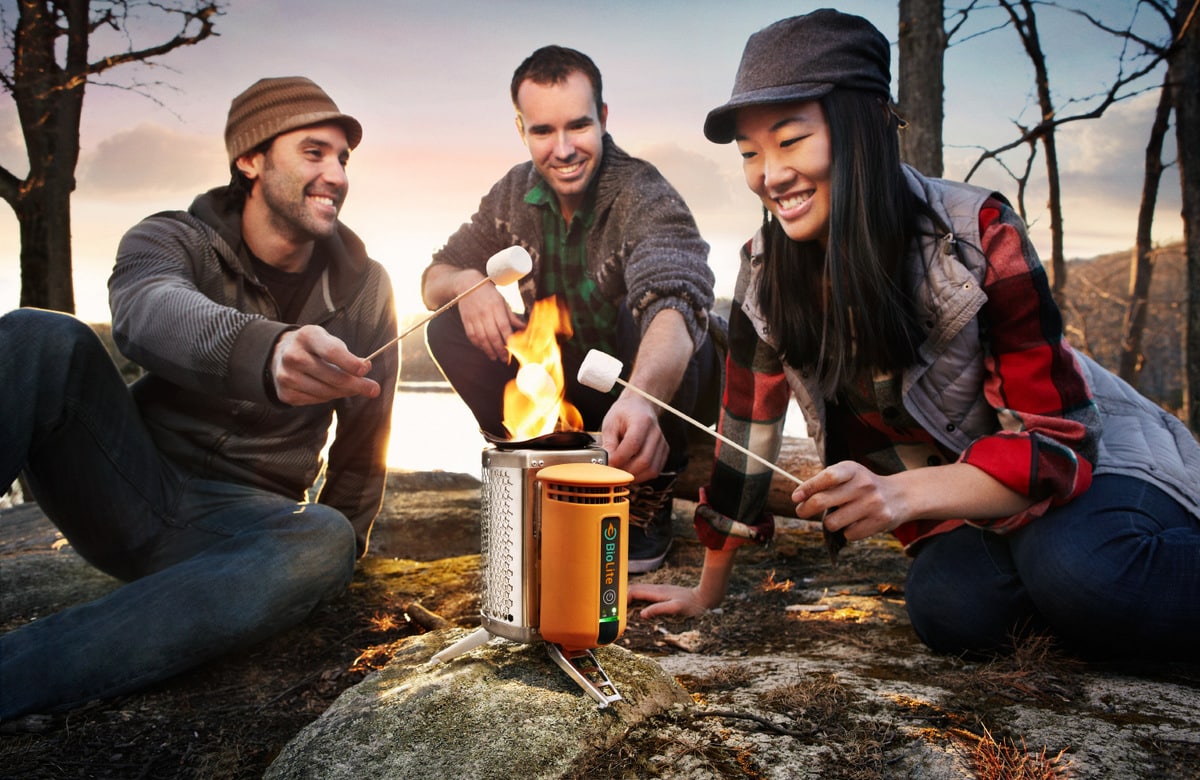
My experience with wood stoves is that they are much less user-friendly than this picture suggests they are. (And I’m pretty skilled at fire-building.) Photo courtesy of BioLite.
A major attention-grabber at last week’s Outdoor Retailer Summer Market (ORSM) was the BioLite CampStove, a unique biomass-burning stove that will boil water and charge your electronics via USB. The CampStove was featured by many of the most popular online media outlets, including Outside, GearJunkie, and TrailSpace; Brian Green has also written about it a few times.
I have not seen or used this stove myself, so perhaps I’m missing something, but I’ve been surprised by the excitement over this product. Frankly, I’m a skeptic. Based on my extensive experience with common backpacking stoves (e.g. liquid fuel, gas canister, alcohol, and esbit), with other wood stoves (namely the revered Bushbuddy), and with cook fires, I’m doubtful that the CookStove’s popularity as a backcountry stove will be long-lasting. Two simple reasons:
1. It’s really heavy.
The stove weighs 33 oz, not including a pot or fire-starting supplies; assume that a complete CampStove system will weigh about 40 oz, or 2.5 pounds. Its weight is very difficult to justify for a backpacking trip that entails even a moderate amount of hiking, as pack weight then needs to be an important consideration.
“But I can heat up an infinite amount of water.” Yes, you can. But in all but the most extreme applications (e.g. you are living off the land for months) there are lighter and more user-friendly options. For example, my preferred Fancy Feast alcohol stove system weighs about 6 oz, making it 34 oz lighter. If I carried 34 oz of fuel on a trip, I’d have enough fuel for about 45 meals. Even if I was hiking with a large group, which by nature will consume a lot of fuel, I would still choose a more efficient system than the CampStove: I would break the group into small cook groups and give each cook group a stove (probably alcohol or canister).
“But I can recharge my electronics infinitely.” Yes, again, you can. But personally I’d rather take extra batteries, which won’t require me to stop hiking and to build a fire so that they can be recharged — I go backpacking to hike, not to recharge electrical batteries. Even if I carried a heavy stove like the JetBoil PCS (15 oz sans fuel canister), I could carry a dedicated GPS and a dedicated camera (instead of using an iPhone for these purposes), and a backup headlamp, and maybe extra batteries, without exceeding the CampStove’s 40-oz system weight.
Moreover, if you plan to use the BioLite to recharge your devices, I hope you have are planning ample down-time — it took Philip Werner of SectionHiker two hours of burning wood to bring an empty Android smartphone to 50% power.
2. Cook fires and wood stoves are inherently not user-friendly.
Humans have relied on biomass fires much longer than they have relied on modern backpacking stoves — the skills needed to build a fire are well known. Yet most backpackers prefer non-biomass stoves. Why? Because they are:
- More reliable — Wet wood or no wood? No problem!
- Cleaner — No soot-covered pots and hands, and no ashes in your food
- More time efficient — No need to gather wood, build a tepee, and then tend to the fire
- Foolproof — Suppose you’re a first-time backpacker. Would you rather carry a stove that requires you to build a fire, or a stove that operates like your backyard propane grill?
Moreover, most land mangers prefer — or even mandate — backcountry stoves too, since the frequent burning of biomass in high-use backcountry areas depletes this important resource. There are already enough campsites where people have burned every nearby combustible material, making the area look as if it’s been vacuumed. Open fires and wood stoves are also prohibited in many areas during peak the wildfire months.
Ultimately, I think that wood stoves are romantic but mostly impractical. It’s telling that when I take my Bushbuddy on a guided trip for demonstration purposes, the clients are interested to see how it works but not sold on it enough that they want to trade their alcohol stove with me on Night 2. While the CampStove has an added feature that the Bushbuddy lacks — the ability to recharge electrical devices — presumably it shares the same pitfalls of this stove category.

Photo courtesy of BioLite
Uhhhg – this is the kind of product that makes me want to act like an even more obnoxious zealot about leaving crap behind.
I go into the wilderness to escape this kind of shallow materialism.
Is there really an iPhone plugged into that thing?
Yes! I felt Edward Abbey rolling over in his grave when I was sitting at Delicate Arch enjoying the view, only to hear some teenage girl exclaim to her friends, “Look! Full bars!”
Understood, but sometimes a phone can save you.
Agreed. Earlier this year, my boyfriend and I had the misfortune of being stranded on a river overnight. His phone has a lifeproof case, but we left that in my car. We would have given anything to be able to phone in help and rescue.
Seriously stranded overnight!! Would have done what with the phone, called for a chopper or SAR?? Overnight is not a panic scenario. Everyone and I mean everyone knows you are supposed be able to be able to survive overnight. A day late for work really who cares. The definition of camping is go outside and stay there until morning. Start thinking about what you would have done 20 years ago in the same situation. Yea the same thing you actually did.
I felt the same way until my colman broke and had to use my brothers biolite. It actually cooked food as well if not more easily than my colman…..it redirects some energy to a convection fan which helps generate a steady heat unlike other wood stoves. you dont have to carry around fuel or batteries because you are surrounded by fuel in the forest….and buddy…if you are going camping without a cell phone or radio…you arnt really camping..or are a novice who doesnt understand the dangers of being far from civilization. I live in the far north of Ontario and I grew up camping….my job for years was 5 or 6 man fly in Bush camps…I know what I’m talking about and this little stove is genius.
Andy you have no idea what happened to Sarah that night. All we know is that Sarah, presumably female, went on a boat with her boyfriend and had no phone. An incident happened that required them to wish they had help. Sarah lived. That’s all we know. Were they surrounded by alligators? Monkeys? Maybe they only planned to go out for a day trip, but capsized, and got wet, and were ill prepared for a cold, wet night in bear infested woods due to lack of camping provisions. Flash flood turned the river into rapids? Maybe the boat broke free and floated away when they stopped, or Someone was injured. It irritates me how people on the internet are quick to condemn complete strangers based on scraps of information. I’m glad you lived, Sarah 🙂
I love my Biolite because it is efficient using very little fuel and provides power to a small light. Phone is a bonus during power outages, which happen too often this past winter. The weight is not an issue. IF you get a good fire started virtually no smoke and the sear on the meat with the grill is wonderful. I highly recommend this sweet little stove and the varied attachments that go with it. I have hiked with it, camped with it, and use it for a quick grill at home. Wonderful and very handy.
I’ve been camping ever since my oldest brother took his 2 sons and wife on a camping trip to Sequoia National Forest and I tagged along. The first time I saw a real redwood tree, honestly, I though they were fake. I was only about 9 or 10 years old and had absolutely ‘NO’ camping experience. However, a lot of years have past since then, and I’m on Darlene’s side of this issue. There are a lot of young tough men and women who can do a lot more with less to work with, so I applaud their positions, but they left out one extremely important factor! It’s the campers age and physical difficulties. I was a 4 year Varsity Letterman in football and the fastest sprinter on our track & field team. Just prior to enlisting into the U.S. Army, I received an opportunity to try out for the U.S. Olympic Track & Field team for the upcoming 1964 Olympics in Tokyo Japan. I was a card carrying member of the A.A.U. and the tryouts were a ‘closed’ event offered to A.A.U. members. My best time was 10.4 that was my best time ever, and pretty darn good to, but not good enough to be on the team. It’s what occurred to me while in Vietnam that changed my once ‘concur all’ attitude. I was severely wounded and almost lost my left leg. Being shot right behind my left knee and I was also peppered with shell fragmentation from a mortar that ended any hopes of being a well built brash and physically able to take-on just about anything. So, my point is, there are a lot of people like myself who want to hold onto the dreams of their youth, but their also unable to do what once was so easy and mentally reassuring who we were. I’m a 70 year old retired Senior Research Engineer, and from my point of view, these types of ‘tools’ make our outdoor experiences accessible and fun to do with friends and family.
I have hiked a continuous 950 miles on the AT (not section packing or slack packing), several more on the BMT and the Florida trail. I have NEVER needed a cell phone. Not only did I not want to waste precious hiking time, my hands were frequently TOO COLD at 6 AM to break wood into tiny little twigs to fit in that thing. If you are convinced this is for you, by all means YOU should be stupid enough to carry it with my blessing.
I keep a Biolite Campstove in my work vehicles just in case I get snowed in on an interstate, or any other emergency situation that I may encounter anywhere along the 7 States in my service area. And yes, I do take it camping with me.
Oh, and btw, calling someone stupid for utilizing a piece of equipment that you would prefer not to makes you sound, well, stupid.
April, if your hands were too cold to break twigs, then you were stupid for letting them get that cold to start with.
Okay, so you’ve been lucky because you haven’t needed a cell phone while hiking. But sometimes the unexpected happens. Just because you think that you’re too perfect and invincible to not need a cell phone does NOT give you a right to act as if you’re better than someone else.
Oh, and it can be used to charge a flashlight too, not just a cell phone. I’m sure that you’re not willing to do without a flashlight. If you are, you’re truly the stupid one.
John H Sachs, Are you sad that nobody you know will acknowledge your olympic try out? Are you sad that you have nobody to brag about your life? please stick to the review…
To: “April on December 1, 2015 at 4:19 am ……”
Your comment was 4 years ago and you’ve probably matured since then however…
you really shouldn’t use words like “stupid“ in your replies; it kind of reflects back on you :-).
People are just sharing their views not putting others down… At least the productive ones.
I personally think the bio light stove is a little heavy for backpacking but I really do enjoy using it at home as a little grill. It makes the best anything that you cook on it. It’s fun and it’s different and my wife gave it to me for an anniversary present.
And if you yourself April are talking about not wanting to break little sticks up at six in the morning you obviously have never experienced a situation of wishing you had the foresight to do it the night before… When it rained all night and got cold in the morning and you didn’t want to do that. Then there would be the person with foresight sitting outside happily building their fire because they had done it the night before 🙂 [Just like any smart camper who prepares ahead].
So… In that case,… who’s the stupid one?
It’s amazing how many people think they are experienced woodsman and come out with the most ignorant ideas…like the guy who apparently hiked 950 miles in wilderness without a cell phone….moron….just cause you did it doesnt make it smart its dumb…and the guy who said 30 years ago people did without it….doesnt realise that back then people stuck in the middle of nowhere…just died…today they call for help….I’ve used this stove and it is amazing easy and light to carry….I thought it was a gimmick till I used it (because Coleman broke) and it was amazing…goodbye Coleman and campfire cooking with ashes in your food! And light to coom with….if you have used this you love it
Since I am interested in vandwelling I thought this might be an asset since weight is not as much of an issue. It seems to be rather compact. Anyone have experience with this as a vandweller.
Also..I am 70 now. Learned about car camping when I was 30. Now I want to see the great outdoors here in Israel. Vandwelling..called caravaning in Israel is new here and I am developing a dream that includes freedom. Thought of buying the Biolite as my preparing for vandwelling. Only problem is that it cant be used inside…but what a way to grill outside my tiny abode(another way to get ready for vandwelling)! I was an over the road long distance driver in the lower 48 for 5 years and am ok in small spaces. One doesn’t have to give up a dream..just modify it, right? Looking forward to hearing from you. Francine
Mine is ok – indulgent . Complete with grill and light . My own private pleasure to sit by a brook in Wales , UK and cook say a burger and sausage to go with a salad . Tranquil and peaceful. Even the little fan ensuring full combustion of wood or wood chip . ( cat litter )
Exactly, I have children… We go camping and hiking and adventuring a lot.
Google
What is best? Backpacker cook inside using a chimney or outside no chimney
Agreed, the concept is absolutely ridiculous for the dedicated backpacker– however, for a long-term encampment, living of the land with no access to electricity, this is an incredible tool. I would absolutely never hike with this, but i would trudge it into the forest one time, as it quickly provides warmth, a method to cook, and if you’re isolated – a way to communicate with your friends back in town.
This is genius for the dedicated backpacker you dont know what you are talking about … I thought the same until I used it and was blown away…its looks gimmicky…in use it is not at all it does what it sais and does it very well. The space this saves a dedicated backpacker in the tools it replaces is genius…you dont know what your talking about….and dont try putting your Bush knowledge up to mine…few people outside Canada or Russia have my experience. Power at any time saves lives…and batteries are a bitch…they corrode…are hard to find and loose power by themselfs over time especially in the Bush were its damp..ect…and the ooking capabilities fsr exceed a campfire and the convenience is better than a coleman
Agreed. I have a Biolite Campfire 2. Depending on what I’m carrying on particular hikes determines whether I take it. It IS a useful tool. Hike smart – not harder.
If you add the total weight of another stove, canister or alcohol fuel, and a supply USB battery / solar battery for recharging your phone, camera, headlamp, GPS locating device, etc. It’s not way off the mark.
Dave you seem to be the most logical poster on here and you posted 2 years ago. I’m in Canada too. I agree with you.
I think what folks get all up in arms about is crazy. Reality is in survival two is one, and one is none.
I think folks don’t have to say ( let me toss away my coleman or phone or whatever else) use both. You will be glad you had a biolite in your gear when the other craps out and likewise if the biolite died. However even if the battery died in the biolite, a person would still have a unit they could toss wood into and cook with.
I’m a fan of both.
great response Dave
There seems to be a nasty battle between folk who only consider backwoods trips!)
I’ve had my Biolight since it was 1st on the market.
I’m a bit older, only doing day hikes with my dog and don’t need to cook on these trips
HOWEVER I do keep a decent grab bag on the ready st home and iny car.after last years durecho and other power failures my Biolight has been invaluable.
just recently we had a power failure (live in a heavily populated area)
easily used my hardwood pellets (I have a large outdoor pellet burner) to make my tea, hard-boiled eggs, toast, fried up some ham and thus had a great breakfast in my back garden..everyone else in my neighborhood was grouchy and hungry…I topped up my phone and also used my solar charger.
point is the Biolight is excellent also for those urban power outages (which NO one ever mentions!).
It’s great until all the USB ports rust like mine did – all the power generating benefits go out the window. Can’t believe they didn’t make them out of something that won’t rust
Agreed wholeheartedly.My campstove has been on hundreds of trips with me and wouldnt replace it with anything.When the turbo kicks in it gets pretty damn hot and eats damp wood for breakfast.Next to no smoke or smell means i can heat up the inside of the tent in a pinch.The charging is a bonus ,intended to charge your phone enough for an emergency phone call not charge it to full or even 50%.What are you doing on your phone in the wild,playing tetris?Some people just dont know a good thing when its staring them in the face.There is nothing i hate more than carrying cans of butane on a trip
Since I am interested in vandwelling I thought this might be an asset since weight is not as much of an issue. It seems to be rather compact. Anyone have experience with this as a vandweller.
Hey Francine.
This stove is ideal for vandwelling. I’ve got a VW California camper van with built-in gas hob but I don’t enjoy cooking in the van so I use the Biolite – particularly with the grill attachment. I really appreciate that I can use scrap or scavenged wood to cook reliably rather than use fossil fuels and as it’s portable, I can carry it to any location to make a meal rather than have to stay in the van.
Ignore the negative people And give it a go. I hope you enjoy it but if not, sell it on and try something else.
Have a great time…….Mike (UK)
You guys really have a preconceived notion of who and what cultured persons are using this.
I’m sure you feel like you’re helping but I prefer options to insults.
Thank you.
Perhaps I am not “running away from society” but feel fine taking tech into the lonesome wilds.
Perhaps I am not small or frail but large enough to ignore the common weight capacity limits of hikers who strive to bring only their shoes with them.
This thing is great in many situations and not in others. I’d say the exact same of alcohol stoves.
Let’s try to leave the bias of who you think uses a piece of equipment and just talk about how it works- not weather every hiker/camper should be some minimalist survivor and not seek comfort or ease of authoring while out in nature.
Do you bring into the backcountry a flashlight (headlamp), a compass and a map? unless you are going somewhere you have been before and don’t plan on taking a piss in the dark, these are good tools to have. Similarly, my iPhone does all that plus it is a gps, a camera, a book, a conversion chart for converting milliliters to cups, and much more at no more weight, all kept working with a little help from the biolite. We just used the biolite for a week long backpacking trip with my oldest nefues, it performed very well. It allowed me to not bring my mini solar charger and weighed less than my gas stove an fuel and solar charger combined. Also it let me have many many hot cups of tea, hot water for dishes and washing up, and let the boys roast marshmallows even though open wood fires were not permitted, and never once did I worry about running out of fuel.
The biolite rocks, boils fast, and entertained the boys.
The problem with an all-in-one electronic device is if you break it, you lose all your instruments at the same time. It is better to have separate devices so you still have some when obe of them breaks.
Simple solution here, bring a second back-up all in one device. When the first one fails…just switch out the SIM card. Even 2 are way lighter then all the other devices one brings.
There is a tech culture war here that is even more pronounced among back to basics, nature enthusiast. Smartphones are a Swiss Army knife…..and a stove that charges, +1.
How can a person give an opinion of something they have never used or even seen , and you all seem like a bunch of haters , everyone putting everyone down , if you don’t like it don’t use it , it’s that simple, I think I would like to have one for my property to run some lights , charge my phone etc. And no I wouldn’t be carrying it around on hikes . But the guy who never even used one sounds like he should not offer up any kind of opinion.
This is an old thread, but here I go. The Campstove 2+ really spins my propeller. It’s a solar panel for when it’s dark – and its true purpose seems to be charging little usb lights.
Thing is: it’s a complicated system that doesn’t seemed designed to tolerate failures. Sure, a stove is like that, too – but a stove is most likely a little more durable and a little simpler. It seems to require a mechanical fan and battery to work! There doesn’t seem to be any air filters, so dust-n-junk is going to mess up that fan. Batteries wear out, and that pcb can break. Not sure what the upper limit is for a lithium battery, but a really hot day and a high charging rate cause a battery fire (that’s educated speculation.)
This might be ok for a canoe camper – though not sure if it’s rugged enough. Or someone who is staying at a (non-electrified) camper cabin.
Cell phones are not GPS. They use cell phone towers to triangulate their positions on maps, whereas a GPS device uses satellites in space to get position. If you are hiking in an area with no cell phone signal, you won’t be able to use the GPS.
Actually, not true: many smartphones have a GPS receiver and will determine their location beyond cell range. When a GPS signal is unavailable (e.g. indoors) and/or it’s been turned off, the phone will use cell towers and/or WiFi signals to approximate its location. Thus, many smartphones are viable backcountry GPS units, assuming you have the maps pre-downloaded since often data service is limited (or non-existent) in the backcountry. A smartphone is also not as battery-efficient as a true GPS unit, though there are some ways to turn off most of its functions in order to conserve power; read this, http://adventurealan.com/iphone4gps.htm
Yes true many phones have a GPS, but they load their maps from the cell network or wi fi. so you will know your exact lat and long . . . but good luck finding where the hell to go from there. I mean phones are great. BUT!!!! water, done, oh put it in a case, yea right, humidity high, done, drop it hard, done . . .I mean they are not rugged. I take mine, I put it in a super duper floating case, but use it with gloves, nope, super cold, nope, too hot, nope. All these sensors built in will disable the phone if too hot, and too cold and the screen freezes, batteries die in an hour. I mean stop it. Use your common sense. ha ha
Very bit Chris there is apps out there that now use GPS only for maps.
Not True. Many cell phones use real GPS
Most real map apps allow you to download the maps you will need for your trip. I use Backcountry Navigator and can download topo maps for my area and use the GPS and navigate just fine. I still carry a map and compass and I know how to read a map so lat long is all I need anyways.
The comment about phones not using GPS is absolutely untrue, in fact most phones these days include a GLONASS (the Russian version of American GPS operates on the same principles) receiver as well for very accurate positioning when using both positioning systems in conjunction.
Iphones actually do have a GPS system built in. The maps are loaded from the internet but Garmin and Tom Tom both offer programs that allow the user to install maps to use the GPS functionality of the phone without needing wi-fi or a cell tower.
Smartphones use AGPS. Cell tower replicate complete GPS datagrams which your phone can use to speed up signal acquisition. A GPS cold start(with no known signals) takes about 15 minutes otherwise.
Smart phones with GPS can work if you have no cell signal, as long as you load maps before you lose the signal. The GPS works on the map as long as you can get the satellite’s signals. Might not work in a deep canyon or dense forest.
I hope nobody is depending on their iphone to help with navigation. Please tell me that people are still carrying their map/compass and a good quality handheld gps unit…Any search and rescue person will tell you that the people that get lost the most are those that do not carry or know how to read a map, and those that depend on their iPhones in the backcountry..
Wrong!!!
That isn’t true. iPhone 5 and other new smartphones have independent GPS chips. The issue is that they usually use Internet to download map data. Download NavFree maps if you want to navigate free of cellular towers.
yes they are! You are describing ‘assisted GPS’ most phones now pick up satellites…..
Oh really, for the previous several models of iOS products, tablets included, Apple has placed GPS modules inside of them that work without cell svcs. True GPS in the devices. There are some great backcountry and open ocean apps that take great advantage of this. The only current shortcoming is that it reads only US based sats and not yet the Russian Glonass sats. As for weight, biolite is a much lighter system than carrying extra devices and batteries. Charges sat phones too! Of course, apple also has an app for that…with a third party sat antenna clip on case your iPhone is now your sat phone, cell phone, map, gps, sat picture repository, multi-function camera, survival info book shelf, reference book shelf, note pad, ICE contact list and health chart, emergency strobe light, blinking light fish and insect attractor & so much more.
has an app for that…with a third party sat antenna clip on case your iPhone is now your sat phone, ………What is the Apple App and where do i buy a SAt Phone Antenna for the iPhone?
yes and when you are out of cell tower range, you will have your lat and long, with no supporting graphical maps . . .good luck
The “app” isn’t just an app for satellite phone. I believe he’s referring to the Thuraya sat sleeve which is an add-on case for the iPhone. Unfortunately no coverage in most of the world (including the US).
Oh really, for the previous several models of iOS products, tablets included, Apple has placed GPS modules inside of them that work without cell svcs. True GPS in the devices. There are some great backcountry and open ocean apps that take great advantage of this. The only current shortcoming is that it reads only US based sats and not yet the Russian Glonass sats. As for weight, biolite is a much lighter system than carrying extra devices and batteries. Charges sat phones too! Of course, apple also has an app for that…with a third party sat antenna clip on case your iPhone is now your sat phone, cell phone, map, gps, sat picture repository, multi-function camera, survival info book shelf, reference book shelf, note pad, ICE contact list and health chart, emergency strobe light, blinking light fish and insect attractor & so much more.
PS. Depending on fuel source, the charge times for devices vary GREATLY. Best to use dry, dense hardwoods that you take an axe to make into bite size pieces. Loose, small and old fungal sticks work; however, it will eat them like a hungry dragon and take -2- hours to fully recharge a 5s. This is about four times longer than a good hardwood takes.
Cont.
As for charge times:
Depending on fuel source, the charge times for devices vary GREATLY. Best to use dry, dense hardwoods that you take an axe to make into bite size pieces. Loose, small and old fungal sticks work; however, it will eat them like a hungry dragon and take -2- hours to fully recharge a 5s. This is about four times longer than a good hardwood takes.
Cell phones have a gps receiver on the same chip as the cell radio transceiver and DON’T require a cell tower for location. I use mine in my plane and obtain 15ft resolution regularly. The towers may be required to obatain map data although that is app dependent.
I beg to differ cell phones are not GPS…some have built in GPS receiver. While hunting this last season near the Bob Marshal Wilderness my iphone 4S with the iTopo application ($9) loaded with available USGS maps out performed several of my hunting buddies expensive Garmon GPS units when it came to finding old FS trails available on USGS maps. I did not have cell coverage and the application used the iphone GPS receivers and kept us spot on the non- maintained trail system.
Who cares , most of you would be lost in the woods anyway ,
Wrong. Cell phones nowadays have true GPS receiver antennae. They are also able to use towers to enhance the plot for street navigation. I use a cell phone as a GPS in addition to my Garmin eTrex 10, and it is far superior. If it breaks I use Garmin. I also take maps and a compass. It isn’t gimmicky to use technology in a survival situation, it is smart. Having a smartphone doesn’t diminish my outdoor enjoyment, it enhances it.
Not true my phone is equipped with a GPS and I have offline maps.
That’s totally wrong. Every phone I’ve owned has a real GPS. The latest one picks up GLONASS satellites, too. I have offline maps in 2 different formats for different apps, taking up about 8% of my SD card.
Actually I have an app on my iPhone called MotionX-GPS that triangulates satellite GPS. As far as a backup, I carry a map and a compass.
I also have a BioLite Stove which I like very much, I have the BioLite flashlight/lantern as well and the Kettle Pot which the stove nests inside. The BioLite Stove and Kettle Pot combo doesn’t take up much more space or weigh much more than my Solo Titan stove and 1800 billy pot.
Depending on where I’m hiking/camping and the rules pertaining to fire for the area I don’t always carry a biomass stove, but it is my preference, and the BioLite has become my go to. If I’m not carrying it I’m carrying a ZeroLemon solar charger, so weight wise, same difference.
If I wasn’t carrying a rechargeable light and phone and instead a conventional flashlight and GPS I’d have to carry extra batteries, so again, same difference.
Where I can’t use a biomass stove I carry a GSI Pinnacle Dualist, or parts of it, and a compact butane stove.
As far as the weight issue, I’ve been backpacking/camping/hiking/canoeing/hunting since I was a kid, so for over 35 years and for much of that I didn’t have the advantage of the ultra-lite/ultra-compact equipment available today, but I still had same equipment needs, it just weighed more, and we dealt with.
I don’t understand all the whining about a couple of extra pounds.
Your oldest what?? What’s a nefue?
Like a neece only male.
People who cook outside in the wind do not go out much.
Everyday is fun to be camping if you use a 14 ounce chimney inside a square tarp pitch, all sides tight the ground or all sides raised to cool off.
Google chimpac
Bam.
I just returned from a 10 day hiking and hunting trip to the northern part of Norway. 6 lads each carried in more than 250 pounds of equipment, food and beer. Had to make two trips to get it all. My day-trip pack weighed between 15 – 25 pounds, not counting my shotgun and shells. I carry what I need to, in case I get stuck and can’t get back to camp. I’m strong, and prefer the peace of mind that comes with carrying gear and knowing that even if I fall and break my leg, I can make calls for help (if there’s a signal), and cook food while waiting. With the BioLite Stove I will not run out of juice on my phone or GPS. I will definitely try this stove out (it’s in the mail AWS), and hopefully it will turn out to be just as cool as I hope.
So, if you only carry what you need to, what are the shotgun and shells for? Really only for entertainment if you are going on a hunting trip. No more necessary than the cases of beer, for entertainment, that the others you refer to were carrying.
He said he was on a hunting trip. Learn to read.
“nefues” ??? Really? Don’t you mean “Nephews” ???
As for the BioLite, I would welcome an alternative fuel system to use with it for different scenarios, maybe if they could provide an alcohol based burner that replaces Bio mass, I have used other types of pressure stoves before, very good but has draw backs like any cook system.
This is really an apocalypse stove. Great item to keep in the Bug Out Bag, but a lighter version (i.e. drop the charger) is the way to go for back country/camping/hiking. I much prefer to not carry fuel. And no matter how picked over a campsite is, there are always twigs around. One can survive a lot longer with a wood gas stove than an alcohol stove.
I agree, this is perfect for thinking ahead and being prepared for disasters. I have a bug-out bag and I plan to purchase the biolite campstove to add to the bag. I mean, if we have to leave our homes and there is no access to electricity or fuel, what the heck do people think they are going to use to cook with? I think it’s an awesome idea as something to have for emergencies….what if there were an EMP attack killing the power and vehicles?
I plan to purchase the campstove for now and when the homestove is available I’ll be getting one of those also. Things to own imo…..a gun (or several), crossbow, good boots, hot-spark fire-starter (because matches and lighters will deplete) wood burning cookstove, wood burning heat source, lots of back-up batteries, battery operated radio, flashlight and walkie-talkies, canteen, medications, etc. etc., whatever small supplies that are specific to your own family’s survival in time of crisis.
Let’s face it, things are not good and we are precariously teetering on the edge in America. Why not err on the side of caution and be prepared for anything? Unless you just don’t care about surviving and have been living under a rock. Let’s not forget the reality of 9/11.
Your point about the value of this product in an emergency/bug-out situation is a great one — much stronger, IMO, than this product’s use as a backpacking stove. If you read through the comments, many of the supportive ones have this emergency preparedness, just-in-case theme.
I wonder, then, why BioLite is marketing their stove as a s’more factory instead of a save-your-@$$ device.
Probably because the “Preppers phenomenon” has jumped the shark with the uneventful passing of 2012, the re-election done, and the housing market improving. For a short term disaster, this would be up against propane storage and generators and the like. Perhaps the larger stoves would be a better investment for distaster preparedness if the electricity output is increased. All in all, if its as good as it says, the marketing is hitting its mark by making it look pretty, useful and appealing to less experienced and purist backpackers as well as those in the SHTF communities.
Doctor, your analysis may be a bit off. I think you have the preppers confused with the Mayans. I don’t think 2012 passing uneventfully will quell the fears of those who anticipate the policies of the past 100 years eventually coming to their most logical conclusion. You really think an uptick in the housing market will reassure those whose eyes are fixed on the debt clock, China’s military build-up, Russia’s saber-rattling, and an increasingly destabilized Middle East?
In any case, the prepper community (of which I cannot claim to be more than a sympathizer) would have little interest in this stove. There are better solutions for the world they envision surviving. The fact that it can give you a trickle of energy for your iPhone is useless in the scenarios they are prepping for, because there would be no wireless service or internet for it to connect to. In short, if it can’t power a ham radio, it’s pretty well useless to them.
The Biolite *home* stove—now that might be more in line with what a true prepper would be looking for.
Now, for minor disaster preparedness—what I term “provident living”… the kind of preparedness actually advocated by DHS and other branches of “The Man”—the Biolite would actually be a very good option. In a localized disaster, this would be an essential item for your bug-out bag and ride-it-out kit.
>> what if there were an EMP attack killing power & vehicles
your iphone/gps unit would also be fried, as would the electronics in the thermo-electric converter part of the biolite stove. presumably you could still use it to boil water/cook with though..
More importantly, anything your iPhone or GPSr could connect to would also be fried. An ICBM detonation at a sufficient altitude to send an EMP much further than the blast radius would also knock out cell towers and yes, even satellites.
Electric motors and generators (even thermoelectric ones) are inherently resistant to EMP, so the Biolite might very well make it through… and it would be easy to store it in a Faraday box to keep it protected. However, the trickle of energy you get from it is really only useful for small electronics that would be useless in a post-nuclear environment. I suppose it could recharge LED lamps, if they were kept in the box as well.
On another note… the military has discovered that most vehicles—even modern ones with timing chips—survive EMPs just fine. A steel auto body evidently makes a pretty decent Faraday box. Good luck with that fiberglass Maserati, though.
Satellites would be fine. Gamma radiation interacting with the ionosphere creates the device killing microwave radiation. Oh and if you want your devices to survive,keep an old phone in an old gutted microwave. It is engineered as a microwave barrier.
I agree with you completely, that’s why I want one , for my bug out property that has no power on it , at least with this I could have a few things like a light, recharge my flashlight , phone etc. I wouldn’t take it on s day trip or even an overnight trip , but when shtf I would like s little juice for some certain items
The charger is just an added bonus, the real use of the thermoelectric generator in the orange unit is to power a fan that powers air into the cylinder of the stove through jets, giving a hot and efficient burn. Wether you are charging or not this stove is still far superior to any other like it and rivals many but not all fuel fed cook stoves.
Finally. A voice of reason. A stove that gives an efficient burn is a big plus and the weight is not that much. Weighs as much as one shoe. My experience in the Army says that one of the big enemies out in the woods after a month or so is the grand cosmic boredom. If I can recharge my tablet then I can carry a complete library. Entertainment, research and technical information. I think this thing is great.
exactly!!
another added bonus for the current short term is my vaporizer. without it i am still a smoker and hate throwing buts on the ground/smoking in general. with this i can charge my vape lower my impact on the environment and always be able to charge my phone gps rechargeable batteries and such.
The charger also contains a fan which helps get the fire going faster and also hotter to cook with. It also fits inside the campstove itself making it more portable. It is only 8.5 inches tall and 5 inches in width with the charger inside the stove for transport. Yes it does weigh 33 oz but does quite a bit for so little size. When backpacking size is almost as important as weight. If you are bringing and alcohol stove you have to bring in alcohol as well. I guess it is up to the individual but if you are going to review something it would be best to at least try it out first before shooting it down.
You need the charging bit, fool.
Otherwise the fan doesn’t spin which won’t intensify the burn.
Essentially, without the charging section, it’s just a tin can
I think this will really come in handy when this county falls and the grid no longer lasts. I’d love to have my metal while running from fema. lol. But what’s this thing cost?
Well Mike you’re more open minded about crop circles than you are about rocket stove design!
Check out http://www.biolitestove.com/ where you’ll find these camp stoves are financing a huge program to bring efficient heat and light to the Third World where millions die from inhalation of smoke from inefficient fires.
Loved your interview with Colin Andrews BTW – a dear friend of mine
Humanitarian work is a really poor reason to buy a $130 backpacking stove. If their cause is important to you, making a donation would probably be more beneficial — figure that half of the purchase price goes to the retailer, than another 10 percent for shipping and sales commissions. Not much left at the end.
Just because someone has a device capable of charging a phone doesn’t mean it needs to be used for such a purpose. If you really put things into perspective, using a liquid fuel stove (like the JetBoil) is a more complex idea than the BioLite stove. The BioLite stove converts thermal energy into electrical energy, and it’s fueled by wood. The electrical energy then powers a fan that circulates air through the device. What could be more environmentally friendly and simplistic than that? As far as the phone part goes, well, I’ll explain. I’ve summited Mt. Rainier and Denali, and both times I had a satellite phone. Combined with a backpacking stove, spare batteries for the satellite phone, and fuel for the stove, the bundle is very heavy. Cellular phones are now ubiquitous and are an essential part of many peoples’ lives. When I spent three months on the Appalacian Trail, I brought along with me a solar charger for my iPhone, a backpacking stove, and many weeks of fuel at a time. I would turn my iPhone on briefly every other night as to check the weather. Even if a phone is off and stowed away, the battery still dies. An iPhone can last about 5 days from a full charge if it’s turned off. Having the ability to charge a phone, even if it isn’t being used, is great. So, for my purposes, having the BioLite stove is a wonderful convenience and it frees up valuable space and reduces the weight of my pack when I go on extended trips. The BioLite stove in and of itself is not much larger than the JetBiol, nor is it much more expensive.
It’s not a back country/wilderness device. This is a great piece of equipment to bring on a day trip just outside the city. We chop up some veg at home and make a ratatouille/goulash-type dish along with espresso coffees.
This is especially useful for those with families that have resigned themselves to the fact that it isn’t practical to go “real camping” with kids every weekend.
My son loves looking for small sticks that fit and it makes for a non-bulky cooking device.
I rarely use the charger, but the fan produces great heat in a short time in a small compact unit. If you’re complaining, you’ve got no idea about how to use it.
Hi Mike,
This may seem like a materialistic piece of kit but I swear by it. I planning a 7k bike tour and I’ve been researching and using multiple fire options. In my three month long testing experience this kit is the all round best I have used so far. I’d like to point out that I have no affiliation to their product. I just love it.
Ignore the device charging. That’s just a bonus and not that efficient. As a method for creating a camp fire it is great. I soak cotton balls in vaseline and use them as a starter and woosh! Fire going in no time.
Can be smoky but if managed well you’ll have no issues. Trick is to keep the tornado going and not to overload with to much wet or green bio matter. It will handle wet material quite well when it gets going.
Use pine or the like to get going. Pine cones work great. For a longer term burn swap to some hard wood when shes hummming along.
Pros:
Efficient burn
Low impact
handy as hell
Free fuel
Cons:
Bit bulky
FIre bans?
Cheers,
M
I just stumbled on this website-blog. I do like the idea of the Biolight stove for extended use during a protracted emergency during which liquid and canister-gas fuels for outdoor stoves may be scarce. But, for most backpack trips, a conventional camp stove makes more sense. Now, for a car-camp trip, when weight and size may not matter as much as when backpacking, it would be quite nice to have a stove that doubles as a campfire. As for its battery-charging ability, well, don’t we go into the woods–in part– in order to AVOID the internet, texting, and so on? Oh, yeah, if you want reading matter, a couple of Louis L’amour or P.D. James paperbacks weigh much less than a Kindle or my iPad.
As a ham radio opertor, I might take a handheld since it is far more capable than a cell phone for emergency comms. And if I were to be out in the boonies where only HF (shortwave) will work, I might take a low-power HF tranceiver. MAYBE.
When it comes to a GPS unit, be it a cell phone or stand-alone, there is the excellent advice from experienced hikers and search-and-rescue personnel to ALL those who take to the woods (or the deserts): a GPS unit may be handy, but be sure to have a compass and good topo maps for where you are venturing–and know how to use them. Electronics fail, and even a working GPS can direct one incorrectly or, even, fatally.
Back to the Biolight. It interests me, but for most camping trips, my vintage Svea 123 and my Coleman 2-burner (that burns propane, gasoline, or Coleman fuel) are very tough to beat.
Hey Steve, Have you looked at the PowerPot? That would be an alternative thermoelectric generator which you could use over your Svea 123 or Coleman 2-burner.
While I agree that it is silly that they market this by showing an iPhone plugged into it, I own one of these for bicycle touring so that I can recharge my bike headlight. That’s not materialistic — it’s necessary and safe. The weight doesn’t bother me as much on a bicycle, and it is nice to have a stove and charger without packing fuel. I also love the concept behind it — use the gimmick to collect American dollars to improve the lives of people in third world countries. Hard to complain about, in my opinion.
The comments he made is in relation to HIKING not BIKING. Different conversation, different rules.
True, but nonetheless an useful and helpful comment that shines a positive light on a wood gas stove for bicycle touring.
so?
i think the points the author makes are good but i think you need to use one before you do a review.
Yes, exactly! Everyone who booboos this here loudly has never tried one.
Why are people attacking others over what they choose to take camping or hiking, calling people stupid or materialistic? How ridiculous.
If it works for some, awesome. If it doesn’t work for you? Awesome. No need to insult people, there are actual problems in the world that could use that energy.
As much as people will hate it for backpacking, this is a PERFECT item for motorcycle/adventure camping, it fits in my tailbag nicely and compacts into the kettle. I have the grill but i prefer to cook with a collapsable mess kit so the grill isnt needed. I can charge my gadgets such as phone and gopro while cooking dinner, and i dont have to worry about packing extra fuel and what not.
Don’t judge the item based on your philosophy. Judge the item on it’s ability to fulfill it’s intended role. It’s a camp stove meant to provide USB power for a mobile device. It’s not great at it, it’s not even good at it. It’s weight makes it useful for car or bike camping. If you’re car or bike camping, you have better options for power.
Yeah. When it says you can keep your electronics charged, it doesn’t mean your radios, flashlights, etc. It means your cell phone, tablet, laptop. Honestly, I’ve been interested in the combo version of this product. It’s just a little pricey for me at the moment, though.
I felt the same way until my colman broke and had to use my brothers biolite. It actually cooked food as well if not more easily than my colman…..it redirects some energy to a convection fan which helps generate a steady heat unlike other wood stoves. you dont have to carry around fuel or batteries because you are surrounded by fuel in the forest….and buddy…if you are going camping without a cell phone or radio…you arnt really camping..or are a novice who doesnt understand the dangers of being far from civilization. I live in the far north of Ontario and I grew up camping….my job for years was 5 or 6 man fly in Bush camps…I know what I’m talking about and this little stove is genius.
Well thats all fine and dandy for you, but there are some people like me a disabled vet who would rather ensure accessability to help if i get above my head even by being able to charge a sat phone or when elon musk finally has star link. Where the disabled vets might want to be in the wilderness and with a way to simply charge a phone.
Nothing fanatical but we are not all rock climbing ball scratching zealouts who want to escape.
Ironically, not using the biolite is (in my opinion) less connected to nature.
Think about it. If you buy a gas powered stove, there is a company that has to go out and extract that raw gas (fossil fuel by the way). Compress it. Then store it… marketing etc… sell it.. and then you throw it away, where does it go? landfill?
biolite does require a factory to produce it, but I’ve had mine for over 5 years and still use it regularly to cook on and charge up AA batteries…. guess how much of the landfill I’ve filled up by using it:
zero.
Lol. You are all fools. This is a never ending source of electricity and heat. It’s efficient. I hope you all die from being stranded someday.
Campers who cook outside in wind are fair weather campers that run for home when it’s no fun.
For centuries aborigines lived summer and winter in tipis and did their cooking inside.
Industrialized people make chimneys available for campers so they can do their cooking inside and enjoy camping in any weather.
To be comfortable a backpacker will carry a 12 ounce chimney to vent his cookstove and also serve as centre pole for his tarp all sides tight to the ground to be warm or all sides raised to stay cool.
Google chimpac
PS. People can eat in tents but never store food in a tent. Keep as clean and tidy as possible but you are not going to get rid of the food smell you just ate or touched. It is best to be waiting inside the tent with your bear spray instead of running around outside,
What the hell as this got to do with the biolite LOL
A well known Wild Camper on You Tube , likes to watch a recorded movie in his sleeping bag at night . I am also one of those campers and have multi use for my phone .
This small stove ( and grill ) is really handy concentrating fanned heat economically using either bio mass ( wood cat litter) and or twigs or hex tablet etc
Ok I’m not a backpacker . The flexi light runs off the stove which means you can see what you’re cooking .
But I also gave other systems for different occasions . Their fire pit is amazing .
this isn’t really designed for survival (look at the packed size and weight). it is more of a car camping stove for sites with no electric hookup.
So precious. And probably a hypocrite.
I was experimenting with the biolite with my high school class, and it is not efficient! My class could barely light it and keep it running, and this is in a comfortable and controlled environment. I cannot imagine what a pain it would be to use this product while camping. My advice: buy a portable charger and a less expensive camp stove. Don’t waste your money!
I’ve used it and have one in my EDC box in the car, with 1 pack of wood, 2lit water, coffee tea bags, soup packets sugar and dried milk, 2 cups.
the other car has a murphy kettle with same water, wood, tea coffee and 2 cups etc,
it works for us as cover for trips.
we also have a sleeping bag and torches and wooly hat and gloves.
Life is for living, not denigrating others, only fools do that.
The initial concept of the Biolite Stove was, and still is, a brilliant concept – that is, providing a way for third-nation worlds to have a safer, clearer, and more effective home/hut cooking platform.
The fact that it was migrated into the camping world — and I think we can all agree this this is targeted towards “car campers” hopefully — was rather unfortunate. Perhaps it was necessary for seed money for the next phase of development, but it would be really great to see BioLite put all of their efforts into producing a truly revolutionary stove for those who cook 100% of their life with wood and other burnable fuels.
I don’t find this stove any more appealing for strictly “camp” use — it still has the standard drawbacks of a wood stove (handling time, poor wood selection, soot, etc.). Plus, if I’m car camping, I’d much rather bring a two-burner propane stove than a small wood stove. And there are probably simpler recharge options in this situation too, e.g. the car charger, or maybe even an electrical outlet or a generator.
You won’t have a car charger, electrical outlet or generator in the wilderness LOL
But I agree if you were close to your vehicle that would be easier.
I think this is designed for an additional item if you are far from your vehicle.
John,
Interesting to hear that this was originally designed for use in the ‘third world’ for household and daily cooking.
I live in Rwanda (where I’m currently serving as a Peace Corps Volunteer), in a rather rural village of about 600 people. About half use wood-based fires to cook their food and clean their water (the other half use either charcoal or kerosene).
While I think this idea may be decent for trips in these kinds of places, where access to propane and other safe stove fuels is non-existant or limited, I’m not sold on its practicality for the residents of these places.
Most of the campfires are built to cook food for a dozen + people and require quite a bit of wood. A stove this size couldn’t possibly heat a pot designed for that many people. Also, Rwanda already has a deforestation problem as it is.
Another issue I see is price. I’m not sure how much this is supposed to retail for, but I imagine its going to be a decent chunk of change. Well, not for us as citizens of the ‘first world,’ but when your whole families income is about 300 USD a year, affording something like this is highly impractical.
I will admit that the USB charger attached to a cook-stove is a fascinating idea.
I’m not trying to rag on anybody or the product, but the idea that this could make a major impact in the ‘third world’ is not quite realistic yet. That said, if I was willing to carry an extra 2 pounds in my kit, this is a nifty idea. It would be better, though, if its weight was, say, cut in half.
I actually bought one of these. I agree that it is not a backpacking stove alternative, nor a home replacement.
That said, the company IS producing a much larger version which the sales of the CampStoves is helping to subsidize. If you check out their website, you can learn a lot more about their efforts and plan.
I do think it has some utility but not in a backcountry context.
I’ve had one of these for 9 months and used it for about 8 meals. I like it as a stove, and I think it’s a better stove than a charging unit. I can get a hot fire going in about 4 minutes and boil 2 cups of water in another 4 when the air temp is below freezing. This is one high-efficiency fire!
I pick up twigs on the trail as I’m going, which breaks up the boredom, trying to spot dry hardwood instead of softwoods. Charging is a bonus. Cooking marshmallows on it with the Scouts once was a treat!
I just bought their kettle, which the stove packs inside, very well done! The kettle works well and the nesting of the stove saves pack space. At a combined weight (kettle and stove) 3 pounds, 5 oz, it’s a pound lighter than my butane stove and small pot set. For me, never having to spend for fuel and being able to charge my phone and headlamp (Black Diamond Revolt) is worth an extra pound.
I like it as a backpacking stove, especially because it works great in winter, when the butane stoves struggle and the alcohol stove someone mentioned above would just whimper. Your mileage and needs may vary
Hi Shawn,
I’ve been working for a while in Africa (including Rwanda, by the way) helping to promote clean energy, mostly small solar lamps, but also improved stoves. The lamps are relatively easy – everyone hates kerosene, and they are tired of buying throw-away dry cells every few days for their battery/LED lamps.
But getting folks to change cookstoves is much harder. I am optimistic that the biolite stove, or something like it, might be a single pathway to upgrade both lighting and cooking. But there is so much that isn’t known about this, starting with any field experience with the cookstove. We have to wait and see some real results. But I’m very very curious.
Paul
If you get a chance to check out their website you will see that the Homelite stove is much more ample. So that it will be able to handle larger pots as well it burns fuel at a more efficiently due to the fact that it has a fan that helps stoke the fire.
The BioLite also has a fan, with two speeds. With the fan on low, the fire burns extremely well with almost no smoke. With the fan on high the fire becomes extremely hot and can boil water as fast as my Whisperlite kerosene camp stove. The fire is as close to smokeless and sootless as you can get with wood. By the time your fire has cooled down and your BioLite shuts down, all you have left is a tablespoon of ash as fine as baby-powder. I haven’t taken my BioLite into the woods with me yet, but I’m looking forward to camping without having to deal with disgusting kerosene.
I have actually taken my Biolite on a solo weekend backpacking trip. I also have taken it on some family trips. I admit it is a little on the heavy side but not needing to carry fuel almost balances it out. The charger makes it worth it. On a longer trip the fuel would definitely outweigh the difference. Here is a tip: The stove will not shut off until the chamber is cool enough. The problem here is it uses up a lot of the battery power it has gained while it is cooling down. The solution: take the battery pack off and let the chamber cool down itself. Also lint from you dryer makes a great fire starter and weighs almost nothing.
Yes! The internal fan provides oxygen to the fire, no/little smoke, and minimal soot! A natural fire using scrap wood. And it gives you an intense fire the cave men be soo jealous of. The USB charging part is just a bonus.
@shawn,
When you say that this stove would not be suitable for third world application are you referring to the “camp stove” or the “home stove”? If you are referring to the “camp stove” then you are correct. It is not very useful in that situation. But, the “home stove” is the product designed for large family cooking in a village environment. Not only is it suppose to reduce smoke (up to 70%), but, it also is suppose to use up to 50% less wood because of the increased burning efficiency. This helps with the deforestation of African forests.
The home stove is a totally different design and allows one to feed the wood from the bottom and it is much larger. My family and I have spent much time in Kenya (Mister in law has been there for almost three years) and having used the “camp stove” I am convinced that the “home stove” will make a huge impact in the town of Meru, Kenya, where we are involved.
Second, many people in Kenya have cell phones. Many people in moderate villages that still cook over open fires have cell phones. They walk several miles into town every few days and pay to charge their phones at local charging stations. The “home stove” would solve this problem for them. They could charge while they cook. Brilliant.
Regarding price, the “home stove” is not available in the US and based on the biolite website they are working with organizations to provide these stoves and a very low cost to those that need it. Seeing how you are involved in Rwanda I would encourage you to reach out to biolite and see what they are doing.
Again, focus on the “home stove” not the “camp stove” for use in developing countries.
Actually the large version of the stove IS available in the US. They have just renamed it the Basecamp Stove. I emailed them to ask what the differences were between the stove for the Third World and the US Basecamp and they said the base and power module were identical. The only difference is in the grill on top.
This wee stove helps the company provide second and third world country’s with much much larger stoves that use little wood and no smoke to save the trees that they have left. Go to thier website and look at all the have done. the large stoves can cook for a village and charge 8/10 items at once. By us buying the little stoves we are helping them help the world.
Shawn,
Check out the Biolite website:
(http://www.biolitestove.com/homestove/overview/)
The Home Stove is the product they’re developing for use in home cooking. Quite a bit bigger than the camp stove, and already in use in some African communities.
I came across your post almost a year later. Hopefully someone else reached out to you before me but judging from the comments I doubt it. Biolite may offer you one free as selling the smaller campstove helps offset their humanitarian efforts. The bigger stove can cook for more people (they suggest 8 hamburgers), has a larger output (5W), and can be fed larger pieces of wood. I hope you reach out to them and good luck
Check out. http://cookstoves.lbl.gov/darfur.php
It is the same concept adapted to commercial applications.
I probably won’t get one for one reason soot
Hate it all over my gear which is all but guaranteed with this type of combustion
The question about woodstoves is: How is useability defined? My conclusion quite differs from Andrews opinion regarding the Bushbuddy Ultra (BBU), but the Bio… thing seems quite crap to me.
I prefer the BBU for my hikes, even in Finlands winter. There is plenty of dry wood, therefore I suggest useability of woodstoves quite depends on the surrounding resources.
A product’s “useability” definitely varies person-to-person. I think everyone knows where I stand: I love to hike, not camp, and I seek light and efficient gear that helps to maximize my hiking experience. A wood stove does not work for this application — I’m skilled with the Bushbuddy Ultra and with cook fires, but I’d still much rather use an alcohol stove, or even a canister stove.
If you spend more time in camp and are willing to dedicate the time to a fire, there is a stronger case for a wood stove, especially with larger groups (who would require more fuel). But it’s still a messy and skill-intensive operation compared to modern backpacking stoves, thus part of the reason wood stoves have not caught on with the masses.
Plenty of wood lying around you say? Leave this heavy thing at home and just carry a lighter (which you would need to carry anyway).
Thanks for the detailed analysis again on choosing stoves. I applaud BioLite’s innovation and especially their work in developing countries. Guessing they are just trying to find another market, nothing wrong with that, just won’t be lining up myself to buy one since I already don’t get to use my two stoves (alcohol and pocket rocket) enough.
I’m with you Skurka. While the bio-recharging has an appeal, the weight and fuel resources make this a difficult sell. The marketing photos showing a group of happy campers snuggly sharing a marshmallow moment is idillic but probably not realistic. For backpacking, this stove may only make sense if you are sharing it between 3-4 people, but there are still more efficient and lighter wood-gas stove options out there: Bushbuddy, Sierra Zip Stove, Solo Stove (9 oz!), Little Bug, Backcountry Boiler, etc.
It’s a neat solution looking for a problem to solve.
What is the goal of the product and what are the requirement to benchmark it’s success?
I suppose if a person is bicycle riding mostly downhill, off the grid, in a wood-burning approved zone (not California) with an iPhone… and was planning to take those solar chargers, there is a niche market for this.
Curious why no one mentioned that electronics/plastics should not be near flames, also when cooking/boiling water, there is a higher risk that boiling water will get in contact with the iPhone.
I thought it was neat, but have not identified a situation where this would solve an existing problem or improve a process by weight savings or needed feature.
It has a battery. You don’t need the iPhone plugged in while the fire is going.
@Aaron,
I have used the biolite campstove for a few months now and am confident it does not have a battery. The biolite stove does not maintain a charge. The charging has to occur while a fire is lit. This is why an extra long cord is required to keep battery packs or devices safe.
It does have a battery. (you’re supposed to charge your Biolite from a USB charger before its initial use.) The battery is used to spin up the fan before the thermoelectric generator kicks in.
But yes, the Biolite can not charge your phone from its internal battery. The internal battery is just for running the fan until the fire gets going. The Biolite can only charge electronics while the fire is burning.
The outside of the Biolite barely gets warm while the fire is burning. You can easily grasp it with a bare hand while it is burning. There’s no need for an extra-long cord and no reason to worry about having your phone near it. A regular charging cable works just fine.
It does in fact have a battery. The instructions state that the battery must be charged prior to first use. The battery powers the fan, the thermocupler recharges the battery, and the excess power becomes availabe via USB.
I bought one and so I had to play with it! So unpacked it and went around the yard and found some dried wood. If your wood is any where remotely wet, it is rough, I was able to get the green charge light to come on but it only stayed on for about 5 minutes. Because the charge light is dependent on the output heat of your fire that you produce in your Bio Lite.
The idea and concept is awesome but the usability and the feasibility is still yet to blossom to an efficient product. Granted IF you can find any dry wood and get yourself a nice hot bed of coals and then add bigger pieces, you can get your charge light on in about 10 minutes and once the green light comes on, then you are producing enough heat to boil water too. (I am not to sure who did their test and said it could have water boiling in 4.5 minutes.)
However the weight of the products weight is a hindrance for back country back packers. Like it was stated there are lighter stoves out there and then once you add the weight of fuel for other types of stoves, you have reached the weight of the Bio Lite. If anything, consider it a nice way to be able to control a fire instead of making a fire pit.
The internal fans that are used to push air to your fire is nice and helps one to maintain heat and flames to burn. However your fire can get hot but keep in mind you have a piece of plastic attached to the side of your fire canister so you don’t really want to get it rip roaring to hot or you might end up melting your plastic batter case.
Honestly, if you were going to be out for a week or more and you didn’t want to pack a fold out solar panel and you know your GPS or electronics will die. Then it might be an option for you. But bring a battery bank because your battery bank will charge your device faster then the Bio Lite. This is what I do, I charge my Burton battery bank off my Bio Lite and then use my battery bank to charge my device. Yep, it is more weight and seems like why go through the process of all the steps but honestly, the output charge is not consistent enough to keep a steady strong charge on your device…so the two step process is what I do which works for me. This trickle charges most devices that can be charged off of USB. Just remember to check your device input charge, because if it exceeds these numbers listed below it will not charge your device.
Bio Lite
Fire Power Output Peak: 3.4 kW (LO), 5.5 kW (HI)
USB Power Output Max continuous: 2W @5V, Peak: 4W @5V
(http://biolitestove.com/campstove/camp-overview/tech-specs/)
Hope someone finds this information some what useful.
Ted,
Thanks for your post. Your last paragraph has me really curious, though… what does the battery bank do for you? I understand that it will charge the phone quicker, but how does that help me if it charges slowly from the Biolite? You can attach a firehose to a water fountain, but you’re still just going to get a trickle. What good does it do me to charge my battery bank with a trickle just so my phone/gps can charge fast after that?
I’m sure you’re doing this for some logical reason that I’m just not seeing… I want to know because I’m considering buying this stove and I want to be prepared to make effective use of it. Is it so that you only have to fire up the stove every time you need a charge (i.e., your device doesn’t have enough juice to make it through the day or you don’t want to fire up the stove every evening)?
Hope maybe you see this and reply… Thanks in advance if you do!
The electric output on the biolite isn’t a steady max output. When charging things like an iPhone you’ll see it constantly start charging, stop, start charging again. The bank possibly isn’t as sensitive to the fluctuation and remains constantly charging. I recharge AA batteries with the Goal Zero guide 10 plus while I’m cooking then top off my electronics when I’m traveling.
Andrew – Any thoughts on the Power Pot V (1.4 liters pot, 12 oz for just the pot and 18.2 oz w/lid + cord, http://www.thepowerpot.com/powerpot-v)? Compared to the BioLite, it is possible
to still use the Fancy Feast stove and the lid/cord combo are only about 1.7 oz heavier than a
mobile phone charger + 4 AA batteries (for example, the TekCharge MP1550 and 4 batteries
weighs 4.5 oz vs an additional 6.2 oz for the PowerPot V lid/cord combo). And a hiker would probably need to carry more than 4 AA batteries if the trip is over 5 days to keep the phone charged.
I was not aware of the PowerPot — thanks for the link.
The PowerPot strikes me as being more versatile than the CampStove. For example, it would work in combination with an alcohol, canister, or liquid fuel stove, as well as an open fire. It is also lighter. I’m sure there are some technical/electrical differences but commenting on those is above my pay grade.
My hiking partner carried half of the Biolite (each half weighs about a lb.) so my pack still feels ultra-lite as normal. Lots of solo hikers commenting here I guess. Wilderness travel is a dirty activity so those saying soot on the cooking pot drive then nuts is very strange. Solution: plastic bag the pot when hiking. Collecting sticks to fuel the Biolite takes very little time. Thickness of a pencil works fine; easy to break to size. Boils water very fast. All the heat goes up to the pot. You never choke on smoke as a normal campfire will do to you. You can sit close to it and cook without melting your shoes or microfiber zip off pants like at normal campfires. The ‘I’m running low on alcohol/gas fuel paranoia’ is a thing of the past when you have a Biolite. Endless hot water for drinking and food prep and washing is a transcendent game changer for burning a couple of sticks. Plus USB recharging the droid to listen to music or ebooks and making calls to jealous friends is certainly a kick.
A stove that “boils very water very fast” is different than a “fast stove”:
If I had a cook-off against myself, with Skurka A using a canister or alcohol stove and Skurka B using a BioLite or other wood stove, Skurka A would be eating dinner by the time Skurka B had collected enough wood and started a fire. Also, during the day Skurka B would also have to over-stress himself to keep up with Skurka A, who was carrying 2.5 pounds less in stove equipment (which is a very noticeable amount of weight).
[…] recently ran across Andrew Skurka’s review of the stove and felt more than justified in my skepticism. His critique is thoughtful, objective […]
The people who reviewed these products obviously never bothered to use one to recharge a empty cell phone battery.
Philip – You should reference your own review of the BioLite: http://sectionhiker.com/biolite-campstove-the-substance-beyond-the-hype/. I’m impressed that you were willing to feed the BioLite for two hours to determine how quickly (or, actually, how slowly) it would recharge an electrical device.
I am a bit surprised at all of the negativity, but I’m not a regular on this site –I found the site by googling BioLite stove review. So I don’t know if that is the primary focus of the site. I’m not a hard core solo backpacker. I’m personally not looking to shave off every ounce of kit. I’m more of a casual weekend camper/backpacker/hunter, so YMMV.
I bought a Bio Lite camp stove because I liked the idea of being able to cook, heat water and charge gear, with an unlimited amount of fuel at hand. I have had Mr. Murphy strike too many times on past campouts, hunts and hikes –fuel runs out, leaks, or something else unforeseen happens, like your phone’s battery dies right before you need to use it, or the GPS dies right before the unannounced blizzard strikes. So the concept of both unlimited fuel and charging gear made sense.
Does the Bio Lite have disadvantages? Sure. It’s a bit of weight. I live in Colorado, and we were under burn bans for most of the summer. So I didn’t use it until this weekend. I do carry a MSR Superfly stove for cases when you can’t use an open flame. A BioLite is certainly not the be-all-end-all camp stove.
But I can say that it did function as advertised. I was able to boil enough water for two Mountain House food pouches in 2.5 minutes for our dinner. The MSR took 6 minutes to boil the same amount of water for breakfast. Granted, it took about a minute or two to get the BioLite stove to burning at high speed, so from fire start to boiling times are roughly comparable.
Yes, the MSR kicks on instantly –I do like the piezo ignition. That’s one reason why I keep it in my survival pack –instant heat and firestarting capabilities (assuming I remembered a fresh canister of fuel.) The MSR can be shut off instantly –a requirement around here during fire ban. Another reason why it stays in my survival bag. But fuel can run out. If you didn’t pack in an extra canister or two… you are SOL and eating cold food, or making a cook fire.
The BioLite caught fire very quickly and used a very limited amount of fuel. Honestly, it was about one small stick’s worth of fuel to boil the water –maybe the equivalent of 5-10 pencil’s worth of wood. Less kindling than a campfire would need –just to get started. The BioLite also put out a lot of heat. Enough that you could warm yourself by it quite nicely if you were getting hypothermia after an unexpected dip in an ice cold creek. It put out a lot more heat than the MSR did.
And yes, it did charge things as well, and that’s somethign the MSR just can’t do. I have a small Kodak Playsport video camera (the size of a cel phone), and it charged while the fire was going. So, it did function as advertised. No gimmicks. It can charge your GPS, cel phone, LED headlamp o flashlights, or most anything with a USB connection. And it can cook food and boil water. Pretty spiffy –it did everything they said it could do. This is really handy if you have electronic gear that has internal batteries.
If your needs are different, and every ounce matters, then this is probably not the stove for you. But it worked perfectly for me, and I’m looking forward to using it next weekend, and it is definitely going with me on my late October elk and deer hunt.
…And yes, I do like the idea of the developing nation cook stove. I salute their desire to make these work for them, and I feel good in supporting a company that is trying to do something positive. I’d also love to have one of those larger Home stoves for power outages or larger family campouts. It’s a great concept. If more folks buy these and keep the company afloat, then maybe they can make a real difference. There are certainly worse things we could do with our money.
The website serves many purposes, including honest and critical reviews of backpacking clothing and equipment from the perspective of a backpacker who wants to optimize their hiking experience. The BioLite certainly does not work for this type of backpacker. And I’d also argue that it doesn’t work for most camping-focused backpackers either: the stove is much heavier and much less user-friendly than standard backpacking stoves (e.g. alcohol, canister, and liquid fuel) and extra batteries.
As you pointed out, the BioLite stove has one useful application, but it’s not the “average” trip: long-term, self-supported backcountry camping trips, e.g. your elk and deer hunt trip. On this type of trip, weight is not important, time is not of the essence, and electronic gadgets are not forbidden. Erin Mckittrick (who posted an earlier comment) identified this exact type of situation in making an argument for the BioLite stove — she spent two months with her husband and two young children camped on the Malaspina Glacier in Alaska last Fall. I would certainly not put this type of trip in the category of “average.”
I have to say I am with Bill on this. I found this page by searching for reviews of the BioLite Stove. Now my use is a bit different, I am looking for something to carry in a dogsled that will cook meals and melt snow for water, both for me and the dogs. The most widely used method by mushers now is homemade cookers that uses ‘Heet’ (the gas line antifreeze) openly burned in a large kettle with a smaller kettle inside that. These are inherently dangerous, inefficient and not particularly environmentaly friendly. Other commerical stove products tend to be too small and would require a huge amount of fuel to sustain snow melting on a multiple day trip. The weight factor is less for me than a backpacker, but still a concern and I think the return in not having to carry fuel, especially on multi-day outings is a huge weight advantage. Also the ability to charge items in cold weather is priceless as battery life is shortened dramatically. Time in camp is also not a concern for me as dealing with and caring for the dogs is time consuming and generally I will have a fire for heating and drying anyway.
I looked at BioLite’s website and this stove really isn’t being pushed as an ultra-light weight backpacking stove, it is a camp stove. As for the author of this Post, it is clear Mr. Skurka knows what he likes and probably isn’t going to vary far from that, but in all fairness if you are going to provide a review of a product and post it online where it shows up as #6 on a Google search don’t you think you should have used the product at least once? Or at least went to a store or show and held it in your hand? Luckily some other commenters actually owned and used the stove and had useful information to share.
My opinion is we can continue to purchase petroleum based stoves that require us to continually buy and consume more refined petroleum products while sitting around campsites complaining about how humans are ruining the planet. Or we can give products such as this a chance while supporting companies that care and truely try to make a difference. While an extra pound in the pack is more work, gathering wood and starting a fire is more work, making meaningful changes rarely come from the quick and easy.
While I agree that Mr. Skurka was basically asking for a bit of blowback for posting a “review” of an item he had not actually tried, I don’t think it’s quite fair to ask him to accept responsibility for how highly it ranks on a particular Google search (It ranked #2 on my search). If he had the secret formula for how to make that magic happen, he wouldn’t have balked at the price of a $130 camp stove, no matter how useless he thought it was.
I for one thank him for posting this as it has started a good, thoughtful discussion in which I have learned a lot of things about a product I have been considering. The worst I can accuse him of is poor word choice. Perhaps “thoughts on” would have been a better choice than “review of”.
Spot on…. Its a shame common sense isn’t common at all…lol I thought this was a ‘review’ on a stove, its turned into a ‘who knows the most about Iphones’ contest by the looks of it… Who cares about their bloody Iphones, this stove is the best I’ve found, where else can you boil a kettle or fry some Bacon while you play some tunes from your Samsung galaxy note 11…lol brilliant stove, which unless you’ve tried one, how can you make an honest judgement on it??? Fair play common sense…
Thank you for an honest and frank review of the Biolite. The purposes you used it for sound exactly like what it was designed for. I plan to buy one soon for just the things you used it for. Rechargeable lanterns sound like a match made in heaven for the Biolite. I was growing very weary of reading all the negative reviews that were trying to fit it into a niche of specialized equipment it was not meant to compete in.
Why is everybody in such a hurry? Why do seconds count in the backcountry? Gee, it takes an extra 30 seconds for this stove or that!!! Loosen up, people! Stop being so critical and anal about “time to boil” when you’re 50 miles from anywhere! Here’s the deal: Find the stove/fuel system that works for you and stick with it. I think the Biolite is a great concept and will improve with time. I’m going to buy one!
I feel yes for backpacking trips this stove is not my first choice. I have a wide array of homemade and purchased stoves. I have an alcohol setup that includes two small pots and alcohol stoves. Lets me make dinner and have tea for under a pound an half everything to cook and eat included. The biolite for me shines on climbing trips. Bringing in tons of gear for few days or a week. Use as a stove and to charge Go pro and other small video devices. Plus phones for quick calls and check in. I think to feel that it is overly limited is a stretch. I do feel it has a niche and if my purchase ends up helping the production of other larger stoves then so be it. I still find use for it as I do for my bemco backpacker oven. Sorry third day climbing on a rest day with chewed up fingers a cinnamon roll taste good while looking at photos on my not dead camera is nice. Im son tired right now I am just glad this wasnt one long run on. Close but I managed to slap in a period or two. goodnight 🙂
I totally agree that wood-burning for cooking is one of the least practical solutions in many situations. Another major disadavantage with wood burning/and or woodstoves that I do not think has been mentioned is that you cannot really use them in lightweight tents. This is a major drawback in my back yard, the Scandinavian Arctic. This summer I spent 12 days above timberline in unusally cold and windy weather. All my morning and evening meals except two were cooked in my shelter with me in my sleeping bag.
This can be compare to last summer along Canadas Nahanni where I cooked all meals on a Bushbuddy. But this was along a forested river with lots of fuel. Also I did not not want to cook in my tent but used a tarp quite a ways from where I slept because of bears. Which is not a problem at all in Scandinavia.
There is another option: Going stoveless. This is how I pack for warm temps.
In colder weather when I appreciate a hot drink my goto stove is: esbit, graham cracker stove, and caldera cone.
Well, at least you were honest about being a skeptic and slightly bias, Andrew, and you were honest enough to admit you haven’t seen one in the flesh!
I met the Alec Drummond the behind the Biolite Stove and did a podcast interview at the European Show last month (http://www.theoutdoorsstation.co.uk/2012/07/no-349) which comes just before your show in Salt Lake and saw many merits in the stove for certain users.
You state obviously that you like to hike, rather than camp. That’s one outdoors user approach to life, and I hope along the way you don’t spend you time tripping over empty gas canisters, deep burned patches of ground and empty plastic alcohol bottles along the way?
You seem to have missed the most important aspect of wood stoves v gas/alcohol stoves, which is the about of damage to the environment in the ‘production and containment of those fuels, and the disposal of the materials used’. It does appear to be a very American thing, but on this side of the pond we have the impression that because you have so much space, you don’t really care about how you use it, or what rubbish you leave lying around in it. This extreme comment is born out by the total lack of reference in your article and comments above to the environment and the impact we are all making.
Therefore yes gas may be easier, quicker and potentially more efficient, but come on, what about the number of land fill sites, rubbish bins, and areas of beauty you have which are stuffed full of half filled, non recyclable cartridges? On this small island this is becoming a regular problem, with road side bins full to over flowing with half empty gas carts in the Scottish wilderness.
I agree the Biolite is heavier than many of the other wood stoves on the market, but for all that, the argument is that it is possibly more efficient due to the science involved. The USB idea has merit (again environmentally – battery waste landfill etc) as most outdoor electrical gear now has rechargeable aspirations – GPS, Camera and Comms devices.
Efficient Wood Gas stoves also will help developing countries save lives from smoke and CO2 deaths, which isn’t to be dismissed out of hand of course.
Using organic matter is a skill, like putting up a tarp and hiking light. You just can’t learn it over night so experience and patience will help you overcome most of the negative issues mentioned above. Sooty pots – Really? Use a bag then you precious little wimps! Wet fuel – well pick up twigs as you walk and let them air dry on your pack. Not quick enough to cook? – That depends on your needs at the time.
So I think you are being unkind towards those who choose to use organic matter to cook and enjoy their pastime. For you and your peers it just isn’t the right tool for the job. Camping is something you do in-between hiking. But for many others, there is an enormous amount of sheer pleasure to be had from escaping into the wilderness and cooking their meals in this way, knowing that what they have gained in stove weight, they have offset by not carrying full fuel carts in AND back out again when half empty.
Burning organic matter is no more environmentally sensitive than using alcohol and gas stoves (canister or liquid). As a global concern, carbon is still released into the atmosphere. As a local concern, campsites become very heavily impacted and landscapes are robbed of nourishment. Pick your poison — both energy sources have their downsides.
> “Using organic matter is a skill, like putting up a tarp and hiking light. You just can’t learn it over night…”
This, we agree on. I know how to start a fire, really well actually. And other types of stoves are so much more user-friendly that, despite being very skilled in this area, I much prefer them over wood stoves.
Andrew,
You ignore the environmental cost of bottling and shipping the fuel to the brand name store you purchased your fuel pack from. It costs quiet a lot to move oil from the source to a refinery. Once refined into the fuel you desire, it costs even more to move it to the place where you pick it up off the shelf. Then, when you are driving to your tail head, the weight uses up just a bit more energy.
The lowest carbon footprint is to stay local. Pick it up on the way. Bit by bit. There is plenty to go around.
The Lorax
Oh dear. You clearly have no idea that there are two distinct carbon cycles – the short term carbon cycle, which is the one in which the Biolite stove participates, and the long term carbon cycle which is the one your gas stoves fit into. Gas comes from hydrocarbon reserves laid down hundreds of millions of years ago, locking up lots of carbon from the atmosphere. Burning it now re-releases all that stored up carbon into the atmosphere in greenhouse gases. Burning biomass merely recycles short-term carbon laid down in the wood within the last few decades. The distinction is important because short term carbon release is sustainable – today’s plants can metabolise today’s carbon release from today’s plants – whereas long term carbon release creates an imbalance of carbon with which natural processes cannot be expected to keep pace.
If you ran out of your precious fuel, or lost it, kayaking on rough waters. What would you do to heat your food? God forbid you kill the environment by burning small twigs you gathered on the ground!
Really… Lets not forget the house you live in was built from wood! And most likely from a deforested part of the great white north! So, lets put this in prospective.
“I know how to start a fire, really well actually. And other types of stoves are so much more user-friendly that, despite being very skilled in this area, I much prefer them over wood stoves.”
You included fire starters in your weight figures. I find it very easy to light a fire starter and add sticks ontop of it in a can. It’s just as easy as connecting a bottle of fuel to the stove, pressurizing the fuel bottle, priming the stove then cooking once the stove reaches tempurature. It’s only slightly more difficult than pouring fuel into a can and lighting it.
For starters, to the person who was trashing the impracticality of this stoves’ use in the third world – this is not the Home Model but the CampStove, one should really know the product they are criticizing beforehand. 3 BILLION people in the world use biomass for cooking and heating. Wood smoke in huts accounts for millions of deaths every year. The original concept from biolite was for the home model, in order to get the wood smoke to burn as well as the biomass through the use of forced air provided by the biomass energy captured and converted with a TEC unit. When you burn the wood smoke, the fire gives hotter, cleaner, healthier heat. The home model uses 50% less wood, produces 90% less smoke, 91% less carbon monoxide, and virtually eliminates carbon deposits when compared to an open cook fire. Healthier people and less deforestation — they get the electricity as an added bonus. Profits from the Campstove are being used to fund getting the Home Stove out to people who obviously can’t afford it.
Until the Biolite, I used a canister stove. My titanium stove weight is 2.5 ounces, and had my water boiling in no time. Your review of the 33 OUNCE stove makes no mention of or totally ignores the huge weight of canisters. A small 4 ounce fuel canister has another 4 ounces of steel to contain the fuel. I use the 4 ounce canisters even though they are more expensive than the 8 ounce canisters as they are equally bad in dead weight; 8 ounces of fuel and 8 ounces of steel for the big ones. The partials of the big ones are that much harder to use up.
Speaking of the partials, I hike often and still have a huge pile of partial canisters to use. I found some nice adapters that allowed me to refill my lighters with the isobutane from the partials, but it is going to take me a while to use them all up. In the past, once I had accumulated too many, I forced myself to hike with the partials – for a week trip I generally had 2-3 pounds of ONLY fuel canisters to carry; the same seemingly arduous weight of the biolite stove.
Now we talk about the cost of the fuel – alcohol has the canisters in spades, even the small “Heet” bottles are very affordable compared to $5 – $6 4 ounce fuel canisters. It takes only 25 or fewer isobutane canisters to add up to the entire “overpriced” cost of the BioLite. There is the added bonus of having ~6 pounds of steel left over that may or may not be accepted for recycling. As inexpensive as alcohol is however, it isn’t free, and it does need to be packed and carried along as you “enjoy the hike”. Biomass on the other hand does not need to be packed or carried at all. If there is anything to be packed it would be non-liquid fire starters when no dry fuel is around. Something like the compressed wood and wax sticks are lightweight and ideal..
I went back to canister stoves after trying at least a DOZEN different alcohol stove designs, it isn’t like I didn’t want to give alcohol a fair shot. Though I loved to hate the fuel canister dilemma, alcohol stoves were pure frustration to me. Alcohol has the plus of being light and having reusable containers, however the stoves are slow and far too susceptible to wind. When you add in the various windscreens, cones required to get a boil at all; and the relatively lightweight bottles of alcohol – the initially miniscule weight of the alcohol burner multiples substantially. You then have to waste a lot of time monitoring and waiting for your water to boil compared to other heating methods. As a person who likes “experiencing the outdoors” when I get out there, I simply didn’t enjoy waiting for and screwing around with an alcohol burner. While fires are part of the outdoors for me, the invisible blue flames do not feel the same as the yellow-orange one. This is important when open fires are not allowed – you can have the yellow flames in a Biolite (* and look stupid with 3 of you roasting marshmallows on it*) The one positive thing I have left from all of my tinkering with alcohol stoves is for me, the ideal boiling container – GSIs 5 ounce haulite kettle. It captures heat far better than any other product I have used to date.
I had a “heavy” Jetboil PCS system prior to giving the alcohol a shot, and a MSR Whisperlite Universal prior to that. I have tried them all, and I like the Biolite the most.
To sum up, I believe that by concentrating solely on the “horrible weight” and going bleary eyed when seeing 33 ounces, you are really missing out on the value and weight savings that are experienced, namely:
– substantially faster boil times when compared to alcohol and very similar to canister stoves
– dramatically reduced waste and the distinct potential for reduced weight when compared to even titanium canister stove burners, particularly on long trips or for frequent hikers
-substantial savings in just one season when compared to canisters
-=-=-=-=-=-=-=-=-=-=-=-=-=-=-=-=-=-=-=-=-=-=-=-=-=-=-=-=-=-=-=-=-=-=-=-=-=-=
Had I heard of the BioLite during its KickStart Days, before the USB port was even added, I still would have wanted one. I didn’t get one until the V2, and it will bring substantial additional weight savings. How so?
– my UV Water purifier uses 16340 cells (a 3.7 volt rechargeable lithium battery the same size as CR123A primaries). The USB output allows me to attach a “cottonpicker” Several users on Backpacking light started attaching a cottonpicker to their solar panels in order to recharge Lithium cells. I had always found solar panels too slow or heavy (only the big ones can recharge in a day) and the sun too unreliable to count on them to recharge my water purifier. So I have always opted for 2 ounces of extra 16340 cells instead. The Biolite USB port will be able to give me a charge suitable to zap microbes after a very short time. The newest model of Steripen UV sterilizer has a built-in lithium cell and a direct USB input – some time next season I will be able to upgrade to that and stop carrying the 16340 cells altogether.
– my Android is truly a multipurpose device provides me with a GPS, camera, music while I hike, and the capability to send custom alerts with my Spot connect while a long way from cell phone coverage. The biolite will allow me to get a usablecharge if I need it in an emergency, even after the battery is totally depleted. I realize it will take a biolite many hours with that 2W continuous 4W peak output to fully recharge a phone – but you don’t need a full charge to check where you are when lost or send out a text with a spot connect.
– my headlamp and flashlight are already standardized on the 18650 Lithium cell type to save weight. I typically only need one cell for a week long trip’s usage but packed 2 spares in the past. (As long as I am not planning extensive night hiking such as a hike in to the first back country site Friday night after work, then more cells were packed), I will lose at least an ounce by carrying fewer spares. I realize with its output, a full charge on one of these high capacity cells would take 5+ hours, but I only use about 1/10th of a charge on a typical night – so about 30 minutes on the BioLite will be all that is needed for a typical day. Generally it has been my practice to just try to keep the flashlight on the Biolite for 30 minutes a day, and the cell stays close to full. My flashlights all have regulated drivers so they have consistent brightness regardless of how much charge is on the battery if it does get more use.
The spot connect recommends the uses Lithium Primaries (non-rechargeable) because NiMH cells often lose charge while not in use. I am hoping to test out possibly using NiMH cells now that I will have a charger with me – and can stop throwing away non-rechargeable cells.
Thanks for a great comment. You crystallized the argument that was building in the back of my head as I read the negative reviews. Everybody has been painting this picture of canister and liquid fuel as the easy solution. My experience has been the *exact* opposite. I have had nothing but trouble with every kind of fueled stove I have tried. Leaks, failure to seal, spills… there always seems to be some kind of problem with them. When they work the way they are supposed to, then they are okay, I suppose, but my experience has been that this is only 50% of the time.
And when the fuel delivery actually works, then I’ll get problems with sputtering flames that blow out in gusts or cook unevenly due to the wind direction. Or the lightweight burner is too unstable or flimsy, tipping over easily if your sleeve accidentally brushes against your cookpan as you reach for a food item or even just when stirring with a spoon.
Furthermore, as you point out, fuel is not so simply managed. You always have to carry spares, and then there’s the remainders for fuel types you can’t self-refill… are you just going to throw that away? And let’s talk volume, not just weight… If you’re packing all those canisters in and out… the remainder from the previous trip, the full canister for this trip, plus your spare… I just don’t have the room in my pack for that unless I buy a bigger one which would… wait for it… weigh more.
And then there’s the hassle of refilling or ordering more canisters. It’s one more item you’ve got to store and maintain with your gear. When your buddy calls you up to say it’s great weather, let’s hit the trails… you have to think: “Did I refill my canisters? Do I even have any more fuel? Do I need to stop by REI on my way out of town?”
Easy? HA! Anything but, in my experience. All the obnoxious fiddle-faddling that it takes to make these contraptions work has led me to go 100% stove free in my backpacking. I just do without. GORP, jerky, dried fruit… all my food is grab-and-eat, with the exception of my powdered hummus which can be prepared with cold water. Still, I miss a hot cup of Alpine cider in the evening and morning to warm me up in colder weather, to the extent that I typically bring a packet or two and a pot so that if I chance upon a legal fire pit I can make myself a cup of toasty-warm.
This product is tempting me back to the land of pack stoves because it strikes me as much easier than a fuel-stove, not harder. I can make fires. It’s easy. I can find dry twigs in almost any conditions. When I’m done, I’ll empty out the ashes and that’s it. Ready for use again if I pull it out tomorrow or a month from now. It can sit unused for six months and all I’ll have to do is plug it into my truck’s inverter on the way to the trail head to top off the battery. That always-ready-to-use, no-maintenance factor alone is enough to make any additional fire-starting hassle (if, truly, there is any in the final analysis) more than worth it.
I think I’m starting to get sold on this contraption.
Thanks for the very thorough review of your experience with the Biolite. You experience plus someone else’s review indicating they used a battery pack, charged the battery pack with the Biolite, and used the batterypack to charge their electronics has convinced me to give this product a shot, and maybe get one for an avid hiker friend of mine who manages to drag me kicking and screaming into the woods now and again where once I get there I have a blast.
I do think there is a potential suburban back patio market for this product as well, since those back patio “Wood pit” basins seem to be pretty popular these days. If a homeowner could get a less smoky fire, AND be able to charge some patio LED lights or a small radio I think they may have a popular product on their hands to help fund the Homestove product for third world countries which I think is just genius.
I really do appreciate Andrrew’s feedback and skepticism and I have found the comments here MUCH more informative and less “Trolly” than almost any website I have read, genuine interested people giving real experience pro’s and con’s.
Andrew,
You have a great thing going here, keep up the good work!! You have a new fan
I think you touched on one of the best arguments for the biolite: it’s a portable moral booster. I really enjoy sitting around a campfire and cooking on a biolite is the next best thing. I too have had the same issues with other stoves and find the biolite to be the most fun stove to use along with one of the hottest.
I would have to disagree with your comment about the “average” trip.
I just got back from a 5 day PCT hike for testing new gear. On this trip I met probably 100 different groups of hikers and would say that 10 were carring less than 30 lbs. The rest were Backpackers not Thru-hikers like you and me.
Defining a Backpacker as someone who packs for comfort in camp and a Thru-hiker packing for comfort on the trail.
I would say that the “average” trip into the “wilds” consists on the hunter, fisherman, or some other activity where weight is only a side thought. The “average” trip into the wilds would include me and my teenage daughters (years ago – now it is my Granddaughters) who went backpacking with me as long as they could wash their hair every other day with hot water and plenty of it.
These are the “average” backpacker and for them the BioLite is made to order. Not only will it provide gallons on hot water each night but will also top off their Spot 2 and iPod(s) to provide them with “something to do” while in the “wilds”.
Let’s face it I’m not the “average” person in the “wilds” with my 10# base weight.
Therefore I say that the BioLite is aimed at the large majority of people going into the “wilds” and at the average backpacker …. but …. not aimed at you and me.
Unless I’m going in with my buddies who are taking in their fishing rafts and large skillet planning to stay camped a one lake for five nights hitting the sack at 11 and getting out of the sack after 8 ….. then I’m “average”.
Oh yes…. I agree …. those backpackers are probably not reading this site.
That wasn’t Kephart. It was Richard Harding Davis, in “A War Correspondent’s Kit”.
http://www.pbs.org/weta/reportingamericaatwar/reporters/davis/kit.html
I have heard veterans sitting around a camp-fire proclaim the superiority of their kits with a jealousy, loyalty, and enthusiasm they would not exhibit for the flesh of their flesh and the bone of their bone. On a campaign, you may attack a man’s courage, the flag he serves, the newspaper for which he works, his intelligence, or his camp manners, and he will ignore you; but if you criticise his patent water-bottle he will fall upon you with both fists. So, in recommending any article for an outfit, one needs to be careful.
Sure we are! We need equipment too!
Really, I fall between the categories. I hike often, but in a leisurely sort of way. I’m not a serious excursion thru-hiker by any means… I don’t have the time to be. But I pack pretty light and minimalist anyway. My trips are rarely more than 3 day/2 night, unless I’m on a 50-miler with a scout troop or something, which I’ve been known to do.
I respect serious light packers, though I’m not sure I get the fascination. It seems like an awful lot of fuss to shave every last quarter of an ounce from your kit to the point of trimming your toothbrush handle. Still I imagine that’s part of the fun of it, if that’s your thing. I like saving weight where I can, but often I’ll just trade it for a luxury that makes the trip nicer for me. In the past I’ve traded the camp stove entirely for other luxuries. This little guy has me reconsidering.
I’ve lost a lot of weight recently, so maybe I’ve earned a 2.5lb camp stove luxury and as a bonus I can charge my phone.
I agree with the biolite being specialized in it’s use, and I’m not big on taking a charger. Though I do use a phone for pictures, and GPS, so I’m not innocent in the electronics arena.
I strongly disagree with the characterization of wood stoves as impractical. I use a Ti-Tri by trail designs. It weighs around 5 oz including the inferno insert for wood burning, and I bring a little alcohol or esbit as a backup. Set-up only takes a few minutes, as does gathering a few sticks from nearby. I rarely have trouble starting a fire and the water for my FBC meal is boiling within 5-10 minutes- and I’m young and inexperienced!
I believe there’s something to be said about having a wood fire in the wild too. The smell of a campfire is something I really enjoy, and i think we all recognize the psychological effect a campfire can have. Of course, I like to spend a few hours in camp in the evening after hiking all day. I feel that if all one does is hike, an important part of the backcountry experience is missing. Assuming you can find a nice place for camp.
On a side note: the Ti-Tri rolls up in such a way that I rarely contact the soot except what’s on my pot (and the stove design keeps that from going up the sides much at all). I store my stove in the pot and my pot on a light nylon bag, or a cozy. No soot in the pack yet!
On another side note: using wood is great for extended cooking recipes. I use the grates from the stove as a bakepacker to make muffins and nice dinners on rest days.
that’s the end of my rant. Thanks!
I personally love hiking with both alcohol and wood burning stoves. Alcohol’s great for fast, no fuss almost boiling water. Wood’s great for splurging on slower cook meals and for being a bit more connected to your landscape. I love having an excuse to look for cattail fluff and other tinder when I’m walking, but I like to forage in general so maybe that’s just me.
I feel like one of the biggest advantages of a wood stove is that you’re practicing your fire skills. I just got back from hiking the JMT and we got seriously dumped on. Several of the other hikers ended up cold and wet and weren’t sure how to start a fire in those conditions ’cause they didn’t usually have to think about fire. We got one going and had a great evening.
I’m kind disappointed to see a review here that doesn’t touch on the substance of the product and doesn’t involve any actual use. If you aren’t interested in wood burning stoves please write an article about that. Does anyone on this thread have any experience with how the biolite compares to the bushbuddy, if the electronics are waterproof, etc?
Also it’s nice to know how to use fire when you run out of stove fuel. (which might have happened on my last trip due to a leaky fuel bottle and not careful enough communications…) Wood stoves/ground fires aren’t for always, but I feel like they’re an important tool to have in your arsenal.
And ‘sides it’s hard to beat the coal baked trout for those shorter days when someone’s joints are acting up.
Background: I’m more of a “traditional” backpacker who is in the process of lightening up. I’m not looking for SUL nor even UL. I just want at least “lightweight.”
With that in mind, the BioLite sounds heavy. People who say “it’s for the ‘3rd world'” are missing the point. THIS particular version is for the “1st world” (US, Europe, etc.). Even as a “traditional” backpacker, the Biolite’s 2+ lbs sounds a little intimidating. Personally, if I have to go to the extra trouble of wood-gathering, building, starting, and cooking on a wood fire, then I want my weight to be *less* than a typical backpacking stove, not more. Heck, my old Svea 123 weighs about 1 lbs, and I can do a lot of cooking with . What’s my incentive for putting up with the hassle of a wood fire?
And by the way, I’m quite conversant with wood fires. I grew up in the 1960’s using wood fires to cook on exclusively for backpacking. In the present, I’ve used the Bush Buddy, Ti-Tri Cone, Back Country Boiler, and others, so it’s not that I’m innately prejudiced against wood (where ethical, legal, and practical).
The other question I have is: How long before I get a decent charge in my phone? With low output won’t it take hours and hours of continuous charging before I can be at full charge? In what way would this be practical? Am I missing something here?
HJ
Well said.
Re the question of how long it takes to get a decent charge, read this post: http://sectionhiker.com/biolite-campstove-the-substance-beyond-the-hype/. Philip reports that after 2 hours of charging, he recharged a dead phone to only 50%. Unless you have A LOT of time, its recharge rate would seem to completely undermine one of its supposed advantages.
Thank you for that link, Andrew.
From that link: “If you plan on recharging a dead cell phone battery, I’d recommend you gather about two paper shopping bags worth of small sticks because you’ll need a lot of wood to keep the fire burning for the 4-5 hours required to recharge a cell phone.”
Two shopping bags worth of wood to re-charge a cell phone battery? Um, exactly how that is practical?
The Biolite is interesting, and the self-powered fan may even attract a devoted following (the Sierra Zip Stove for all its drawbacks certainly has), but it doesn’t look like it’s quite ready for “Prime Time” backpacking use. Perhaps it would be useful for car camping in heavily forested areas where power is scarce but time is plentiful. That’s just my tentative take based on what I’ve read. I haven’t used the stove itself yet.
HJ
I waited a few years for the biolite camp stove to be released,only to be disapointed when i discovered that it is totally unusable in rain.
I also waited for this for a long time, with anticipation. I then bought one even though money was scarse. I too found out, the hard way, that it doesn’t work at all as well as they said with damp wood. Living in Sweden there is not a lot of time when the wood isn’t damp.
I feel cheated and wish I’d never bought the damn thing.
Feel free to contact me if your in Sweden and want to take it of my hands
Would this be appropriate on a 2+ month canoe trip into remote Canada? I’ll probably also have a small solar panel, but this seems like a good duel purpose piece of gear. I don’t know what electronics I’ll be taking with me but it will include GPS, some sort of communication device (sat phone?) camera, and maybe an e-reader or tablet.
What do you think?
Michael – This is the type of trip where the BioLite starts to make sense. The weight of extra batteries would be considerable. And given the remote location, your impact from burning biomass will be negligible. Of course, yours is not the average backpacking trip.
I actually like this stove mostly because of how fast you can make a fire with the built in fan and how hot and clean it burns with very little waste left over. I’ve tried tin cans with twigs and they all smoked like crazy and took forever to put out the fire. This is perfect for even fire bans because it’s self contained, burns fast, and you can stop and make a fire and clean up in a jiffy and be on your way. There’s no other wood burning system out that that even comes close to this level of sophistication.
Another benefit… once the fire is started, with the fan forced air, this stove operates at a very high temperature, so it can use dead hardwood that has been rained on as fuel much better than a normal small campfire.
I tried using wet hardwood branches that were lying on the ground in the rain (about 1 inch diameter), they dried and lit pretty quickly and burned fine. They were old dead wood, not green wood, before being soaked by rain.
I’m an avid alcohol stove user. I build mine from those aluminum beer bottles. They’re perfect for weekend trips. I just recently bought the BioLite for an upcoming week-long solo trip, and have been practicing with it at home. It’s no big deal, easy to use. I’m so looking forward to not having to pack a week’s worth of alcohol, and I won’t have to conserve my electronics’ batteries either. I can’t wait!!!
Ok, I’m back from my week-long trip. It turned out to be only 3 nights, 4 days due to a catastrophic pack failure. I digress. The Biolite Stove worked as advertised.
As far its abilities as a mere cooking stove went, it was very powerful. With the fan on its high setting it boiled water in minutes. My dinners were a quinoa soup that takes about 10-15 minutes to cook. Keeping the fire going in the stove while cooking was no issue. A few minutes of scrounging for some twigs and breaking them into 4-inch pieces was all it took.
As for its abilities to charge my iPhone, it wasn’t as convenient as I’d hoped, though it worked. I drained my phone to the red line (<20%) on the first day and took the time to charge it back up to around 2/3 charge each night. It took some time to figure out the best and most efficient way to charge things. Here's what I figured out:
The Biolite switches between charging itself and your device. You can tell the difference via the green light that comes on to indicate it's charging your device. It can charge its own battery very quickly with a hot fire going; but it doesn't require as much heat to charge your device, though it takes more time. So, at night, I'd set the fan to high and keep the fire going big and hot until the Biolite's internal battery was charged and the green light came on. Then I'd just add enough twigs to keep the fire going until the green light went out, at which time I'd build the fire back up so the stove could charge itself quickly. Repeat as needed.
It really wasn't a big deal once I got it down. I got to use my phone as a GPS and camera without having to worry about conserving my battery. I could bring homemade meals with long cook times and not worry about conserving/rationing fuel.
I did not have to deal with rain on my trip, so having to find useable fuel under those conditions is something I'll have to figure out later. But I can see that being an issue. And I'll still use my alcohol stove and pre-made dehy meals for weekend trips. But for longer trips and a possible thru-hike in my future, I'll be taking the Biolite.
Interesting review. I still want one, but I don’t do the sports you do, Mr. Skurka. I would want one as a long-term survival aid. I could see uses with certain military units, as well. Not advantageous, perhaps, to the typical hiker or even those more serious.
As an aside, however, for those referencing its or its sibling models use in undeveloped countries to ease the burden and cost of biomass burning, I would suggest the SODIS water purification technique: http://www.sodis.ch/methode/index_EN as well as solar reflectors and ovens for cooking: http://solarcooking.org/plans/. Both require few materiels that could not be scavenged from a typical dump and produce no waste products and once built require no inputs. Perhaps something like a BioLite would be useful in areas without regular sunshine?
The question remains: Can this blasted thing charge a Kindle Fire in the Amazon?
Sorry, couldn’t resist.
By the way, it would be nice if someone would invent a USB firestarter. Can anyone say “positive feedback loop”?
Where to begin…lets be fair and agree that the bio-lite and other bio-mass stoves are probably not the best choice for the average backpacking trip…by that (cause I doubt there is an average backpacker) I mean the stoves are a little heavy for a one or two day trip (which is why I own a canister stove)…but the extra weight is not necessarily prohibitive given some of the other benefits the biolite and stoves like it offer…and the basic skill set needed to use a forced air bio-mass stove is hardly the obstacle it is made out to be in Andrew’s article (though the stoves of the unforced variety are terrible…sticks burning in a paint can could hardly be called a stove).
So why the hype from people in the know (not just the industry)?
1) bio-mass stoves are popular favorites for those who spend extended time outdoors…particularly for thru-hikers…because the savings in fuel weight and fuel cost far outweigh the stoves weight and the very basic understanding of fire required to operate the stove properly (forced air bio-mass stoves are fairly easy to use…comparing it to a non-forced air stove like the bush buddy is not a good comparison)
2) you really do not spend a lot of time looking for fuel…bio-mass stoves requires very little fuel to boil water (see youtube)…and as anyone who uses these devices long enough knows…you collect the fuel you need throughout the day rather lazily…which helps you to observe the environment around you…and also helps dry materials that might be too damp
3) biomass stoves are the only camping stoves that pay for themselves…that’s right…in a matter of years for avid campers…and months for thru-hikers the stove can easily pay for itself…then it just saves you money…I seriously cannot overstate this fact…seriously…besides solar rechargers what other piece of camping gear pays you back?
4) true…carbon in the air is carbon in the air…in fact…forced-air bio-mass stoves are less efficient than canister stoves to a degree…so they probably do pollute more (marginally so)…but not using petro-based fuels is environmentally significant not only in terms of pollution…but in terms of depleted resources (also geo-politically more friendly)…and this is compounded by the fact that the biolite stove is producing larger stoves for lesser developed countries…still further lessening the demand on petro-based fuels
5) there is something nice about the sight and smell of burning wood…at least for me and a large number of other people…but this psychological treat can also be extended to the preparation and consumption of food…as the coals in a bio-mass stove can add both flavor and texture to a piece of toasted bread or other source of food.
6) it is true that all bio-mass stoves will ‘dirty’ up pots…but the right choice of wood and using the fan to maintain an efficient burn will greatly minimize this. Personally I use a homemade pot cozy made of reflective tape and bubble-wrap covered in reflective foil (available at any hardware stove)…tailor fitted to my cookware the cozy not only helps keep things warm…it serves as a light weight container that holds my cookware together and keep the rest of my pack clean
7) finally…the idea that you can use the biolite to regularly charge an electronic device is kind of silly (except that it ‘charges’ its own battery….which the zip stove does not)…more power to you if you do use the stove to charge electronic devices…but this seems like too much work to me…for me the biolite is more of a back-up for my solar-powered system…the noteworthy difference being that the biolite’s ‘charging’ capability is an on-demand source of power when you have no other power supply available…day or night…the stove can be used to provide an almost immediate source of power for devices like GPS or cellphones…which could be invaluable in an emergency situation
Hope I made the case for the bio-lite…but more importantly…the case for bio-mass stoves in general.
I like this. A lot. First I have to say that this stove isn’t for every situation and as an “experienced” backpacker, who owns different models of every product depending on the multitudes of mostly personal preferences I’ve developed over the last 5 years, I can see the advantages of this stove in some camping situations. Primarily as a base camp stove for trips where you’ll be coming back to the same spot for an extended period of time. I visit the Hawaiian islands every year and usually try to spend about a week on at least one hard to reach beach. Just try to keep your iphone charged for a week in paradise. You don’t stop taking pics. And I’ve tried bringing solar chargers and back up batteries but FAIL. Nothing worse than waiting for the sun to charge your phone when your trying to take a picture of said sun with said phone. UGH! very frustrating. The weight doesnt bother me either. Again, if you are going to be in the same spot for an extended amount of time than the additional weight doesn’t really bother me since I probably won’t have to carry as much water. Water weighs a good bit if you haven’t noticed.
Now the bulk of the stove is a little hard to overcome. It will take up valuable space in your pack. About 2 nalgenes worth. I suppose if I didn’t bring any other stoves as back up including fuel that it won’t be more than I can fit in my “Big” pack for a multi-week trip. But I will bring a back up. I love my “Jetboil Flash”. Which brings up a question though. Why don’t they develop a canister fuel stove version? Makes sense to me. And will the home version be able to charge more than just electronics with usb ports? They should. I mean really. Think about it. What about a whole house charged by the fire that keeps your water hot and or by the gas ovens we use every day. This tech needs to be extremified. I’ll start by purchasing the camping version……unless of course BioLite wants to give me one in exchange for a real world review. I’m your man.
It seems as if there is a lot of redundancy in your kit, e.g. two stoves. But I suppose if your trip is camping-inspired, you have a license to carry the kitchen sink without consequence. Not so when you optimize the hiking component of a trip, as I — and most readers of this blog — do.
Will the stove still charge items even after the battery wears out provided it’s burning something?
Given what has happened to many along the East Coast as a result of “Sandy”, might not this be a good emergency preparedness item for those in such areas?
Fuel from the debris (plentiful) to provide heat and cook, power for LED light and recharging cell phone so at least have some light and communications while waiting weeks in the dark for power.
It could be a useful “survival” stove, but maybe there are better alternatives, frankly I’m not sure — I’m qualified really only to speak to its practicality for backpacking. Maybe someone who is more of an expert in emergency preparedness could chime in.
This stove was very useful after Sandy. I used it a couple of mornings along with the PowerPot mentioned above to charge my families cell phones and heat water for breakfast. Although, I also ran into the issue of it taking forever to charge. I have seen other reviews where charge times are more in line with what people expect and it could just be my inexperience with such a small burn chamber.
Its the Toyota Prius of all stove solutions:
It costs a lot more than any other solution
Its heavier
It needs technical solutions that easily fail
It is trendy because everyone tells you it is green
It burns bad (saw a lot more self made biomass stoves that burned clean, I mean “blue” clean, thats because the burner got more air from the outside.
If you look for things that really “could” make some difference for people, maybe less fortunate than IPhone-hikers (rolflol), check out the Protos or Aristo Stove.
Just my 2 cents…
Awe, I dunno. I’m on the fence about getting one of these Biolites. 2lbs is quite a comitment. The saving grcae is that I only need readily found fuels. With these other stoves you mention it appears I would need to “milk coconuts”. That ain’t happening on the trail or at camp.
I do see vegetable oil being useful though.
As someone who despises the Toyota Pious and all its ilk, but remains intrigued by this camp stove, I take exception to your analogy.
1. “It costs a lot more than any other solution”
The Whisperlite Universal cited in several responses here costs $140 at REI. Several of the others mentioned are in the $75-125 range. Furthermore, you are leaving out the fuel savings. This thing will eventually pay for itself. Unlike the Pious, this isn’t a shell game where you are discounting the cost of the plug-in time at home, which is just trading one energy cost for another (and one supposed environmental impact for another).
2. “It’s heavier.”
… than what? As has already been mentioned, by the time you include the fuel you will need over an extended trip, it’s not heavier than the total weight you would have to lug about for most camp stoves.
3. “It needs technical solutions that easily fail”
I’ve counted about ten different posters in the responses who have actually used this stove, some of them quite frequently. I’ve read reviews on every site imaginable… not a single failure. Some liked it, some didn’t. Not a one has said it failed on them or didn’t perform as advertised. Yes, this stove has moving parts that will someday fail. Some day the ball bearings on that fan will finally give out. That’s going to take a long time. On the other hand, I’ve had countless gas stoves fail on me ON THE FIRST OUTING. I rest my case.
4. “It is trendy because everyone tells you it is green”
Actually, while this stove is a popular thing to talk about, there really isn’t much ownership around. Lots of opinions, but few experiences. You can’t drive two blocks without seeing some nouveau hipster in his/her Pious. This stove is not trendy, it is *trending*. Very different. Don’t confuse being tired of hearing about something with being tired of seeing it. I move in outdoorsy circles and I have yet to actually see one of these things. It’s a hot topic to discuss because it is so different and the radical idea behind it naturally invites this kind of debate.
Further proof: If I buy one of these, my gun-nut, libertarian, Gadsen-flag-waving buddies will drool over it and want one too. If I bought a Pious, they would stick my head in a toilet, give me a swirly, and then disown me. Despite the back-story, any green-ness about this product is entirely incidental. It’s value is not in saving the planet. The global carbon emissions from outdoor enthusiast camp cooking are an infinitesimally small drop in an Earth-size bucket.
5. “It burns bad”
Wait… how does that make it like the Pious? Anyway the point is not whether it is the cleanest burning biomass stove on the planet. The point is that it is much more *efficient* than a regular (non-accelerated) fire box. It is. Demonstrably so. If there’s still a little smoke, so much the better. My food will taste better. I like the smell of burning wood and it would be a strike against this product for me if it entirely eliminated that aspect of the experience.
I’d probably like burning Priuses too, but I imagine they don’t smell as good.
As someone who’s backpacked for 20 years, I think this stove seems quite intriguing and useful for backpacking, the weight is balanced by the lack of fuel that you need to carry (Whisperlite + 22 oz bottle + 22 oz fuel = 41 oz, exactly the same as the Biolite.) I like the idea of burning wood vs fossil fuels, and I’ve only been one place (the very top of the Wind Rivers) where there wouldn’t have been things to burn. You compare the fire in this to cooking over a campfire, and from every demonstration out there that’s like comparing cooking with an MSR Dragonfly to cooking over a bowl of burning gas — it’s not the same.
Liquid fuel stoves like the Dragonfly and Whisperlite are hardly the benchmark for backpacking stoves — save for melting snow from water, they have been made obsolete by canister and alcohol stoves. (And even for that single application, I’d rather use a canister stove via liquid feed if I can reliably obtain canisters.) And if you compare the weight of the BioLite to the weight of a canister or alcohol stove, it’s not even close.
Re the burning of fossil fuels versus biomass, I think most land managers would disagree with you, especially those that oversee heavily-used areas (e.g. all of the National Parks with “backcountry” areas, plus many of the best Wilderness Areas like the Wind River Range). With both fuel sources, you are putting more carbon into the atmosphere. With biomass, you are having a second negative impact: robbing the local area of (sometimes precious) nutrients for top soil.
Andrew,
First…I have a ton of respect for you (also Justin…sorry) when it comes to increasing distance traveled in the backcountry while backpacking. You have personally allowed me to enjoy my stay in the backcountry more by increasing the distances between my re-supply points in nearly all of my outdoor activities (kayaking/backpacking/climbing)…which means I get to go further into…and stay longer in the backcountry than I could previously. Seriously…you are one of my first resources on the matter…and given how much I read on the subject…that’s saying a lot! Thanks for everything.
Second…I hope that my first comment didn’t come across too negatively…I simply felt you gave the bio-lite (bio-mass) stove a rather unfair judgment for uses OUTSIDE of your (distance 1st) approach (which is clearly the intent of your blog…and not a criticim that you do not address aspects outside of it). As an owner and user of the bio-lite I simply wanted to share SOME of the ways I have found the stove to be an appropriate choice of gear outside of your specific perspective. To be sure…the stove is certainly not something I am eager to throw in my pack on a solo trip…but it is a rather effective piece of gear for those trips when I am with friends who want to mostly “camp” as you say.
Finally…I would like to respond to your comment about the second negative impact of biomass stoves (since I feel this is partly [fully?] in response to my comment).
Of course land-managers would suggest something about biomass stoves robbing the ground of precious resources (it is their job to notice such things)…and without a doubt building open fires in heavily used areas has had serious implications for many of our shared open spaces (which is why I personally do not use open-fires). However…my bio-lite stove uses only a few handfuls of finger width sticks to boil a pot of water…so the notion that this is actually a REAL negative when most places still allow (and many UL backpackers…and famous long-distance trekkers) still use open fires to extend their fuel supply is kind of a muted point…particularly when a canister stove has so many negative impacts that I feel guilty every time I use mine…and that’s leaving aside the geo-political implications that the use of fossil fuels generates.
My point is not to suggest the non-use of canister stoves and open-fires in favor of bio-mass stoves (to each their own)…but to simply state that of all the methods I’ve used to heat food and water “twig-stoves” (to which I consider the bio-lite a relative) seem far superior in terms of environmental negatives. To be sure…unless you decide to eat your food cold and not purify your water…there are always environmental “costs” involved in such activities…but as someone who regularly measures and weighs biomass to approximate the carrying capacity (K) of particular areas for a living…the argument that the few sticks my stove uses is in some way more harmful than the resources required to acquire…manufacture…and transport fossil fuels to the backcountry (particularly in the form of a canister stove) borders on ridiculous. In fact…I would argue that with biomass stoves the harm you do is much more visible (localized) than other forms of heating food and water…something that the history of environmental inequalities has effectively demonstrated as a real factor behind the changing attitudes and behaviors of folks regarding the environment.
As far as depleting biomass, park rangers have been telling us for years of their concern over the unnatural amount of biomass in forested areas. Fire suppression has created deep layers of pine cones, needles, small sticks, etc. that would normally have been burned away by lightning strikes. In areas where I have hiked there is plenty of small fuel. In concentrated areas like roadside campgrounds, overharvesting of fuel could be a problem. But how many car campers will go to the trouble of a wood fire, even if it will charge a cell phone? Their car is sitting right there next to them. The idea of all those nonrefillable fuel canisters makes me very sad. They are often left behind in the trash cans of end of trail communities that already have very limited options for trash disposal.
I was totally amazed to find so many people getting excited about this product and a similar pot. I too love my gadgets, so that’s why I carry 10 batteries weighing 350 grams to power my Android driven GPS map program on week long trips. It is almost sad to see how many people think this is a practical device as it means their intentions are not a result of experience. If you want one of these cheap just wait 6 months when you’ll get one for $5.00 at the garage sale down the block.
Andrew,
Thanks for an honest review of this product. There are many positive reviews and I always look for the skeptics review as well.
I have owned and used the biolite “campstove” for a number of months now and agree with your assessment. I love my biolite camp stove, but, would never take it on my backpack trips. As you have pointed out there are much better options for cooking while in the back country.
My biolite gets a lot of use on family car camping trips and is a must have for my home survival kit. When car camping I always have portable solar panels and the biolite. Sitting around the biolite for a few hours in the evening with the kids is a lot of fun and keeps devices charged. In my survival kit I have gas cooking options, crank radio and lights, solar panels and the biolite, with plenty of pencil sized sticks. The idea of being able to charge emergency devices while cooking is very appealing.
Thanks again for the review!
I dont know how long of camping trips you people have been on. But, after weeks of just paddling its fun to crank some tunes to raise peoples spirits. or watch some movies and chill. I brought this and my ipod touch on a 35 day trip from superior to james bay and really when your carrying a 150lbs food barrel im not thinking “OMG like this 2.5lbs biolite stove is sooooo heavyyyy!!!!” no, your thinking once this is over i cant wait to relax and just chill with my friends. this stove does a fantastic job of charging and cooking heck the fuel alone for whisper stoves weighed 4 times as much as this thing. And to people saying “why go camping just to bring an iPod.” the scenery doesn’t really change all too much when your only going 40 km a day. strap an otterbox armor series case to this thing and you have a indestructible gps, flashlight, camera, gameboy, dvd player, music player, entertainment machine. weighing far less than the battery’s required for all the stuff you need plus the giant pelican case to waterproof it all.
I appreciate the thoughtful critique on the Biolite stove. I fully agree it isn’t the best stove to take on a hike. Its too heavy and bulky. There are too many alternatives that have been mentioned that are lighter and better for backwoods use. That said, having lived through many hurricanes and storms in my 80+ years, this could be a very good item to make surviving during and the aftermath damage and outages in a severe storm. The Biolite will make a good addition to my emergency supplies and equipment at home.
Didn’t read all the comments so possibly someone might have mentioned this. Sorry guys, the Biolite wasn’t developed for campers. It was designed for the third world where they don’t have access to a power grid or solar panels and emergenies such has Hurricane Sandy.
Stop comparing apples to oranges. It is a great idea for its intended purpose. For you hard core guys go for it. For us citified who won’t go camping without a shower stall with 100 yards its a possibility. For the end of the world or the grid, whatever comes first, it deserves serious consideration.
I would not dispute the potential benefits of BioLite products in an emergency setting. But BioLite is trying to market the Campstove to backpackers, as shown by their product photos and marketing materials, and IMHO it is inferior for this application.
Sometimes, cool gear is just cool gear. Sometimes a neat idea is just a neat idea. Sometimes, you can enjoy things just to enjoy them…just because they are cool or perhaps cracking a door open in a direction we really haven’t ventured too far before. Not everything has to be the lightest, or be the best, or be the most efficient, sometimes times it can just be.
Bottom lines the BioLite is kinda cool, kinda neat, kinda efficient, kinda ground-breaking, and kinda fun to play with and use when appropriate. As for the negative impact of burning bio-mass, I’m sure that the Bio-Lite and the Bush-Buddy and open camp fires will contribute to the ultimate destruction of the planet. They must all be banned, opting instead for the way more environmentally friendly methanol and alcohol, production of which is just wonderful to the planet. Sometimes you gotta “Lighten up Francis”, and enjoy. Although I’m not sure that would optimize your hiking experience.
^^THIS!^^
I took one of these on an 8 day trip 70km hike and regret buying it.
It’s hard to light fires from the top so you do need to carry firelighters
In wet weather you need to carry dry wood with you as well as the firelighters. Just three or four twigs simply wont do. Furthermore you cant burn wet wood on it, it just sucks the heat out of the fire box and goes out. Burning two dry twigs to dry one wet twig does not work well either. A few days solid rain and youre on the crunchy noodles again.
The bottom vent holes soon become clogged with ash if you are using it for long then it starves of oxygen and goes out. Those holes are only about 1cm from the bottom.
Its hard work maintaining a fire in such a small firebox. You need to be constantly taking your pot off to stoke it. but it likes the firebox to be hot and taking the pot off can make it go out then you have a few minutes of smoking until it fresh wood lights then you get some heat and its just about time to stoke it again. It does go more reliably when its got some solid embers, then you are about finished with it or the vent holes are about to clog with ash.
You cant put it in your pack hot unless you want to be the first person to have a pack fire, so if you don’t have spare water to waste cooling the firebox, you have to wait.
You cant use it in your tent if it’s freezing or pissing down.
Friend ran the internal battery flat so fan stopped 40 miles from anywhere. No hot drinks, crunchy noodles.
You cant use it when there is a fire ban on.
In the end someone stod on it so I had to ease out the walls with and old cow bone. Went just the same.
Was damn close to leaving it behind to save lugging it home, and anyway my batteries didnt even need charging. Furthermore, it does not charge my garmin GPS, does not charge my headtorch and does not charge my dicaphone which I thought would enable me to charge my headtorch AAAs.
You can buy it if you want only two weeks old. $20 plus freight from NZ. [email protected]
When its cold I want hot food and drink not an hour pissing around in the cold. When the weather is going bad I want to get going not sit around waiting for something to cool down before I can pack it.
Have to say I feel some validation after reading this. As I disclosed, my “review” was based on the products specs and designs, not on actual use. I’m pleased that my chief criticisms of it as a backpacking stove — specifically its excessive weight and lack of user-friendliness — have been supported by at least one real consumer.
Hope you find a willing buyer. For someone in NZ who is looking for a camping toy or a survival device, it might be perfect.
That’s fine and well, but you should also acknowledge that several posters here have had very positive experiences with it. I’m glad to have both perspectives, because no product* is good for everyone and posters of both varieties here have done a good job of explaining their experiences with it. I get nervous about buying something with only positive reviews. Every product has issues and tradeoffs. I want to know what they are so I can decide whether they are a deal-breaker for me.
Further, I’m not sure you can take credit for predicting what is listed as his biggest gripe with the stove: ash clogging the holes in the bottom. All the others were acknowledged even by those who like the stove… they just found other ways to deal with the problems that worked for them.
I would say that there are a few conflicting views in Jeffs opinion of the Biolite. It sounds that the challenging environments might cause someone to loose skills in the fire making process which when one is to look at it may the primary reason for failure. Making a fire in the wet is difficult, not impossible, in a majority of cases when using wood as fuel. A good knife and some savvy will certainly help one find something appropriate. I would say the Biolite is a positive and in the hands of a seasoned hiker and it would be considered as an asset. There are other stoves for those that require a user friendly item. I had purchased a fire-piston some time ago and to be honest it has no viable use for me – much like a toy, I feel. Wood stove are a popular item with many hikers and the Biolite works better than all the others I’ve tried, why? It has a dual setting fan that helps it to distribute the wood gas around the the stove for efficiency which is generated through a process by the heat from the fire in the stove. Brilliant!
try this https://www.youtube.com/watch?v=GOgObHdPdsA
These are the exact same issues I ran into when using mine after Sandy. Thanks for confirming that it wasn’t just me having the clogging issues.
Sold it for NZ$20, new owner made this vid
https://www.youtube.com/watch?v=Hkl_0hoB6So
I got a MSR liquid fuel stove to replace it and took it on a trip over the southern alps of NZ. Stoked with the new stove and glad to have $20 bucks to get the biolite out of my sight…
Hi Jeff, really “stoked” with the Biolite stove. $20! What a steal. This thing is sturdy and why you “stomped” on it puzzles me. It took one afternoon to straighten it out. The inner chamber is stainless steel. As you can see I had this stoves working and it does all that it should. When dealing with wood stoves they ALL require skill to use and your not going to always get a small fire to burn well unless the fuel is dry. I carry a 100 ml bottle of oil to start the fire and some dry wood in case, which btw is not that much as heavy as solid fuel.
For example, carry some dry wood for the first meal, preferably the evening, and gather some wood for the next meal. While cooking place your gathered wood around the stove to dry. One can let the fire die down and the gathered wood will dry out somewhat. And that will be you next days\meals fuel.
If it rains, well, that’s difficult for a lot of stoves but not impossible.
As far as charging electronic devices I wouldn’t rely on the Biolite except as a last resort.
I must say that if I were to go on a hike longer than a couple of weeks, the Biolite is not my first choice but it certainly has its uses in an emergency.
I have a caldera ti-tri that I’d carry, which I took with me to NZ. Weight wise a little less heavier than the Biolite (that is with alcohol) but has the option to burn wood also.
At $20, I am very happy with it. A great addition. Thanks
I had this for 10 years now and it works well. There is a new product that might be useful: LOFI Stove
https://www.youtube.com/watch?v=GOgObHdPdsA
I love my $20 Biolite wood stove
Jeff,
Thanks for posting this. I’m very curious about this problem. There are two here now who have complained about it. I haven’t seen any top-down pictures of the stove (empty), so it’s hard to know what holes are getting plugged. Can give some more details about this problem?
The other issues you mentioned I can deal with, but this would be a deal breaker if the actual firing of the stove does not function well for a long period of time. Can you tell me what kind of biomass you were burning and how you set up your fire? Was it fine ash or larger embers or both that were clogging the holes? Where exactly were these holes and what was their function?
Thanks in advance!
I’m a distance bicycle tourer. I completed my last x-country solo tour with my little beer can stove and it worked ok, but took a lot of alcohol and time to boil water. Plus I had to restock on alcohol every week or so. the stove is super light, but the alcohol isn’t. I got the biolite because I’m hoping to do a trip in Alaska, and the stove packs reasonably small for what it does and will keep my old, crappy-batteried phone reasonably juiced in case of emergency.
I don’t think I’d hike the AT with it, but I’d do week long or less backpacking with it, and of course car camping which can be fun when you’re in the mood. So far I’m pleased I find it well designed and mostly practical.
I was hoping this review would be an informed review of its functional drawbacks, so I’m not caught off guard, instead of a theorized review based on specs.
I would totally put this stove on the front porch of a remote cabin and boil my tea water while reading a tawdry paperback.
Reading through all the comments, I missed one of the great advantages of an alcohol stove. If I go out with my cat-tin stove and 32oz of fuel, I’m carrying the same weight as this stove. But, every day, my fuel weight decreases. I walk out of the woods with just a cat-tin and a plastic bottle. Biolite is heavy going out and coming in.
But, really, I don’t spend that many days camping that I need more than an 8-oz bottle of fuel. With an alcohol stove you can tailor your weight for the trip.
If there’s an emergency, I still have the option of building a fire. I’ve just never had that kind of emergency before.
Have you seen the new grill attachment?
Check it out here
http://www.yourpersonalsurvival.com/2013/01/18/biolite-campstove-new-biolite-grill-attachment/
I am an experienced wilderness camper…canoe, backpacking, mountain bike, ultra-light, and everything in between. I am always struck at how juvenile these discussions can be…like arguments about which super-hero would win in a fight. I too am a gear junkie…I have micro-stoves that I have build that burn alcohol, multi-fuel gas stoves, Esbit style solid fuel stoves, twig stoves, and yes a BioLite stove. Each one is absolutely best for something. None are best for everything. If I had to have one, this might just be it, because even what it’s worst at (ultralight), I can still have a pack under 15 lbs, never want for cooking fuel, or batteries for my led lite/camera/steripen…all with a product that is carbon-neutral (bio-fuels only release what they capture in their lifetime. Other stoves can beat this one in their own nitch and definitely also have their place, but there is no denying this thing is simply amazing and also has a very appealing set of nitches.
We have received the new BioLite Portable Grill and have done our review and unboxing.
We will follow this up with a video review of our first cook on this new grill
Come check it out
http://www.yourpersonalsurvival.com/2013/02/16/biolite-portable-grill-unboxing-and-review-ypsb-review/
Mr Skurka, I work for a large-box outdoor retailer. Our company sells the BioLite CampStove so I am approaching this well-reasoned essay from both the seller and consumer perspectives. I too have not used the BioLite Camp stove yet but I don’t have to use depleted uranium hiking socks to know they’re a bad idea.
There are two basic problems with the whole BioLite scenario. Folks have commented on design philosophy and practical use issues (problem one). No one talks about why anyone would think designing a stove to recharge a cel phone that does not work in the backcountry is a good idea (problem two). Better yet, why are people bringing cel phones at all? Since the phone itself doesn’t work in most places, many smartphones get used for navigational purposes. However, smartphones are ill-suited for the purpose whether they use GPS or AGPS simply because they’re designed for an environment where electrical power is available 24/7. Using a smartphone for backcountry navigation is like buying an SUV and thinking it will make a fine boat.
The microprocessors in smartphones are very fast. They eat power like popcorn. My wife gets maybe eight hours a charge with a tailwind going downhill. Also, that eight hours is largely “talk time.” That’s the easiest smartphone time there is. My customers report much faster battery drain during heavy GPS usage with their iPhone 5s. They’re getting maybe four hours of battery life on average. So the “one hour of talk time” BioLite touts on their own website may be 1/2 hour of “nav time.” Remember, the CampStove recharges electrical devices with the SURPLUS power generated by the heat which means the fan battery is first in line. I notice many of the BioLite website “stories” are for little trips where a fully-pre-charged battery may not fully discharge and then hog all the power.
The newest stand-alone GPS units can operate from 20-25 hours on one set of two AA batteries because the processor runs much slower by design. Navigating with a GPS, a topo map and a six-dollar piece of plastic called a UTM square means the GPS can be left off for most of the day and turned on only when one needs to know where one is (also good to keep it on for the serious off-trail bits in case retreat is necessary). Four AA batts total are good for two weeks with power to spare. The same goes for headlamps. One set of batteries in the unit, one set in the pack. Conservation costs nothing but lost weight.
Wondering whether I can muster any enthusiasm to sell these products for backcountry travel is a dilemma. However, there are so many people projecting their wants, needs and hopes on this stove, it won’t be too hard. However, wants, needs and hopes don’t make a product work. For those carrying a cel phone in the hopes it might work in an emergency, purchase a PSB instead. It’s lighter, requires no charging and it WILL work. For those curious about the stove but not wanting to spend 130 bucks for it, there will be plenty available on craigslist before long. For those wishing to support BioLite for making the Third World a better place, contribute 50 bucks and send it with a nice note instead.
Interesting perspective, thanks for sharing. I’m know a few people who work or have worked for big-box outdoor retailers (one, in particular) and they also discussed the regular conflict between sales goals and informed spending.
Thanks for sharing. You perspective is an important one, but I’m not sure that you are seeing the real point of this product.
The charging aspect never was the original intent of the device. It was designed to power *itself*, not other items. The prototypes did not have this capability. After designing it, somebody gave them the idea to make leftover power available to charge other devices. They threw that feature in as a “why not” and an added sales pitch, because… y’know… they’re trying to sell a product.
What is this product really? It’s a Zip Sierra that doesn’t require any AA batteries. Oh, and as a bonus you can get an emergency charge for your cell phone so you have enough juice to call the Rangers to come rescue you when you get bit by a copperhead. If you play your cards right and supplement with a solar panel on top of your pack, you might even be able to run Gaia GPS to record your hike.
So, I think you’d be doing your customers a service by steering them away from this product if they think it will allow them to maintain their digital lifestyle and keep their 500 Facebook “friends” apprised of their mental diarrhea while on the trail. However, there are other customers for whom this product might really work well if they have more realistic expectations.
Assuming this thing actually works. Jury’s still out and I’m still trying to get enough early adopter opinions to come to a conclusion on that.
Jerry,
You have over-reacted to the charging feature of the product. The charger is simply a byproduct of having a thermoelectric (TE) generator and a battery. You can buy a female USB port with integrated regulator for PCB mount for about $0.40, so no surprise they choose to add it to the stove. Would you like the product better without the charging port? Consider the charging feature a bonus to what would be a pretty interesting gadget even without the charger.
BTW, Andrew, I have requested technical info on the stove in terms of battery size, battery type and TE specs and I’ll post them when I get the info. If you have that info, let me know.
DJ
Thanks for publishing the link for conserving power on (some) iPhones. My more stubborn iPhone devotees will appreciate the info. Just because they disagree with me doesn’t mean I won’t help them as best I can.
First, one should never publish a review if one has not used a product.
Second, I don’t get why everyone is talking about how ridiculous it is to have a camp stove that has a USB charger, like it is an affront to the outdoors, a slap in the face to purists. Whatever! Like a propane gas stove isn’t technical? Anyway, the point is I’m sure when they were designing this, they didn’t say, “hey, lets make a stove that charges an iPhone.” I’m pretty sure they said, “let’s make a biomass stove, and in order to do that efficiently, we need to generate electricity to power a blower fan to get more energy out of the biomass, and hey, this would be good, as long as we’re doing that, let’s make it provide even more power than the fan needs, and we’ll use that excess power to charge other devices.” Now that’s GOOD engineering and marketing.
Despite much criticism that a “review” should not be written without actual first-person testing, I have yet to read any comment that substantively disputes my position about the BioLite as a viable stove for distance-oriented backpacking trips. This post was never intended to address the conflicting interests of backcountry campers, car campers, survivalists, preppers, or gear heads.
It is still dishonest to call it a review. Perhaps it should be ‘My thoughts on …’ The cynic in me suspects you used the word review to drive page hits to your website; currently the #1 hit in Bing for ‘biolite camp stove review’.
Wish I was that adept at SEO. Heck, it’s taken me three weeks to get through SEOmoz’s “The Beginner’s Guide to SEO.” Given the number of other BioLite reviews out there now, the ranking probably has more to do with the number of links to and comments on this post.
Your point is correct, and I thank you for posting this despite not being a “true review”. Look at the discussion it has sparked!
However, you apparently haven’t read all of the posts if you haven’t read any that substantively dispute your position about the BioLite as a viable stove for long backpacking trips. Matt, numberonecanoer, Bret Haas, Chris Hardwick, and several others made substantive counterpoints to your arguments. It doesn’t mean that they are right and you are wrong, but it does mean that you cannot claim that your points stand unrefuted.
I think this boils down to preference. IF this stove performs consistently as advertised, then it is likely to satisfy someone who likes biomass camp stoves as a solution for long (or short) excursions. It has the added bonus of helping top off electronic devices for *light* usage. It will obviously never satisfy someone who does not like the biomass camp stoves for backpacking to begin with.
You, apparently, don’t like biomass stoves as a backpacking solution. Most of your criticisms center around biomass stoves broadly, not this particular stove. That is why you were able to write it off without needing to actually try it out. And I say “pshaw!” to anyone who says you can’t have an opinion about it without trying it. Even if it works exactly as advertised, it will not satisfy you and stating your reasons for that is not a fruitless exercise. So, once again, thanks for starting this discussion.
Andrew, I beg to differ on the “its Ok to write a review if you have never used it” and ” I was only making claims related to long-distance backpacking”. I found that you made a whole lot of claims leading others to dis it as “complete junk”?!?
Heres my 2 cents:
The world of ultra-light backpacking stoves, alcohol and wood, manufactured and homemade is exploding. This is an very well engineered and well thought out entrant into that market. Lots of long distance backpackers are using wood stoves, not sure that you can really put down wood use overall, regardless of this stove.
That said I have to say that my backpacking alternatives are white gas – my 20 year old Coleman Peak1, or a 20 year old WhisperLite with bottle. I dont measure in grams, but I think that the BioLite is pretty close in weight and bulk to my Peak1 and some extra gas. I am not a long-distance high altitude through hiker, but as someone who has used the stove a few trips I am ready to ditch the white gas for the Biolite, unless I would be camping at high elevation.
I would also say that there are a whole lot of other uses that I would call intermediate types of backpacking. The first is walk in camping – where you have to lug your stuff some ways from the car, but aren’t remote backpacking. Sorry, I have kids, and do a lot of this. Two others that have come up for me are canoe camping, and bike camping, where weight and space are still somewhat of a premium. In these cases the Biolite outperforms Propane/Coleman type stoves as well.
The stove is awesome without USB charging. And you can get USB chargeable LED lanterns and headlamps, so that is nice. And for cell phone charging well, there are a few uses to occasionally keep the iphone charged up a litte? ( call for help or a helicopter? check the weather if a storm is coming? text for more beer? change the pickup location? check the gps if you were lost? pay a bill or call the office so you can stay out on vacation longer? post a photo once in a while? Call mom from the summit?)
The best thing about this stove ( and biomass stoves in general ) is that its extremely liberating to not have to cook with measured fuel. Alcohol stoves are for folks who eat ready made meals and ramen. Want more tea? Want to simmer something, want to cook something more complicated? Want to boil water for dishes? Biolite will keep going all weekend. Certainly there are lots of high elevation places where there isnt enough biomass to support these, but so far in my experience there has been tons of ready fuel around.
Cons:
It is hard to get started and requires fidgiting with. But for me its part of the camping cooking experience to be around the stove and keeping it going for a while. This is not part of their ad copy, but I think it has a bit of an art to getting a good fire going
Pros:
Hard to explain why a fan makes a difference in a Biomass stove, but it does, read about it elsewhere. Theres some quite complicated science in stove engineering.
You can travel on a plane with it – want to fly to a hiking spot then buy a gallon of white gas or alcohol to use 12 oz of it?
You can pick it up while it is fully burning! and it automatically runs the fan until it burns all the way down to ashes.
No disposable canisters! ( honey how much fuel is left in this butane cartridge / propane tank / special proprietary mix unique cartridge? Can you stop by REI and buy more 7$ cartridges so we will have extra? )
Well, I agree it is bulky and heavy but it does work very well. And when you couple it with a tablet or smartphone it makes all the more sense. For instance, how about books? I know you do not take books but many do. A field guide for wild edibles, a novel for the dark hours, a first aid refference, even your guide, Andrew (that’s gotta weigh 12oz minimum).
So, topo maps (especially for long hikes covering large mileage), a guide like the AMC River Guide (that weighs 10.5oz), field guides, a camera….all are replaced by a smartphone/tablet.
If you add it all up, it simply just makes sense in my opinion. I can have several hundred books at all times and the weight is nothing (5oz smartphone tare). The biolite will feed it.
That’s a reasonable use in theory, but based on its recharging capability I’m not sure that the BioLite will serve this purpose. Philip Werner at SectionHiker found that it took 2 hours of operation for him to bring a dead smartphone to 50% charge. Since tablet have more battery capacity (and demands) than phones, recharging a tablet would probably take longer. To me, that sounds like an excessive amount of time feeding sticks into the stove, and personally I’d probably just carry the paper books if they were that important to me — they’re more reliable than an electronic device, and they wouldn’t force me to devote a few hours of each day to stove operation.
Fair enough. But in reality the smartphones and lessly tablets use far less power than you suggest. Two 30 minute burns per day keeps me reading two hours per night if I choose to.
Chosen right and setup properly, smartphones sip the power. And I get to take a library with me if I choose.
So, for someone who’s main concern is just pushing through where they are as fast as possible, instead of taking a couple hours a day for R+R (or to dry out that soggy gear and explore an area) it might not be the right choice.
I did a video showing a different method of burning fuel in this stove. No smoke, minimal soot and very little scent. It’ll cook continuously for 24 minutes straight…no piecemeal loading. It is on my YT channel. “Biolite Campstove Long Burn – Demo”
It is the most boring 30 minutes that you will never be allowed to regain…
Saying the Biolite is unsuitable for backpackers is like saying bicycles are unsuitable for travel. Context is everything: commuting 30 miles each direction over hilly terrain every day? Of course a bike is unsuitable. Urban dweller near the job? Different story.
The Biolite is not ultralight nor is it compact. But, given the comments I’ve read, I felt I have to respond. Comparing to alcohol stoves or naturally inducted wood stoves to it is silly at best. No alcohol stove I’ve ever seen can compare (except in exceptional weight savings) to any canister or liquid fuel stove and in this light, to the Biolite. A finky stove that is slow to boil and sensitive to wind is a total non-starter for me. Granted, I am no through hiker nor an ultralight zealot, so you can discard my comments if you are of that ilk.
I have a small bevy of stoves from a simple Coleman F1 Iso stove (reliable and super light), an old feather 442 that is still one of my favorites despite the size/weight (it just works), vintage Coleman 520, Primus Multifuel (also just works *every single time*), etc. My friend has a Biolite we just tested out on an 3 day, 2 nite canoe/kayak camping trip. I can safely say the Biolite is the equal or superior to my Primus. It’s no slower to light than the priming sequence of my Primus, requires no pumping, no fuel bottles and honestly, seems much hotter/faster. And it doesn’t sound like a fully loaded 737 at takeoff.
The Biolite seems much bulkier, but unlike any canister, petrol or alcohol stove, the weight/size penalty is fixed. Your fuel supply is essentially unlimited and there’s no fooling with multiple canisters, volatile liquids, eyebrow singeing start-up sequences, worrying about spares, etc. Yes, it likes dry wood, but once it’s started, I think it’ll burn darned near anything. A handful of twigs had the standard amount of (freeze dried meal) water boiling faster than my Multifuel. This with a nearly blue flame. Anyone who claims they’re having soot/smoke problems with their Biolite must be feeding it Cliff bar wrappers and saplings; on high, it’s a white hot blow-torch. With the caveat that you have to be hanging around your camp for an hour or two, to boot, it can be used to bring a small, depleted digital camera back to life – a huge bonus.
Would you pack a Biolite in your ultralight pack next to a home-made sil-nylon tarp and camp quilt? Or expect to use it above the tree line? Of course not. But if you have any fire building skills whatsoever and are capable of gathering a handful of reasonably dry twigs over the course of a day, it will perform the job it was designed for beautifully. I must admit I’m an unabashed gadget freak, but the Biolite seems to have a legitimate use.
I just received one of REI’s marketing emails promoting this stove along with a $90 led lantern by Hozuki. Both struck me as over the top, so I decided to do a little more research and ended up here. I am throwing my hat into the ring of skeptics on this one. It just does not make sense to me and I am disappointed with REI. This reminds me of a Sharper Image product and that company is no longer around.
It is a clever idea, could be a good educational tool for demonstrating thermoelectric generators. But it’s not the most practical. From what I can tell, this stove produces about 2-3 watts of electricity. It weighs 33 oz; you can get 250 watt-hours from 33 oz of AA batteries. That means if you’re not going to be running the stove for over 100 hours, you’re better off to just pack AA batteries and cook on a fire pit made from rocks.
An even better idea: Leave the #%&! iPod at home.
I do own a biolite…. So I think I can review it’s performance. I have about every type of stove thought up. I like this device! I have made wood gas stoves from cans for years. This thing is amazing. the charging abilities are good. I think it is a safety issue…. not a electric generator. The ability to get a charge from my camp stove is a good one. I think until you use these devices yourself, your opinion is essentially conjecture.
I think you have been a little harsh on this. You simply cannot deny that it is an ingenious piece of kit that will revolutionary effects on future designs. It is a place to start. The old ways will always work but the new ways CAN and DO work better, you just have to let them in and accept change.
I have one of these and I love it. Why? One word, fish.
I go on long wilderness backpacking trips and do a great deal of fishing along the way. I keep and eat said fish.
While this stove is heavy I do not have to lug around the fuel that is required for cooking fish for 2 weeks. Nor do I have to worry about running out of fuel.
If all you’re doing is boiling water you probably want something lighter, but remember instead of burning random materials you’re burning fossil fuels that were dug or pumped out of the ground, shipped and refined then shipped to the store so you can use them. Not a very low environmental impact.
Excellent assessment. I think it’s funny how eco-friendly most of us “outdoorsy” folks think we are…but take one look at us: we’re covered in oil…or at least byproducts of the refinement of oil. Don’t get me wrong, I love these technological advancements, and it’s much better to put those byproducts to use than just burn them off as waste.
I don’t have a Biolite, and wouldn’t take it on my typical adventures…but I think Skurka’s comments about “living off the land for months” is very telling about what sort of capability this thing offers.
I live in Alaska. Let’s say folks want to plan a Brooks Range traverse that will take 6-8 weeks. I’m not sure about what connections the charger can make, but if you can charge a satellite phone with this, that’s a major plus. Also, you can apparently run it off of twigs, so being in the alpine or tundra areas won’t prohibit its use as there is plenty of low-level brush, willows, etc…plus the real kicker of how it operates: it’s LNT (leave no trace) compatible. Not having to account for weeks worth of liquid fuel is extremely advantageous and cuts down on needed resupply.
The knock that it’s not user-friendly, in my opinion, is patently absurd. If you don’t have the skills to start a fire from scratch, especially when you have the mechanical advantage of an electric fan to help you out, you don’t have any business being out in the woods.
That all being said, I think this contraption has a much more valuable application if manufactured on a larger scale (I don’t mean more of it…I mean bigger). Theoretically, you could generate power for your house with a biomass furnace that operates just like the biolite, but with a larger battery.
Based on the current recharge capabilities, I think it’s wishful thinking that you’d be able to charge a sat phone battery with it, unless you have days to burn feeding it sticks. It’d be *way* easier to just bring a few extra batteries.
I can understand your comments about fire-starting skills since you live in Alaska, where fires are about as critical as shelter. But it’s a lot different down here, and I think that fire-starting is a mystery to most backpackers, especially in conditions when they would need to start a fire most. Why? Quite simply because fires are banned, regulated, or discouraged in many popular places, e.g. Shenandoah National Park, Yosemite and Sequoia-Kings Canyon, Rocky Mountain, etc. So backpackers rarely get the opportunity to develop their fire-starting skills.
I’m going to reply to my own query because I finally figured out what the battery pack helps with. A good battery pack, like the Goal Zero Guide 10 Plus, will take a flighty trickle charge at low power levels, whereas a typical smart phone these days will not. They require steady, consistent power above their minimum threshold, or they won’t even kick over to charging mode. Many have complained that their phones will charge only intermittently from the Biolite when it’s at its hottest (highest energy output). With a chargeable battery bank, you can store all of that energy and then deliver it to the phone at useful power levels.
I recently purchased a GZ Nomad 7/Guide 10 kit that will hopefully serve my power needs well. I’m still considering this unit, though, and I think the suggestion of a battery bank here might be the best way to make a useful setup. Charge the battery bank off the solar panel by day and off of the Biolite in the evenings. Every little bit helps keep my phone juiced!
John Stamstad June 18, 2013 at 12:54 pm #
Andrew….lots of respect for what you have done….but really? You wrote a review about a product you have never used? You know better than to do that. I have a biolite and think it is great. Foraging for wood you stated as a big drawback? Hmmmm, well this am I used ONE stick maybe 3 feet long and 1/2 inch diameter….had boiling water in 6 min. This is not as light as super light stoves but is lighter than a whisper lite with fuel. ……the charging port is good for recharging a headlamp but otherwise pretty useless.
I just used the BioLite on a short jaunt through Pa nj and ny. Mostly AT some side routes.
1- I don’t buy the anti arguments based on environmentalism. The packaging alone for fuels probably is worse for the Earth than burning twigs.
2-I don’t think I will ever run out of twigs.
3-this does what it should. I am extra cautious and set up fires only in old campfire circles and similar safe spots.
The flame is a little more erratic than gas stoves this the extra care. With cookware on it is not an issue.
I don’t like carrying liquid/gas fuels around. There is no need.
I’m a former no-stove guy but once you’re over 50 some hot stuff in the morning is really needed.
So I can say for the Northeast where there is lots of fuel and access to towns is frequent it does the job. Like any flame it needs to be watched.
Oh for gods sake, it’d just be a nice item to own!!!
End of the world/ alien invasion/ weighs x number of ounces more than my egotistical puerile ideal?
Just get one, enjoy it ‘n’ stop boring the rest of us with your infinite disection…….peace 🙂
All of this discussion is great! The author has done the community a service by putting his thoughts out there and spurring some real discussion. I think Andrew makes some excellent points, as do many of the follow-up posts.
Thing is, there is no perfect stove – they all have pros and cons. What is a deal breaker for one person, might not be for someone else.
I thought JetBoil was the bee’s knees until I started realizing the cost of the small canisters that pack inside it are not exactly cheap over time… and I tend to want to take full canisters with me, rather than risk running out of fuel. So, one solution is to use up partial canisters at home boiling water for tea, etc. I use the Jetboil canister tool to safely prepare the empties for recycling.
Then I acquired a Woodgas XL… sadly no longer produced. Like BioLite, the XL is a forced-induction top-lit-updraft wood gas stove. The small external battery pack runs the blower for a good 10-16 hours on a pair of rechargeable AA’s, which are easy enough to pack spares. There are no electronics to fail, not even a switch; just two power sockets labeled “Low” and “High”. The internal blower keeps the unit compact, and you can cool it off quickly by dumping the chars into water and letting the blower run for a few minutes. It’s actually a joy to cook on, much like a gas stove, but more powerful. It’ll even simmer once the flames die down. From the videos of the BioLite, it looks like my Woodgas stove has a more contained flame, often verging on blue, compared to BioLite’s taller yellow flame (dirtier combustion?).
Both of these units weigh about 24 oz. My JetBoil includes a cooking vessel, cup, fuel, base stand, pot stand, small fuel canister, cozy, and a mostly useless French-press kit in that. I have yet to go look for a cooking vessel to fit the XL into, but plan on kitting it out better.
Neither my JetBoil, or the Woodgas XL, are exactly user-friendly. I define user friendly as pushing a button or turning a knob to get reliable performance nearly every time. JetBoil is closer, but there is some geeky assembly required. There’s also an art to using the spark igniter and not have a ball of flame foomp out the sides. I didn’t need that arm hair, I guess. The Woodgas takes some miniature fire-building skills, which is enjoyable/zen-like in its own way, but not for everyone. Remember, smoke follows beauty…
Alcohol stoves are great and can be very light and compact. I grew up with a built-in unit on a sailboat. It was finicky to ignite, but reasonably safe otherwise and much the same principal as a beer-can alcohol burner. We eventually converted to bottled propane, which introduced some serious hazards on what is essentially a hole in the water (propane being heavier than air). I’ll have to try Andrew’s Fancy Feast stove… it might make a great backup to have with my other stoves. The Trangia also looks good and well-proven.
So my concerns with the BioLite: how long will it really hold up? How many seasons? I see some wearing parts: the thermopile, blower, and internal battery. Are these user-replaceable, or are you expected to dispose of the power unit at the end of its life? I see the external device charging as a nice-to-have, and something that could quite literally be a life-saver… I’d rather have it and not need it, than not have it and wish I did.
Anyway, nice discussion! Reminds me of the debates over kitchen cookware… pros and cost, my friends! Use what you enjoy and what works for you and your needs.
Yesterday I got back from a moose hunt near Iliamna lake, AK. One of the party had a BioLite stove. Being attracted to new gadgets, I was intrigued by how it might perform under harsh conditions, especially those deep damp and chilly fall Alaska days. I did not try using the stove myself, but observed the owner ‘fussing’ with it repeatedly to get it running smoothly. After days of blowing rain, EVERYTHING was damp including the cut and split spruce stashed under the lean-to. Even after making fine kindling, the stove needed the solid fuel it came with to get up and going. In this type of weather, it is impossible to find a ready source of fuel for such a device. Because of this, I will not be adding a BioLite to my kit.
I LOVE the biolite. We have the stove and grill and can’t wait for the kettle to ship in late oct. I am a momma of 3 children under 5 and my husband and I love camping. This is compact, convenient, & I don’t have to carry, buy, or store fuel. Never really used the USB other than at home just to see if it worked. It’s a nice accessory to have with small kids, but so far unneeded. But the fan, which is the real use is amazing!! Hot fast fires!! This is also ideal for survivalists or food storers. Forget fighting over propane and sterno if we have (another) 2 week power outage. This plus my million gallon guarantee sawyer water filter, and I don’t have any ongoing costs. Fabulous!!!
OK – picked up a BioLite Camp Stove at REI to evaluate. About 12 oz heavier than my JetBoil kit, and 6 oz heavier than my Woodgas XL w/cup. The JetBoil includes a cooking pot and measuring/serving cup.
I’m impressed with the BioLite construction. It looks quite well made and even repairable if need be. You can wash the fire chamber in the dishwasher. It’s very stable, and lights quickly thanks to a copious amount of air flow in the burn chamber.
Downside, though, is it appears to be adjusted a bit right for the fuel/air ratio. The flame off the BioLite is unnecessarily long, yellow, and sooty. It leaves soot on the bottom of the cooking kettle, and as you may have seen in videos, it really does shoot out the side under the pot.
In comparison, my Woodgas XL stove burns with a ring of blueish flame that is very well-contained under the cooking pot.. not much different than a home gas stove. It hardly soots up the cooking pots when using dry wood or pellets. The XL also has slightly lower BTU output than the BioLite, but that’s been OK.
I may try blocking one or two of the BioLite’s lower combustion chamber holes with a sheet metal screw. Very strange that they seemingly chose to burn it so rich. Perhaps they were aiming for a high BTU output to compete with gas stoves, even if that meant not as clean as it could be. I would imagine the tall yellow flame is desirable for “ambience” and does make an impression on people as a “blast furnace.”
Great discussion ! I just received a biolite as a birthday present… so far I have a honeybee stove, a Little bug, 2 msr rockets…etc.
As regards smart phones….they equal or better many gps units in their screen size and ability to display OS maps ( am from UK ) … I have a waterproof garmin which is inferior to my iPhone. I have OS maps for most of the uk on my phone and tablet..so … Yeah it’s useful for navigation. My iPhone case is waterproof also.
Of course I carry a paper map as back up along with sylva compass.
At the end of the day, I have to say the biolite is just a bloody good stove…charging aside…the stove does really well with damp wood… A lot of smoke to begin with, but after 10 minutes …. It’s going like crazy ! Yup, you have to know how to start a fire…but with fairly basic skills, it rockets. The fire is far superior to my other wood burners. Also faster due to the fan..
Only used in my garden so far, with wood collected from forest nearby…it rained this morning so the wood has been dry for maybe 4 hours… Pretty damp really. Lots of cracking and spitting of wood but I sure boiled water fast !
I’d probably go with the survivalist stream of thought… Genius bit of kit for home use in a power outage…great for car or bike camping….
Would I backpack with it ? No…cos if the electronics fail yer screwed….I’d rather have something more basic..Like the honeybee stove.
It’s an awesome primary stove..it excels at what it does. Fast and hot… Just have a backp…after all two is one, one is none.
Andrew Skurka!!
Or should I call you Negative Nancy!!
Passing judgement on something you have not tried or owned is shamefull. A book by its cover.
I carry it !!!
You could probably lose more weight from your waistline in a week at the gym than the entire units weight. So really is the weight that important?
Are you that much of a Weight Weenie you cannot carry the extra 300g. To be honest its lighter if you are a real backpacking hiker!!
I doubt you are a soloist and if you are, most likely not 100% of the time so the weight is shared between at least 2 people. 4 pounds for a total cooking, heating and charging solution (including pot, cups, bowls) is pretty light when we carried a combined 90 lbs (55 lbs in food)
Self sufficient for multiple days including reserve. If you get stuck, injured or the weather turns bad and your trip is extended this will provide reliable and efficient heat and power for your entire planned or unplanned trip.
Last year I hiked 210km over 16 days through the north end of Jasper National Park!! AB. We carried more weight in fuel and spare batteries for our camera and Spot than this unit amounts to.
The regular liquid or gas stoves are good. i have used them for a long time. Fuel usage doubles though when it is windy. 5 min boil times become 15min or longer on an exposed treeline ridge. And fuel does not regenerate when it runs out. Not to mention you need to ration your burn times which means you may not always eat a fully cooked or hot meal.
The Biolite when stacked well above the top rim and burning like a champion produces enough heat to warm your cold hands on those sub zero mornings (or suprise snowstorms). Plus when you cook a hot breakfast, lunch and dinner you do not have to tend your fire for days just to charge your phone. You just plug it in whenever you are using the fire and its good to go. Your device may only drop by 5 percent of charge per day using it like this.
4 x 6ft long 1 inch thick sticks is enough fuel to keep this puppy burning for hours. That’s your cooking, cups of coffee, charging, hand warming, wash up water, hot chocolate etc, all done at once. 3 long sticks if used correctly can do all of this. Not exactly time consuming wood collecting.
The other main benefit is it is immune to wind. Boil times are the same wherever you are no need for bits of foil shields and crafty wind avoidance techniques.
It burns stuff. Once going (and dry wood is always available even in a downpour if you have a good knife), the fire will actually burn wet wood, fresh deadfall (green wood) anything you can find on the forest floor. Pine cones work wel. Everything.
No special fire starting techniques just get a flame and turn the fan on low and then it goes. It does take a little practice but anyone can pick it up in there first few uses. A very small amount of tinder and a few matches or lighter is all it takes.
I purchased mine out of curiosity and had my doubts knowing I could return it if it didnt perform as expected and it exceeded.
When I started using the Biolite I carried extra gas and a traditional Snowpeak stove. Never used it. In five days I didnt touch it. Took the gas and stove for a nice long walk.
The Biolite actually boils faster, provides warmth and is quite nice to stare at (as most campfires seem to be). Requires minimal fuel and is just as fast to light, setup and pack away as a regular stove.
Remeber this is Biolite Version 1. I’m looking forward to the future of this product and it is very possible to extract more energy from this setup in the future. The homestove is a great idea. as well!!!
I backpack and hike!! I use it!! I love it!!!
Get one!! Then right a real review!!
You should re-title your review “Why I Hate Wood Stoves in General”.
Take off Biolite’s name because you didn’t review the stove at all. I can’t find anything in your review about how it heats.
And you said “…two hours of burning wood to bring an empty Android smartphone to 50% power.”
No kidding… so does my wall outlet. Sheesh.
Just an update on charging. I did an experiment with my BioLite and an iPhone 5. I allowed the phone to go completely dead. I mean dead-dead… even pressing the power button wouldn’t wake it up to say it needed charging. Cooked dinner on my BioLite using the grill accessory. The phone got to charge for 25 minutes during, with the fan on low. Charging was continuous. At the end of that time the phone was at 22%, which was more than I was expecting given the “dead” start. At that rate, it probably would take 90 minutes or so to reach an easy 80% (with rechargeable batteries, the remaining 10-20% is done slowly for a number of reasons). I did turn the phone to airplane mode while charging. That should have helped it charge faster.
That wood-fired charge lasted until the next evening, when it was down to 14% charge… no other power saving measures taken, although I don’t think I had the occasion to take a phone call, so entirely standby.
On the other hand, my similarly dead iPod Nano charged up to 60% in 20 minutes… obviously a smaller battery. And the stove easily lights up a 1W GoalZero LED USB gooseneck lamp continuously – perfect to illuminate the cooking area if you’re not going to charge something. Piece of cake to pack that slim and featherweight light into the same stuff sack, as well.
Would it be nice if it was as fast as a 5W or 10W wall charger? Sure, and maybe version 2 will be. But for now, it works in a practical way… great stove, lights fast, and can top up or rejuvenate a dead phone in a pinch. Would I completely charge my phone with it? No, I don’t think so, unless I was going to have the stove going for a long time anyway… maybe with pellets, which don’t take much attending to. I wouldn’t even bother thinking about plugging my iPad 3 into it… rrrright.
The grill accessory is a bit of a chore to clean… scrubbing it with a nylon brush and hot soapy water works, especially if you already burned off much of the cooking residue. Two tricks: scrub the grill grate with it mounted in its normal operating position. Then flip the grate over and repeat. If it gets really bad, pop off the wire legs and throw the three stainless steel pieces into the oven next time you run the self-clean cycle. It will come out spotless. Worked great.
As far as a portable grill though… I can nicely sear up a couple burgers on just 1/2 cup of hardwood pellets. That is amazing efficiency and much faster compared to my big pellet bbq, and in some respects the results are better (hotter temps, the grill flame spreader gets red hot, about 750 degrees).
With the comments here, you’d think people were arguing who should be the next president or something. Chose what works for you, and choose wisely. Above all, be safe, and have fun!
Just brought my new Biolite back from a second trip where I gave it a second chance to perform, and, I must say that I fell for the romantic idea of really living off the land (using biomass instead of packing in fossil fuels) and also being able to charge things (cell phone and batteries.) But, alas, the thing never once charged anything, I’m spite of a few times keeping the fire going for 2 or 3 hours just to see if it would work (waiting now to hear back from Biolite on what they’re going to do about it), it took a HUGE amount of little pieces of wood/etc to keep it going–even to just boil 2 cups of water, the fire constantly went out or smothered itself with its own ashes, and when it rained (which it did several times on both trips), there was virtually no starting the stove because there just was no way to gather enough dry material beforehand… much less when it rained for two days straight! This was such a neat idea for the developing world (I’m referring to the large biolites on their website), but the camp stove is just too small toconveniently maintain a fire and really not conducive to the nomadic nature of camping and its lack of a permanent sshelterunder which one could store dry biomass in advance of rain.
I did my research on this stove prior to buying it. I knew what I was getting. This stove is not that heavy, but heavy enough that if you are trying to keep your pack weight down that you’ll have to think about other essential and not essential items that you may be bringing along. For cooking — you’ll to be feeding it fuel every few minutes — but if you put in larger pieces of wood (thicker) once you have a good base of coals, then its not that inconvenient. Honestly, I don’t find throwing a few sticks of wood into the fire inconvenient – its enjoyable — so I don’t actually consider that a con. As for the charging aspect of this stove — its NOT a replacement for plugging your devices/gadgets into a wall charger — BUT what it does do well is give you enough power to make that emergency phone call, for example. I have yet to test the charging aspect completely, but when I do I will certainly post my results. Would I recommend this stove — YES, but you must understand what you are buying. I personally like the fact that I don’t have to bring fuel with me. Even if its raining you can always find dry sticks to burn. I like that if I need to charge something I can —- it may take a long time to do so, but at least I can — And since I have lots of free time on my hands while out in the woods, I really don’t mind feeing the stove wood to keep it charging.
Some reviews I did…
http://youtu.be/zgmpFQAAD2k
http://youtu.be/4BV1NSe_7jA
http://youtu.be/aH6NTeJG0is
Thanks for your reasoned assessment. I would agree that it’s not for weight-conscious backpacker, which is my core audience (at least outside of this single post). For backpackers who prioritize their in-camp experience, and for the disaster preppers, it would make more sense.
Or… you can learn how to live off the land with absolutely nothing but what surrounds you. Go to survival school like I did – left the woods feeling more comfortable than I did in my own house once I got back.
Anybody thought of packing a map? Doesn’t need charging that often.
Hi you all
Yes probably for rich camperswho can buy nice stuff to go hiking with first world budgets all you say is absolutely correct. I am buying some of these as they can potentially help solve a really boig problem i have of no fuel and no capacity to sterilise basic medical equipoment in some very remote health services in PNG. So a pressure pot, a stove that does not rely of fuel from elsewhere that always runs out etc and being able to charge a mobile for places where there is just a little glimmer or communications availability all add up to a very good thing. I came to find these after watcing a BBC doc of the household version in testing in India – quite apart from the reduced smoke, a major contributor to childhood pneumonias and not to mention women and children lugging fuel a long way, it seemed a great way forward for some other applications,
I am totally looking forward to getting some of these out in the field.
Cheers
This article is shortsighted and biased. Yeah it’s not for backpacking. But I can think of a real good use for it. Charging gopro batteries far away in the wilderness, days from civilization. And I would even go for the larger heavier model of biolite for that. Imagine you’re on a photo shoot of some kind and you have to charge a bunch of DSLR or gopro or RED camera batteries or whatever. And don’t even say solar cuz you would need a serious goalzero expedition kit for that kind of charging.
Well, you’ve certainly done a fine job of stating your opinion and prejudices, which considering you haven’t actually tried the stove is about all you could do. I for one am impressed with the technology! It may not be the best choice for back packers concerned about weight (believe me I’ve counted the ounces as well!). But it is very efficient, especially with the self-powered booster fan. One wonders if the technology could not be incorporated into stoves that are being introduced into the third world to reduce the amount of biomass required for cooking fires. In these countries an efficient stove can mean that people, mostly women, can reduce the hardship and risk of daily travel to collect wood.
I’m also considering one to take along in our trailer for outside cooking to reduce the use of propane. Wood is at least carbon-neutral and I can take along wood pellets to avoid pillaging our campsite. And since it is an enclosed fire, it seems it would be safe to use even during a fire ban. Wish they’d make a two burner!
This stove is indeed marketed in part as a backcountry device. There’s no denying it (witness the Mountain House footage in the ad). As such, it weighs three times a typical alcohol cooking system, makes a big mess, takes a long time to get going, and is illegal in most back-country locals. And who’s recharging phones in the back country where most phones can’t even get a signal?
This stove is better suited to car camping, plain and simple.
This is the perfect product for homeless people who have a cell phone and need to charge it.
Except for the fact that the product costs much more than a new phone charger and 5 mins in a wifi cafe…
The actual stove looks interesting but charging a cell phone – hello – has anyone heard about a $10 solar cell that weighs 2 ounces and takes up very little space ? Being free from liquid fuels has its merits but not that many.
Andrew,
I like your site and your reviews. I visit this site often. But I must tell you that when someone reviews a product that they admit at the very beginning they haven’t even tested, that little piece of information discredits the rest of the article.
If you haven’t tried the BioLite on a hike or extended camping excursion, you simply cannot provide a honest review. You know that, man.
I challenge you to actually test the BioLite on an extended hiking/camping excursion. Don’t rely on so called “trusted” word of mouth from people who (for all we know) may not have actually tested the BioLite themselves.
Here’s what I can tell you as a BioLite owner and experienced hiker and adventure junkie:
1. I’m extremely satisfied with the BioLite
2. It isn’t the lightest stove but it isn’t particularly heavy either
3. This is not recharging an iPhone from no charge to full charge. That’s silly. Whomever spent 2 hours doing that wasted their time because that’s not what the BioLite is designed for. It’s for providing enough of a charge in an emergency situation that you can place emergency calls. It can recharge batteries. It’s for boiling water and if you have the attachable grill, for cooking meat and vegetables. It provides heat. It provides light both thru both the flame and by plugging in a USB LED light. It’s for entertainment since you can plug in your iPod or iPhone to access your music library.
Now I don’t know about some of the ultralite hikers on here, but I’m fairly certain from experience that there is a point (usually at night) that you make camp if hiking for an extended amount of time. I mean, surely you aren’t hiking day and night for 24 hours or more nonstop. Right?
If you are a nonstop hiker who never makes camp and never takes a rest, then yes the BioLite stove is not for you.
However, if you plan to rest in the evenings, the BioLite could be recharging your batteries, providing you with entertainment (ie. music or readable material on iPhone), providing you with bright light, and cooking your food…all in a very short time.
Plus, the BioLite takes very little natural fuel to maintain a fire of over 4,000 degrees. Surely hardened ultralight hikers shouldn’t have physical difficulty adding a couple of sticks to the fire every now-and-then to maintain the fire. I don’t think that is asking too much from a very active individual.
But, if lugging around extra batteries, another stove, solar charger, fuel for stove, etc is your thing, then the BioLite just is an acceptable survival device.
Yet, I would like to mention one last thing: What is your plan for extended periods of cloudy/stormy skies in relation to solar charging? What’s your plan for your alcohol stove when the alcohol runs out during an extended survival situation?
I guess you can always dig down and eat grub worms when worst comes to worst.
– Ross
The debate about smartphones and what they can do is hilarious? But it misses the point: there are other devices you can charge with USB nowadays: UV water purifiers, headlamps, ebook readers, etc. All of these have their purpose on a backpaking trip, and it would be amazing if a stove could charge them all while cooking dinner.
That being said, my experience with the biolite was disappointing. For it to charge your device, the temperature of your fire can’t be too high or too low, or it just stops charging. As pointed, it takes forever to charge something. I ended up selling my biolite and returning to alcohol or DIY woodstoves made out of tin cans. If I needed to charge my devices in the backcountry, I would give a shot to the PowerPot instead. It also has many disavantages though, so it’s up to you I guess.
I think its only fair to judge this little stove with a bit of perspective. I recently acquired one and I must say, it has a number of distinct advantages depending on where and how it is used. I tested the stove with garden twigs etc as described above and yes, it does exactly what they say – continuous refueling and less than impressive charge rates, but hey, it still works! Then I fired this baby up with a load of hardwood charcoal – totally different story – it gets going after 3 minutes on the high setting and proceeds to burn with a hot blue smokeless flame for a full 45 min before requiring a top up! During that time I could cook just about anything and heat water and the fan could also be set down to low, leaving more power available to bump 30% of juice into my I-phone 5, not bad! The issue therefore, I think has a lot to do with the density and the dryness of the fuel one uses. Out here in Southern Africa we have plenty of both – dense hard woods, and a generally dry environment. When would I use it? Id use it for long trips (hiking,cycling,off road motorcycling, kayaking) into remote, dry, but wooded regions where liquid fuels or gas may not be available (that includes most of Africa in my experience), and I would use it for safari style 4×4 camping or traveling in the 3rd world where wood and charcoal are often the most widely used and available fuel sources. The fact that this little stove can be fired up efficiently with just about any source of dry plant matter or even animal dung without regular maintenance is a major plus point. All of you guys here are commenting on the pros and cons of this stove as a hiking stove within a days travel of the nearest Wallmart! Maybe you need to consider where and how the other half of the planet live and you may understand why this little device is an incredible piece of technology. I own an MSR Whisperlite multifuel that is 10 years old ( cooked meals for 10 days over 4000m high in the Andes for 10 people amongst many other trips without a glitch), and an MSR Pocket Rocket propane stove ( works like a bomb on lightweight climbing expeditions), and now I have this little Biolite number – none of these stoves is ideal for all situations, they each have pros and cons and limitations, the trick is to choose the right weapon, and I think this stove definitely has a place in my arsenal.
Well, just to add to the discussion: sometimes you don’t find much use for a new product until there is a policy or infrastructure in place that creates a demand for it. I think Parks Canada’s new initiative may help sales of this kind of stove-power product. My guess is that people really don’t want to get away from it all… they want to post selfies and blog updates to the cyber world to demonstrate they function in the real world.
From cbc.ca yesterday:
Wi-Fi hotspots coming to Canadian parks: Parks Canada requesting tenders from contractors to install internet access points at 150 locations – The Canadian Press Posted: Apr 29, 2014 7:36 AM ET
http://www.cbc.ca/news/canada/wi-fi-hotspots-coming-to-canadian-parks-1.2625325
Not user-friendy? – I cannot get it to charge at all! Anybody experienced this, too? The green light comes on, but my iphone doesn’t show the ligntning bolt in the battery symbol, meaning it does not charge.(We brought it back and got a new one) For me, that make it the most difficult stove ever -the biolite sove does not work, because it does not charge my phone.
Just to add something that hasn’t come up yet.
I routinely backcountry camp and canoe in a cold, often wet environment. By continental North American standards, the climate is harsh, harsh enough that backcountry camping is not the mass industry here it seems to be everywhere else.
I would recommend the Biolite even if it didn’t charge a thing. Why? Because the self sustaining blower makes this thing a small incinerator that would be almost impossible for anyone vaguely experienced with fire to get going. Even in wet conditions, a bit of labour in wood preparation can free enough dry wood to get and keep this thing going with ease.
It produces a very respectable amount of heat with very little wood. One can use a small amount of wood far more practically with the biolite than one can with an on ground fire.
It beats the hell out of the propane heaters I have been using for years for emergencies.
If you appreciate having an essentially foolproof root to a respectable source of heat in very difficult conditions, you will appreciate this piece of equipment.
Charging is a bonus, but I would recommend solely for the fire setting ability it affords. I don’t expect people with limited fire in wet conditions experience to get this, but I assure you, this device will get your fire going and keep the heat with much less wood than required to sustain a traditional camp fire.
Wonderful idea, will fit nicely in my hello kitty backpack. 😉
In a test made by Helsingin Sanomat BioLite CampStove failet to charge batteries, but cooced popatoes jyst fine.
http://www.hs.fi/tekniikka/HS-testi+K%C3%A4nnyk%C3%A4n+retkilaturit+huijaavat+kuluttajaa/a1305847682323
Soulra Boostturbine 4 000 also failed
Suntrica Move Solarstrap worked, but needs a sunny day. On cloydy days, don’t bother.
Samsungs portable charger worked fine. You can charge Galaxy S5 2-3 times. Samsung’s tablets can also be charged, but iPads use too much power.
Myfc Powertrekk worked as advertised, but charging is too expensive. You need to buy small fuel capsules that cost 5 euroa piece and you need several capsules to chage a phone.
You are all missing the point. We rely way too much on technology. Ditch the phones do your research and above all have faith.
I have used a Colman stove for years and still love the smell of hot coffee and naptha in the morning. Hmmmm. Anyway, these days I travel with a van and a dog. They won’t let the dog in to everywhere I go so he stays in the van on occasion. I just didn’t want him poisoned with naptha fumes so I bought a Biolite. Extraordinarily pleased. Hot coffee on short notice and lovely smokey flavoured steaks. To be honest last winter I did buy a $6 bag of kindling at a gas station because it was hard to find dry wood, but it has lasted months. It likes charcoal too although the burn time is longer than supper. I have no problem boiling a cup of water in 5-10 minutes starting with dry wood and it will charge my Rugby flip phone in the time it takes to cook supper. The grill is a bit big for carry but is a charm, especially for 2 people. I find wrapping some foil over the grill in cold weather will speed cooking thick things like chicken. On the grill it is important to know your wood for best flavour. Dry hardwood is best for everything but it will boil water on softwood, pine cones or cardboard. I love it.
How can you do a review if you have never tried the product? This is not a review; it is just an opinion, and an uninformed one at that. I have no dog in this fight, but was just looking for info to help me make a decision. It is amazing when calculating weight and size that the “reviewer” does not take into account the space and weight taken up by fuel stoves. I currently use a Whisperlite, and have to carry two pint fuel bottles of white gas which account for considerable weight and space in my pack. Not to mention, when flying from KY to CO, NM, WY, MT, etc., I have to buy fuel at the end point, generally having to buy 1 gal to only use 1 qt. So, try the product before you dis it and compare apples to apples on wt. and space.
So all this single use idea for this unit is not helpful. I’m in California and this is a great little unit to have in an earthquake or emergency kit (probably not so good on boats). It also could be useful in other areas of the country where natural disasters are prevalent (flood, tornado, etc.). The usefulness of this for backpacking depends on what you will put up with to make it work. Its a matter of choice. If you packing in most of your food and supplies for a long trip this might get a bit heavy. If you’re out for a few days this may not be a big deal. This is a very useful tool for recharging. If you phone or device breaks for some reason then you won’t need it…simple.
Wow, this is still going!
I replied 2 years ago and still am using my Biolite. I have been using biomass exclusively for 2 years, the Biolite on most trips and a firebox nano on a few really long hikes.
The Biolite is an excellent biomass stove, the heat energy it gets out of a few sticks is amazing. It is a stove, not a charger, I would still use it if there wasn’t a charging feature. As many have mentioned it doesn’t charge quickly, but in the past 2 years it has charged enough for conveniences.
I’m hoping the Biolite can “fuel” further innovation in biomass stoves. Perhaps someday there will be a titanium constructed, forced air, biomass burning stove that will earn a spot in a frameless pack next to a spinnaker tarp. It certainly will cost a lot more, and (if they know what is good for them) it WON’T have USB power out.
I bought the grill attachment, haven’t used it, will probably sell it on eBay… keeping the stove.
I think it’s priceless when someone who has never used a product, reviews a product. Know it alls amuse me. There is one question I haven’t been able to find a answer to though. How many miliamps at what voltage it puts out? Charging cell phones is well and good but if it will charge nicad batteries it would be priceless. As for having to stop to charge said batteries, Are you so hard core do you hike 20 hours a day. From dark to daylight there is plenty of time to charge several things. I’m getting one and may look into the tech for our wood burning stove to agument my hydro electric set up at our cabin.
I purchased a biolite right after it came out. I own multiple stoves and have always had uses for each and everyone depending on where I was going and how long Im going for. With that said, I tested the biolite, and it does what it says it will do. Its heavy and there are more than enough lighter stoves if all you are wanting to accomplish is cook. Its funny how people are so concentrated on charging their iPhones, when in reality the iPhone requires a lot of power to charge, especially if its on while you are charing it. I wouldn’t put my life in an iPhone’s technology. Anyone who goes into the backcountry with an iPhone and doesn’t bring a map/compass and a good GPS unit is simply putting their lives at risk. Depending on where you are going you won’t have any signals, and the gps on many phones won’t work properly unless its connected to a cell tower and/or wifi. When you do use the mapping feature on an iPhone you will quickly wear your battery down, you’ll be lucky if you get 2hrs out of it before dying. A good hand held gps can run for 10-20hrs , before needing to be charged. So if you are a die hard NOLs backpacker, chances are that the biolite isn’t the right stove for you. The weight is a big issue. However, if you are a backpacker doing the backcountry for less than a week or 2 the biolite does have its place. It can charge headlamps, gps units, and my Delorme In reach, while you are cooking your food. I don’t know about most but I hike 6-10 miles per day, then make camp cook, and maintain my charge for my gps. It works great. I do have extra lithium batteries for the gps just in case and leave my phone off. Be smart, hike smart, hike safe. Always let people know your departure and estimated return date, your route, and check in with park rangers, logs etc. Try and never hike alone.
I am a VERY happy Biolite owner. My mother couldn’t have purchased a better gift for me.
After a storm my gas system was out and this thing came in handy. Not only for camping or day outings, I now I use it for pleasure, especially with the grill attachment. I take it up to the roof to cook at night.
I can’t believe that 2 years have gone by and Andrew hasn’t commented anywhere that he has used the stove in that time. As many here have said, it was irresponsible as a reviewer, but even more so that he hasn’t corrected that gross error. Andy you have had 2 years to at least use one and instead cling to your initial arguments (baseless from your perspective) and cherry pick other commenters’ reviews.
As mentioned above, weight is not an issue, sun is not an issue, wind is not an issue. I can’t believe that people have trouble lighting this thing. A couple squares of (unsoiled) toilet paper and twigs is all it takes. Trouble with that? add a little of your alcohol hand cleanser to the paper. I can make pasta sauce from scratch, and boiled pasta for 2 in under 30 minutes, twig collecting time included.
I have used it at home and camping. It cleans easily (turn it upside down and dump out the ash). I haven’t used the charger yet, but I am glad that it is there. The design is impeccable, both functional and sturdy, as well as efficient. If it breaks, it will probably be my fault from rough use and I will gladly purchase another one.
Andy, try it out at least, or watch someone use it. You’ve certainly had enough time.
I love this product and this company! Go Biolite.
Geez, not exactly sure how you can review something if you have never used it.Ive owned a biolite since it was first released, gift from a friend, and to be honest I laugh at mates with their gas stoves and cans of gas.What most of you people are missing (because you havent used one)is how good a flame it produces, its like a little jet engine.When you crank the fan up it can can boil water in a shockingly short time .Also as said before once going it burns wet wood easily.Ive used it in my tent in the snow as a heater, its sweet.If you want to complain about the weight you really should do some more push ups, and also the recharge option although slow is the handiest thing in the world.How could the recharge port possibly be a bad idea.Phones, gps, come on if you want to be taken seriously in the bush learn how to use a compass.
The wood stove versus packed-in-fuel stove is mostly a matter of personal preference. There are some hikes/parks where scrounging biomass is impossible/forbidden. I live and camp in the deep south, dead wood is never in short supply. I typically use campfires for all my cooking needs. If I were going on a longer trip I would like to have a BioLite to be able to recharge my phone. Smoke signals are an ineffective way to summon help in case of emergency.
What really gets me is the folks who complain about bringing tech along, but still do not want to use a wood fire.
I think that you can use other stuff too in the Campstove, use petrolium or whatever you want.
And…you can make a fire with the battery of your charged phone incase the stove breaks down or the battery wears out or your phone melts…
I have a Solar / Battery Pack – It charges in 8 hours. Carries enough charge to recharge a IPAD Twice and charge a galaxy S4, It’s waterproof (will charge fully in the rain.) and weighs only 5 ounces.
I also take a USGI foldable stove for Biomass, as well as a MSR camp stove. All in all I’m in at slightly less weight than this thing.
and if I dropped the MSR for biomass only, I’m in at 14 ounces.
I take the phone, because It’s GPS, MAPS and that needed nonsense, but seriously to keep it charged there’s better options.
This thing is well Just silly.
Just a couple of questions before I buy this stove for lightweight hiking…
How we’ll does the BioLite work above the treeline in the snow when ski touring?
Has anyone tried it in their hiking tent vestibule in a blizzard?
How do you go about using it in the many National Parks Parks where there is a STRICT ban on anything but liquid fuel or gas canister stoves? (Australia)
How can I use it on declared Total Fire Ban days in summer – which are many here in Australia?
I see there is also available a lightweight grill (850gm) and a lightweight kettle available (450gm) for the BioLite (940gm) have any hikers purchased these?
I’ve had one of these for more than 2 years now and I’ve used it *daily* to boil water for coffee/washing up. With seasoned, dry wood it’s slightly faster than a propane stove and definitely *not* a gimmick.
When we go camping in the mountains (most summer weekends), I use it to charge my ebook reader and LED light. Not brilliant at recharging but a nice little bonus.
Hello,
I bought a Biolite, and I was not disappointed!!!
Okay, I was not expecting it to really charge my phone, not even on a 2 hour Burn up. And lighting it was extremely easy (but I was expecting it to be much harder).
I used it on a trip to a Scottish islant, and I even used drift wood. But, this was all to enhance the fun of the great wilderness.
It does perform its basic function and works quite well, but a good burn is 15 to 20 mins, as it dies down, ash forms in the bottom and it becomes less efficient. Everything stops and one refills and starts again. Boiling water with the boiling pot attachment was a long drawn out affair, but is significantly more to heat than cooking. But, the BBQ attachment (second to emptying) was amazing. Once tuned it is one of the best BBQ I ever used. Perhaps too good. And that is how I normally use it, as a BBQ. ITs fun and funky. The limitless power (500mA) from the USB may not even charge a phone, but a friend managed to make it power a USB light which was quite good in the dark.
In my opinion, it does work, but is a bit of hands-on petrol head nerds party piece. But if it was slightly bigger, had a couple more thermocouples and larger battery I think it could do its job quite well.
Maybe a ash tray and holes in the bottom to allow more contiguous use would make it more family friendly.
The camp stove is interesting and may by size and orientation be more operator friendly. Perhaps in a few years some copies will emerge with some interesting approaches to the problem.
I am very pleased with it, but it did better then I realistically expected. My expectations, however, were in many ways much lower than the advertising and publicity.
Personally, I have 2 1/2 Jetboils and one seems to do all my boiling and cooking needs, with a coleman dual petrol stove for more serious stuff. Cooking with mates is all about the “fun”. IF it was survival, it probably would be a Jetboil Sumo with a Flash and spare can of gas.
I read the entire article but you pretty much lost me at you hade never used it. How can you rate anything like that. Biased garbage.
I’m still waiting for someone to refute my claims about this stove, i.e. it’s too heavy for a moderate- or high-mileage backpacking trip, and that it’s way fussier than a canister or alcohol stove. So you can can dismiss this post because I never used it, but the merits of my argument have still yet to be challenged.
I’m a 54 yr old female car camper with bad knees& other limitations. I’d only backpack or hike if my life depended on it. That being said, I love compact, lightweight camping gadgets. I love my biolite. I got a deal on the combo where the whole stove fits in the multi-use pot (+a bowl). If I’m hurting or too tired to gather sticks,leaves, pinecones or whatever is always lying around to burn, I got a super deal on biolite pellets ($2 a bag). It’s the size of a bag of coffee, comes with firestarter chips, and lasts me 3 days. Fire gets going super fast, thanks to the fan. It blows my friends away with its transformer looks, speed and efficiency. I think it would be great in emergency situation where you might run out of gas or propane. I haven’t used my multiple coleman stoves since I bought it. Call me stupid if you want. I love it, and my coffee will be done faster than yours. ????
I don’t think you’ll get much of a refute really. It’s kind of a neat product, but for it’s price point and weight there are tons of other options out there. If you prefer a twig stove you can get one that’s way lighter for a fraction of the price and then just bring a battery pack to recharge any of your devices. If you’re going on a long enough trip that you might need to recharge that battery pack you could probably look into solar charging and still clock in under the biolite.
It sells great at REI though. They push the biolite like it’s the solution to all of humanity’s ails. I had to intervene last year to point out to a couple that was shopping for a backpacking stove to use locally that we were in the middle of a stage 3 fire alert and the biolite wasn’t allowed and wouldn’t be until after the first good rains. I’m going to go with the salesman was clueless and not the more cynical assumption that the salesman was intentionally selling a stove that couldn’t be used for 6 months locally. Canister, alcohol, etc… are more versatile here because you can always use them unless they’ve been mandated as absolutely no fire allowed in the back country.
If I’m going to drop 100 bucks on a backcountry stove, I want it to be a stove I can use a maximum amount of the time. Here in SoCal, and above the alpine level in the high sierras (and even in the Sierras/Cascades where wood gathering is prohibited) the biolite is useless like… 6 months out of the year.
Most wilderness areas I travel here in Arizona do not have any type of connectivity. (one of the reasons for going into the wilderness)
I usually make my own “bio-mass” stove from the rocks and earth… we used to call them campfires. 🙂
I wonder biolite stove is suitable for backpacking? I want to buy a new stove but still consider between biolite and msr dragonfly.
I would generally say that neither is appropriate for backpacking, as they are both very heavy vs other stoves, like canister and alcohol stoves, that are more than adequate.
To assess charging capability as a function of load I connected a decade resistance box to the USB output port and recorded the voltage and current produced when the copper shaft was heated with a propane torch with the internal fan running. I’m assuming that comparable temperature differences would result using burning dry hardwood as a heat source. This experiment was conducted at 75 F. ambient.
Results:
Resistive Load (R-Ohms) – Voltage (V-Volts) – Current (I-ma) – Power (P-mw)
R V I P
500 – 5.23 – 10 – 50
300 – 5.07 – 15 – 67
200 – 5.15 – 22 – 97
100 – 4.98 – 45 – 202
At this point torch #2 was substituted for a hotter flame.
50 – 5.07 – 100 – 507
20 – 5.22 – 210 – 1100
10 – 4.64 – 400 – 1860
3.45 – 3.10 – 850 – 2635 (Precision 3%, 10 watt resistor)
Well, I’ve read a 100 or so of these responses and I have some conclusions to draw. The first is that it is clear from the myriad of responses that there are many many many ‘different’ types of backpacking and hiking styles that people enjoy. Given that conclusion, it seems pretty arrogant for Mr. Skurka to assume that he knows what is best for any given person. His information is basically sound. His conclusions clearly work for him, but to try to imply that he is the ‘oracle/expert’ who knows what is best for all hikers and backpackers seems just plain idiotic and certainly narrow minded. My experience runs the gamut from walking into the woods naked and emerging two weeks later clothed, fed and with weapons to car camping in National Parks with all the luxuries that can be carried in a car trunk. Is one style the ‘right’ style and the others all wrong? Of course not, but reading Mr. Skurka’s review leads one to believe that there is ONLY ONE WAY to do the things he describes…. and that is patently untrue. Do I have a suggestion? Yes. I’d suggest that Mr. Skurka tone down his product bashing attitude and stick to HIS experience with the product…. OH.. sorry he has NONE since he admits at the start that he has never even used the stove…. enough said. I’d advise prospective hikers and backpackers and all other outdoor lovers to try different ways of doing things in the outdoors, get some experience before sinking money into products and find out what works for YOU. After all it’s what you enjoy about being outdoors that makes the experience fun for you and not at all what Mr. Skurka tells you is the best. Nothing substitutes for experience by getting outside with other people who know what they are doing BEFORE you try to survive blizzards, floods and forest fires, not to mention injuries in the field.
Would it be fair to say that your tirade bashing A.S. could be toned down?
I agree that weight minimisation is key for distance hiking in the Australian outback. Jetboil flash is my preferred option. However a short distance overnighter or car camp where ground fires are often prohibited (due to the inherent flammability of eucalypt forest), My biolite is a great option. Its a practical high temp clean burn, and serves as a comforting and safe fire where otherwise there’d be none. And that same endless supply eucalypt trash burns like the fires hades in one of these.. Even wet green leaves go up like a rocket.
How a stressed-out day to day live you must have that you want to get away from your iPhone. I see my smartphone as a Swiss knive, a tool, mostly as a light and flat camera. My phone doesn’t give me any stress I want ‘to get away from’ during hikes.
Hey Andrew Skurka. Great article. You raise a couple of points that perhaps my wife and I hadn’t considered. We’re still buying the biol-lite, but your insights and opinions are valued and thanks for sharing. The weight and bulk of it are minor considerations for us; most of our distance traveled is via canoe with the occasional short-to-middle-distance portage. As for everybody teeing off on the “it charges your cellphone” point: it charges your small digital camera, too, which was a selling point for us. Someone mentioned that her phone is a tool with camera: that was a great comment. Thx again, Derek + Suzy, Kingston ON Canada
Interesting. Someone does a review of a product he has never seen or used and folks comments degenerate into personal attacks on each other. Welcome to the Interweb!
As for the product; looks like a useful item to have around in emergency situations.
Seamus
Thanks for your critical review.
The 20% off discount made me almost buy it.
Thanks to your review I just saved 170 €
Hi!
I recently buyed a Lavvo (indian kind of tent) how do you guys think this could actually work to warm up a space with 4-6 persons inside as a owen?
Without a stove pipe, you will probably smoke yourself out. I would recommend looking into more of a true tent stove, such as those used by hunters.
The BioLite is a great stove that offers clean burning to millions that need to cook with small wood pieces. Mostly that is overseas, but useful to everyone.
Not intended to be a backpack stove, his is a devise you can keep in you car and turn any nice day into a Picnic, outdoor adventure. Great Stove!
https://www.businessinsider.com/biolite-homestove-alexander-drummond-jonathan-cedar-2012-8
In my opinion, reviewers with this level of exposure should refrain from products they have not used themselves. I love my biolite for camping and more. I live in a rural area with not uncommon power outages in bad weather. It is my home emergency system for possible power outages (emergency preparedness). I am in Kenya now exploring options for use of the biolite with an NGO I volunteer for to reduce cooking smoke in rural homes. This company has the right ethics, balanced marketing with engineering to improve the world. They get my support.
7 years after Skurkas insolent review I’d like to point out: Phones these days don’t allow you to swap out your battery. So times change and as Derek and his wife have found it charges OTHER USB based devices also.
Like a rechargeable GPS that could be used to get you out of the woods.
Consider yourself smacked upside the head Andrew.
Funny, seven years later I think this product is less relevant than ever. With the excellent portable battery banks available now, you’d have to either be a fool or on an unsupported multi-month expedition (big market there!) to justify burning twigs for hours everyday to charge your devices, versus recharging them in a small fraction of the time (and with no effort) using a battery pack.
But please, buy one. I’m sure you’ll love it.
I frequently use mine for car camping and I’m able to give enough of a charge to my devices just cooking dinner for my mates. Of course I’d never bring it backpacking, it’s not really meant for that — anyone who knows how to count ounces knows that — but here’s my 2 cents:
1) The stove in this review is the original stove, the version 2 is MUCH better w/ an onboard battery…then you should consider actually using the device, then write an updated review based on your actual human experience instead of your “holier-than-thou” assumptions.
2) Instead of charging devices, why not plug BioLite lighting into it and illuminate your campsite without the need for external batteries. I’ve never had to think twice about how many lanterns and batteries i’ll need to take on climbing trips…just cook up dinner and have light the whole night through.
3) I’m a rock climber, and I love colder temps for climbing — this thing is PERFECT for warming up your frozen digits at your campsite when you’re (usually) not permitted to have an open fire at your site.
4) This stove requires less biomass than other wood-fueled stoves…and it’s really easy to start up (assuming you’re not survival-skill impaired and can’t light a proper fire with wood). Instead of continuing to contribute to the fossil-fuel industry purchasing your propane canisters, maybe consider putting your money where your mouth is and stop using fuel stoves when you’re not backpacking.
5) 3 billion people still cook over open smokey fires around the world with no access to electricity. Black carbon is the second biggest contributor to global climate change…and it cycles out of the atmosphere MUCH quicker than C02. If everyone were to stop cooking over smokey fires TODAY…we’d eliminate black carbon in 4 weeks and maybe have a fighting chance to have a world for our grandkids.
Summary – you should support this company, and others like it. They’re actually doing good for the world…but be my guest, give your money to Goal Zero (owned by the evil NRG co.) or MSR fuel cans that are hard to recycle properly.
I love the idea of this, but I purchased one off there website and they sent me one that didn’t work. I tried contacting them multiple times to see if I can switch it for one that works. But they will not respond whatsoever and it has been weeks. So do not buy from the BioLite energy website.
I just Seen this product and was wondering if it has seen any recent
shortcomings or feed back, where I live their are no yuppie style hiking
trails. The animals generally tend to eat hikers before they can roll out their sleeping bags or mix up a freeze dried bag of potatoes or powdered roast beef. Im more interested in the off grid use of this device and durability for emergency situations. I like the idea of not seeing spent fuel cells left to decorate the landscape in our ever diminishing wild-lands. It appears to have a plastic housing for the fan and converter has anyone experienced failure do to this from the heat? it looks like it can take some abuse but the only use ive seen is on video posts on promotions or folks pushing the sale so some real world experience would be great.
For the kids, I’ve grilled hot dogs on a fork right over the flame of the Biolite stove – I wouldn’t recommend that with propane or white gas. Also: with the BBQ attachment: grilled corn, steak and assorted veggies for the whole family. Sure it takes planning and care – but that is part of the art.
I like not having disposable canisters, and dangerous liquid fuels in the car or back pack. The stove sits harmlessly in a hot car, or jostled around in the back of a cargo bike – no worries.
I’ve had my biolite for 9 years now and saved a fortune on fuel and the hassle of trying to find meths or the right sized gas canisters when camping. Pine cones make a espresso in the moka pot faster than on the gas stove at home. The heat can be a bit furious when cooking in the kettle pot but so watch for things sticking to the bottom, for the barbecue grill being able to adjust the fan setting and control the heat this way is fantastic. This is now my barbecue of choice at home.
Learning which wood burns best and searching for that while walking or camping is helpful and soon becomes the norm.
The downside on the original stove is that the charging isn’t that great for an iPhone if you are concentrating on maintaining your fire for cooking although seemed to work well with the young people focussing all their attention on keeping the fire burning for the purposes of charging.
The top came off the kettle pot, glue not strong enough to last.
I’ve gotten quite a kick out of reading all the comments on this Biolite review page, thanks Andrew.. The off tangent and off script remarks made for an entertaining 45 minutes or so.
I’d like to own a Biolite as I don’t ‘hike’ but rather, I pull a pop-up trailer behind my little toy 4×4.. and while i doubt it puts off much heat for three or four people like a campfire does, this will provide a central light for lawn chairs and a cooler full of beer and a couple friends. I also hate smelling like a campfire the next morning. Being able to use it to boil water and recharge my electronics and power the flexible camp light is an added bonus.
Will I buy one? Probably not.. Although, maybe.., I’d like to own one just because.. I really like my electronic tech and keeping them topped up is always a good thing to do. I can’t remember camping in a location that didn’t have at least 1 or 2 bars of signal on my cellphone.. Keep in mind, I’m also a radio amateur so in all reality, I don’t even need a cellphone as I have VHF/UHF/HF capabilities with me at all times but some of the apps available on modern cellphones are really, really helpful..
It’s just too bad the Biolite only delivers a maximum of 3 watts of output power but it does have an internal storage capacity so that’s a plus..
Campers who cook outside in wind are fair weather campers that run for home when it’s no fun.
For centuries aborigines lived summer and winter in tipis and did their cooking inside.
Industrialized people make chimneys available for campers so they can do their cooking inside and enjoy camping in any weather.
To be comfortable a backpacker will carry a 12 ounce chimney to vent his cookstove and also serve as centre pole for his tarp all sides tight to the ground to be warm or all sides raised to stay cool.
Google chimpac
PS. People can eat in tents but never store food in a tent. Keep as clean and tidy as possible but you are not going to get rid of the food smell you just ate or touched. It is best to be waiting inside the tent with your bear spray instead of running around outside,
I have 2 of each, 2 biolite campstove and 2 biolite kettle.
Camping I use them all the time.
I have really good luck using pellets.
While cooking or grilling I’m able to top off on my battery chargers and phone.
The kettle although bulky does pack more amps which with a few mods I can use it to help in charging my solar generator (can be charge with multiple sources) along with my solar panel. Just a little extra to help.
When all my electronics are topped off I plug in the light at night.
Great for making coffee and I have a light for fishing.
Pellets are the best and last over 30 minutes before adding. Then only add a small hand full.
We just love it.
I’ve read through all the comments and I think this thing is a gimmick for 99% of the backpacking population. Not just a gimmick but potentially dangerous.
I have an annual 14 day 55 mile backpacking trip in the high Sierra mountainrange, been doing it for 20 years. On average I have a 60lb backpack. My opinion is based on what ive learned on those excursions as well as many shorter trips.
Its dangerous because it could fail. The most convincing arguments ive read is that it can charge your headlight or phone that your using in conjunction with GPS and a maps program. Ive seen expensive solar panels fail to charge a phone so what happens when this thing fails to charge your map and light source?
A large battery pack can bring a dead phone up to a full charge about 5 times. Turn your phone off when your not using it. Even if your using your phone for a map or camera it doesn’t make any sense to leave it on when you’re trekking on a trail with no junctions for hours. Most people don’t use their phones as a map and are probably going out for 5 days max. So even if your using your phone for entertainment like music or games a battery pack or 2 will suffice. 2 large battery packs will still weigh less than 2 pounds and will be far more reliable.
Cooking… ive tried using a camp fire as my only heat source for boiling water. Wet wood and rain can bite you really hard when you depend on burning wood. So can high altitude where trees are far and few. If wood is saturated from rain or snow it is impossible to light without another heat source. If you only have wet wood available your probably looking at eating a cold meal and If this thing is responsible for keeping your map or lights working your in deep poo.
Lastly you have the overall function to weight. My axe weights less than 2 pounds and I question rather or not I should bring it some years because I can usually break any wood I burn by hand or rock. For the most part I dont really need it but i have been using an axe for 25 years and its a $250 hand forged Swedish axe so its hard to leave behind. Gas gets lighter as you use it. This thing doesn’t. An empty gas can weights almost nothing. This thing will weigh 2+ pounds from start to finish. 2 pounds is a lot if your already lugging a lot of weight.
Probably the most important thing I left out is that I absolutely love wood fires and challenging myself with difficult fire starting. This device doesn’t scare me at all. Ive always been a Pyro, my parents started trusting me when I was about 13 to start camp fires. Since then I was up at 5:30 am collecting twigs and starting the morning fire with the smallest embers from the previous night. Ive started fires from flint and bow drills. I still chose gas for backpacking because its the smartest rout hands down.
Brian. Anything can fail. Including your gas. The old saying two is one, one is none is for a reason. Because out in the wilderness things can go awry.
However, it doesn’t matter with the biolite if the device on the side fails. You can still use it as a wood burner. You just won’t get air blowing into it.
Or alternatively you can just start a regular fire.
Calling it a gimmick is silly. It’s just a tool, an option, another way to enjoy camping. Most folks aren’t going to use this in a REAL survival situation.
And as for wet wood. You need to learn how to find the dry part. There are ways to do it even with wood that is wet on the outside. The core often is still dry.
The Biolite is just another alternative. Like choice of tv channel if you don’t like something you chose another . I have many choices of stove and I don’t really mind having them .
Exactly Martyn.
“I have not seen or used this stove myself”
Jeezussss! Outta here.
This is a cool product for a number of various uses, I’ve owned several myself and I have given them away as gifts as well. If you are taking a long hike or camping expedition and are planning on taking something to recharge your phone, and cook, the biolite with kettlepot is not that much different in weight to a stove, fuel cannister, cookset, battery bank, coffee pot, solar panels and depending on options, it may be lighter than a comparible “lightweight system” that includes all those components. One con to consider is that compared to the things it replaces, it is a bigger bulkier single unit rather than a bunch of smaller things, and that may have an impact on how easy it is to pack. I don’t personally do much long trail hiking anymore, but this devise has numerous other uses, we take it car camping all the time, I’ve grilled out at home (we also have the grill attachment) on it many times when I didn’t want to fire up the 5 burner propane grill. Additionally, it’s been on standby for power outages and my family has used it on bush excursions in Africa. Today my wife it taking ours to a friend in Tulsa who has been without power for 4 days and doesn’t expect power for another 4 days. I’m sure she’ll be happy for the ability to make a hot meal and keep her phone charged a bit. this is a pretty decent multi use item that may not be specialized enough for certain tasks, but does do a pretty good job at replacing a bunch of tools efficiently if you have need for all the things this will do.
This is a cool product for a number of various uses, I’ve owned several myself and I have given them away as gifts as well. If you are taking a long hike or camping expedition and are planning on taking something to recharge your phone, and cook, the biolite with kettle pot is not that much different in weight to a stove, fuel cannister, cook set, battery bank, coffee pot, solar panels and depending on options, it may be lighter than a comparable “lightweight system” that includes all those components. One con to consider is that compared to the things it replaces, it is a bigger bulkier single unit rather than a bunch of smaller things, and that may have an impact on how easy it is to pack. I don’t personally do much long trail hiking anymore, but this devise has numerous other uses, we take it car camping all the time, I’ve grilled out at home (we also have the grill attachment) on it many times when I didn’t want to fire up the 5-burner propane grill. Additionally, it’s been on standby for power outages and my family has used it on bush excursions in Africa. Today my wife is taking ours to a friend in Tulsa who has been without power for 4 days and doesn’t expect power for another 4 days. I’m sure she’ll be happy for the ability to make a hot meal and keep her phone charged a bit. this is a pretty decent multi use item that may not be specialized enough for certain tasks but does do a pretty good job at replacing a bunch of tools efficiently if you have need for all the things this will do.
FYI, as a family of 5 we’ve backpacked with a this stove since it first came out. (We don’t use it for 2-day trips, but rather use the pocket rocket.) The BioLite was fantastic. Main reasons: unlimited burn time (3 boys want a lot of snacks/hot drinks), no “will I run out of fuel anxiety”, something to keep the kids busy (collecting debris for fuel, they love it), it’s super durable (we’ve melted most of the top, and it just keeps on working). The only two negatives are: some people struggle to make fire, and the initial start-up makes some smoke (don’t use the stove in a crowded cook shelter…trust me). In summary, we are glad we bought it.
Did a 1300 km hike with one of these and was really happy I had it. No need to constantly buy more fuel and the extra couple pounds of weight didn’t really bother me. The weight shouldn’t be an issue for anyone, an extra pound or two (depending on accessories) to your regular pack weight is barely noticeable and you adapt to it quickly. Mine comes with me every time I backpack or camp.
As for the company claim that you only need a handful of sticks, well, that’s utter bs. These things really chew through wood even when you just need a quick boil. I find the battery to be unreliable as well, sometimes I plug something in and it drains within minutes.
Did a 1300 km hike with one of these and was really happy I had it. No need to constantly buy more fuel and the extra couple pounds of weight didn’t really bother me. The weight shouldn’t be an issue for anyone, an extra pound or two (depending on accessories) to your regular pack weight is barely noticeable and you adapt to it quickly. Mine comes with me every time I backpack or camp.
As for the company claim that you only need a handful of sticks, well, that’s utter bs. These things really chew through wood even when you just need a quick boil. I find the battery to be unreliable as well, sometimes I plug something in and it drains within minutes.
Your insightful Bioloite CampStove review truly sparked my interest! Your detailed analysis of its performance and efficiency brought the campfire experience to life, making it an essential read for anyone seeking the perfect outdoor companion.
However , I have the stove ( plus grill) a new fuel source is Canned Heat wick heater units . It occurred to me that the stove could also be used as a background tent heater . Accumulative heat ( better or alternative to those candle heaters )
Love this, leaves a scathing review of a product he has never actually used 😂😂 clown springs to mind
Thank you for this insightful article on camping stoves! Your detailed tips and recommendations truly make choosing the right stove a breeze. As an avid camper, I appreciate the thorough breakdown of features. For those planning their next outdoor adventure, WildKamp is definitely the go-to for finding the perfect campsite. Keep up the great work!
This product is made useless by the availability of cheap portable chargers and camp stoves. Honestly, having used it, I feel that it has barely enough power to roast a marshmallow, so it will be unable to cook your dinner.