I received my first Fancy Feast stove from Ryan Bozis (aka Major Slacker), who attended one of my presentations in Virginia in Spring 2006. I of course thanked him for it, but given how simple the stove was, I could not imagine that it was better than the stove that I had used for most of my Sea-to-Sea Route hike, a complex double-walled open jet model made from Red Bull cans.
But then I tested it against my original stove and several other designs, and I found that it was the fastest and most fuel efficient of them all. Moreover, it was slightly lighter than the other designs; its simple design meant it involved fewer materials, less time, and hardly any expense; it doubled as its own pot stand, which helped to simplify my whole cook system; and it did not require any pre-heating. I have been using this model since Summer 2006.

Complete stove setup, with windscreen opened to show stove. This particular stove has been used for 300+ meals. The soot on the pot is from open fires, not from the stove.
Key Specs and Advantages
- Weighs just .3 oz (about 10 grams)!
- Costs about $.50 for the cat food can with tax, and $3-$5 for the hole punch.
- It will never clog, and there are no moving or delicate parts that can break. Even if it is accidentally squashed, there is a chance that it can be re-shaped and used again.
- Serves as a pot stand, which means you’ll have one less thing to carry.
- Burns denatured alcohol, a cheap and widely available fuel that can be purchased at hardware stores (in the paint department), gas stations (HEET gas-line antifreeze), and hiking hostels. You can also use Everclear, or grain alcohol, though this is more expensive. Denatured alcohol can be stored in plastic bottles from Platypus or any drink company (e.g. Pepsi).
- Uses about .6 oz of alcohol to boil about 1.5 cups of water, depending on your pot, the starting temperature of the water, and the efficiency of the windscreen. The water will boil within 5-7 minutes.
Disadvantages
- Because the stove is only 2.5 inches in diameter, larger pots may not be stable enough. In this case, it might be better to substitute the Fancy Feast can for a larger can, like a tuna fish can.
- Because this stove is a side-burner, smaller pots (e.g. 600 ml mugs) may not receive enough of the flame. In this case, it’d probably be more efficient to make a top-burner model instead.
- It does not have a simmer feature, i.e. there is no control over the flame output. This will not be a problem if the extent of your backcountry cooking skills is boiling, which is the only thing necessary if you are content (like I am) with meals based around angel hair pasta, couscous, dehydrated and freeze-dried foods, potato flakes, soups, etc.
- There is no OFF switch. The stove will burn until there is no more fuel to burn, unless it is smothered with a pot/mug, dirt, or water. It is extremely difficult, though possible, to blow the stove out.
- It is not as fast as a white gas or canister model. If eating dinner 2-3 minutes earlier is important enough to you that you are willing to carry at least an extra half-pound, by all means… Personally, while I’m waiting for the water to boil, I stretch out, look at tomorrow’s maps and guidebook sections, put together tomorrow’s food, or finish setting up my shelter.
Necessary Supplies
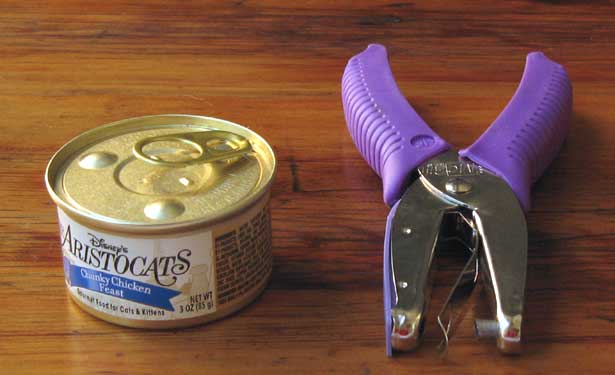
3-oz Fancy Feast cat food can, or another can of the same size. I can usually find the Fancy Feast knock-off brand for $.39 at my local grocery store.
1-hole punch. A standard hole punch is adequate, but an arts & craft model that has a bigger reach is easier to use. With my pole punch I can punch holes 2 inches from the edge of a can or paper sheet, whereas with a standard hole punch I’d be limited to about .75 inches.
Step by Step Directions
1. Remove the cat food and wash out the can.
2. Flatten the sharp edge that was left by the lid with the hole punch (or another hard object, like a butter knife), in order to avoid being cut.

3. Just below the lip of can, make one complete row of hole punches. Avoid breaking the tin between the holes by keeping them far enough apart – about one-eighth of an inch.

4. Below the first layer of hole punches, make another row of holes. The middle of the bottom holes should be directly underneath the 1/8-inch gaps between the upper holes.

5. Make a windscreen, following another one of my articles. A windscreen MUST be used with this stove. Otherwise you will struggle to get a boil, especially in windy conditions.
Operating Instructions
This stove is extremely easy to use. Pour denatured alcohol into the stove, light the alcohol with a match, wait 20-30 seconds for the fuel to warm up, and then put your pot on top of the stove.
I typically boil slightly less water than my meal actually requires but optimum consistency/texture. Once the food has absorbed all of the water I boiled, I then add non-boiled water until the correct consistency is achieved. This has a few advantages: I use less fuel, I never end up with “couscous soup,” and I do not have to wait for my dinner to cool because the non-boiled water cools it down enough to eat right away.

Variations
The 3-oz Fancy Feast stove is ideal for a 1-person cook system with a ~1-liter-ish pot. Personally, I use a .9-liter Evernew titanium pot, which has a 5-inch diameter bottom. If you plan to use a larger pot, and you are concerned about the pot being unstable on the 2.5-inch diameter Fancy Feast can, you can follow the same instructions as above but substitute the Fancy Feast can for a larger can, like a tuna fish can.
I have never done tests to prove it, but it’s reasonable to think that the number of hole punches affect the heat output and the fuel efficiency of the stove. With more holes, the stove probably burns hotter and less efficient. With fewer holes, the stove probably burns less hot but more efficient. The optimum number of holes is probably a function of the pot (its material, thickness, and shape), the quantity and starting temperature of water being boiled, and the performance of the windscreen…in other words, too many other variables to make this sort of testing worthwhile.
This is just plain damn cool. I own a MSR Reactor which is a great cooking system but it weighs a ton by comparasion and I only ever use it to boil water. I’ve ordered your book and look forward to reading your ideas and opinions on gear.
andrew: I modified this can STOVE. Use a small 1/32 inch drill. drill lots of holes near rim about 1/8 inch APART around circumference. drill a second row of holes under this row, about a 1/2 of inch below and a hole every 3 or 4th hole of top row. . i cut 1/8 ribbons from aluminum can and scrunch them up (aluminum wool) and place this in the modified skurka can stove. FILL CAN 2/3 FULL OF WOOL.
ADD FUEL. ONCE THIS HEATS UP ADD POT WITH WATER. i THINK THE GAS VAPORIZIES MUCH MORE EFFICIENTLY UNDER PRESSURE AND I AM ABLE TO BOIL 48 OUNCES OF WATER WITH JUST UNDER 1/3 CUP OF ALCOHOL.
Sounds awesome! Are you able to prove a pic of this? Thanks
This is a great tutorial!!!
Skurka, you evil genius.
Someone tell me again why we’ve spent hundreds of dollars for backpacking stoves.
Exactly what I was going to say! It is also lighter than most backpacking stoves we carry! Continue on with the awesome inventions, my friend!
We used to make homemade bunsen burners in Girl Guides when I was younger with recycled cardboard cut into long thin strips to fit in fancy feast cans we filled with wax and added a wick. We then used apple or tomato juice cans that were taller and larger cut a few rectangular holes around the bottom of the can and triangle holes along the outside of the top using a can opener with a point. We made pancakes, grilled cheese quesadiallas and soup etc etc and the burners cost next to nothing to make and are light weight and last hours.
Very Cool – Just got a Trangia for car camping – but will make one of these for backpacking – thanks.
Great Cat stove. I have used one for years and also made one out of a Potted Meat can.
Can you use it when open fires are prohibited?
I’ve also lined my Cat stove with fiberglass wick that I got from a hardware store for under 2 dollars. this seems to increase the boil time and keeps the fuel from sloshing around.
I’d personally advise to use a fiberglass or glass wool (home insulation) wick to help getting the alcohol to evaporate and actually burn in colder temperatures. I’ve experienced that cold alcohol (in cold air temperatures) can be very, very hard to light.
Awesome concept. Thanks for posting it. This makes all the complicated $100 super lightweight stoves look silly by comparison. Can’t wait to build it.
One question. I noticed the pattern of the holes of the stove in use in the field (the first photo) is different than the one you make in the video. Is there a reason for the difference?
I have not tested the performance of stoves with more holes versus less. Probably more holes gets hotter, and fewer holes is more efficient. But not sure it matters.
I just did some testing (not exactly scientific) on this today and here is what I found. The stove needs a lot of oxygen to burn hot, I boiled faster when there was a little breeze although I’m sure the heat was being pushed away and I lost some effeciency. I started out with a tuna can as it was what I had lying around, and just put a single row of holes at the top. I figured this can had a much wider diameter so it equaled out to about the same amount of holes. This tuna stove would burn for a while but the water never got hot enough to boil. I then got a Fancy Feast can so it would fit within the heat fins on my jetfoil and I did two full rows, as shown in the pictures above. I could get a boil going in my jetboil container in under 5 minutes this way.
Since this stove is light enough, you could almost carry two (different size cans so they fit within each other) so you can have a boil and a simmer stove. Even though it’s only half an ounce, the desire to carry two cans depends on your meals and cooking needs.
I just went camping with two stoves like you mentioned above. (10/8/15)
I made a tuna can with a full row on top, and a second row with only half as many holes, and it worked best of the configurations I tried. I was able to make anything that required boiling water. I only needed 1oz of denatured alcohol to make coffee. 2.5 oz of alcohol made the water boil easily. I simply used rocks as a wind screen.
I also tried a 3oz cat food can with only one row of holes, and it didn’t work well.
That is a lot of fuel for a boil. It should be 1 oz max to boil enough water for a meal. I would encourage you to improve the system’s efficiency.
I am reading your book now. When I got to the part about the fancy feast stove I googled it and got here. I think I will try using this stove with the cup/pot of my Jetboil Sol Ti.
The Golite “Jam” is on the cover of your book. As you discuss items in your book you often give “Skurka’s Picks”. You did not go into light weight packs. Have you used the Jam? Do you have a one or two sentence evaluation on it or Golight products in general?
I believe I discuss the Jam in the Skurka’s Picks section in the chapter on backpacks. It has been my go-to thru-hiking pack since it first came out in 2003.
Very cool , hope to get more tips from your book. Thank you.
I’m making one right now and i’m finding it impossible to penetrate the can with the hole punch. The best I’ve been able to do so far is to score the can with the hole punch and finish it off with needle-nosed pliers. What am I doing wrong? It’s taken 20 minutes to do 3 holes!
Wouldn’t ya know it…as soon as I posted that, the holes started coming. Looking forward to your workshop in Boulder next week.
Hey Andrew-
I’ve been using the FancyFeast for a few months and love it. I actually did a bit of fiddeling with an energy drink can (VUKA, they’re sold in the Denver area) and by inverting the aluminum top of the can inside of the bottom, and by punching holes, have been able to get a pretty efficient design.
Any opinions on JetBoils, or comparable “all in one boil systems” I’m doing a thru hike of the CT this summer and am not sure if the weight of Denatured Alcohol / HEET, will be that much better then just carrying a can of compresed gas.
When I have calculated the weight of stove systems over time, it takes a very long time (i.e. several weeks of having one meal per day) for the efficiency of non-alcohol stoves to offset their higher original weight. Of course, weight is not the only benefit of an alcohol stove — the fuel is also much cheaper and more widely available. If it’s of any value, I carried my alcohol stove across the Yukon Arctic and Brooks Range, when resupply points were often two weeks in between. If I was nervous about how much fuel I had versus how many more days I had to go, I cooked over a fire, which had the added benefit of warmth and comfort.
Really good but not very stable. Have you come across any ‘hacks’ to improve this. Currently thinking if fashioning something out of a wire coathanger!?
The Fancy Feast Can is lined with plastic which contains biosfenal A. I am wondering what the effect of burning this plastic is and the effects on the food and the air. It would be good if you could just have the tin can without the plastic lining.
Good to know. I imagine it gets burned off with the first usage. If you’re concerned about it, it might be worth running a test burn in an open area before using the stove so that all the plastic is burned off before you use it for real.
BTW a canister stove, even a JetBoil can never surpass the low weight of an efficient alcohol stove system. No matter how long the trip. I have done the numbers.
Why? Each time the canister stove system gets close to catching up (propane/butane fuel has more energy) it’s time to get a new canister. And those canisters are heavy!
Bottom line: The weight of the stove and fuel canisters is too large to be overcome, no matter the length of the trip.
-Alan
I have figured out a way to make this a little better with only a slightly larger can you put it over the thing cut out the can till it fits over its with only a 2-3 mm gap between sides and top make sure ot touches ground now you have something to mininmize risk of fire while you are not using aka waiting to burn out only problem is some fuels will cause suit build up on can
I am also working on a way to use this to make simmer type set up by lowering heat output
Here is a tip for getting that gooey fancy feast label glue off the can.
1. Remove the label.
2. Run hot water over the can to get the glue good and gooey.
3. Then apply olive oil liberally and let it set for at least 30 seconds.
4. Finally rub firmly with a Bounty paper towel and should all come off after a minute or two.
My can looked real ugly after being in my pack for couple trips until I figured this out. Alcohol was the first thing I tried and that just added to the mess.
Happy Trails,
Nick
I found W-40 works very well for removing glue, and it is what i used when I made my stove. It sounds like olive oil also works well, though the W-40 make work more quickly; it probably took me 30 seconds total to get rid of the goo. Still, it makes sense to use whatever is on hand.
I tried the two full rows variant, the 50% 2nd row variant and a tuna can one in the Sierras earlier this month. ~9000 feet, temps in the high 50s.
The two full rows one definitely burns hotter and faster but throws flames around the pot, burning the handles etc.
The 50% 2nd row one manages to boil 50% more water per fuel load.
The larger tuna can variant was temperamental with respect to wind and temperature. Surface area to circumference ratio scaling issue?
So 50% 2nd row was the winner but might bring a two full rows one to cover harsher circumstances.
Will this stove work at high alt. around 10,000 ft.
I’ve used the stove extensively at these elevations with excellent success. The one consideration though: the boiling point is lower at these elevations so you need to cook things longer. So long as you stick with instant rice, couscous, Ramen, etc., you’ll be fine. But if you expect to cook 25-minute rice you’ll be wishing you had a more robust stove.
This is a really old post, but what the heck… the secret to regular white rice is to soak it well ahead of time. So about an hour or so before I am going to be cooking, I will put my rice in a ziploc with some water and soak it. Then I will put the rice in the pot with water, about 1 to 1 ratio. Fire up the supercat. When it flames out, I do NOT open the lid of the pot, but I take it and wrap it in a shemagh and put a warm hat over it. Let it sit for about 10 or 15 minutes (experiment with your type of rice I guess). DONE!
In the Japanese DIY YouTube channels they used to cook rice in the same way, pre-soaked.
An guy make a simple can stove, with just a bottom of the can with ~40mm height, with inside wall with vertical grooves, but this wall don’t touch the bottom lower can (fuel tank) and make a trick.
When lit the stove, the capillarity of the grooves wall make the stove run hot, with jets coming from the grooves.
But minutes after, when the fuel level goes bellow the lower part of grooves wall, the stove start burn only in the middle, with less heat.
So the stove boil the water, and minutes after change for simmer mode for cook the rice.
I have been looking for something like this for awhile. I am going out to buy a can inn the next few minutes. Is there something more durable for the windscreen than aluminum foil? Now I just have to figure out a simple, easy and cheap way to use wood. Thanks.
Try this. I just got it in the mail last Tuesday and I love it. Eleven dollars and really lightweight.
http://www.amazon.com/gp/product/B005QRYQ0C/ref=oh_details_o00_s00_i00?ie=UTF8&psc=1
some tin flashing from home depot and paper clip to hold it together. works perfect.
I use the Home Depot thin aluminum flashing, same alloy as soda cans, for lots of things. It’s handy. It’s better to sandpaper the edges ( I think I use 220 and 320 or 400) than try to fold them over.
Also the Alcohol sold in quarts and gallons at HDepot is 100% and about $12/ gallon (The alcohol cost is about $3, but I think you’d have to buy a car tankful.)
You can make a nice, light, cheap windscreen with an aluminum oven liner or cookie sheet available at most grocery stores. Cut with scissors to size. Fold edges twice to prevent them from being too sharp. Make the windscreen come up to the top of your pot. You can use paper clips to hold the windscreen shut.
Made one using a 1/4″ hole punch and used it on a 1.3 Ti Evernew and it preformed like a champ. Going to make some more tomorrow for friends.
I’ve come across a really cool version of this that uses a beer can to make a vapor barrier. It conserves fuel and i think boils water faster. here’s a youtube link. http://youtu.be/7hdnBHb09iI
There are many alcohol stove designs that are more fuel efficient and/or more powerful than my preferred Fancy Feast Stove. But the differences are marginal, and IMO they aren’t enough to justify the additional assembly cost or time, or the need to carry a pot stand. This stove works very well, and it’s stupidly cheap and simple, which makes it hard to beat.
How long will 8oz of fuel last when using this stove primarily to boil water and cook very basic dehydrated meals?
Depends on the volume of water, the starting temperature of the water, and your elevation. Personally, I like soupy meals, and for dinner I typically boil 2-3 cups of water, which requires .75-1 oz per meal. But your mileage may vary, and the only way to know for sure is to test it out using your own system.
Just wanted to say that I made a Fancy Feast stove last Thursday in 10 minutes, as promised, and used it this past weekend on a backpacking trip in Zaleski State Forest with my scouts. It worked exceptionally well! It’s _so_ light!! Thank you for the directions and recommendation!!
Scout warning. BSA policy prohibits the use of ‘home made’ stoves and recommends against the use of alcohol fuel.
So if your camping with scouts you’ll end up buying a vargo, trangia, or similar manufactured stove.
On the other hand, those of us that aren’t shackled by BSA’s liability limitations LOVE homemade stoves!
Just want to say that the Boy Scouts of today are breeding boys alone and not men.
I was a leader in the local scout program for 20 years. Yeah- it got weird then gender/lgbtq hit and the big sponsor (LDS church – almost half of US of A scouts) pulled out and BSA has about died.
Came across this post today while reading some other stove reviews. This reminded me of a stove a guy makes that he started making for people on a forum for adventure motorcycle riders. http://www.advrider.com/forums/showthread.php?t=431851
You had mentioned testing quite a few different designs, didn’t know if you had tried that one yet.
Also, it’s only using 11 holes for a regular or 7 for simmer stove.
Thanks a bunch for the tutorial! Just made one myself for around 2 dollars, and it’s almost as fast as my old Brunton canister stove!
What is the hole size? i tried it with a 4.5 mm/ 0.177 inch punch hole. they seem to me a bit small.
Yes, those holes will probably be too small. A standard hole punch makes 0.25-inch holes.
Down here in Singapore there are 4.5mm hole puncher available. Might go with star or heart shape puncher instead. Or source it from the US.
got one with 6mm, next the can.
I will say this – when considering alcohol stoves, it’s not so much the stove as it is the windscreen. I went through a frustrating period of building cat can and other stoves – then discovered the use of the Caldera Cone type windscreen, and ! Presto ! many issues are solved. So, what are the advantages of using an alcohol stove and a cone-type windscreen?
The advantages: 1) sustainable fuel source (alcohol), 2) fuel easy to carry in very light containers, 3) fuel does not ‘flash’ when ignited, 4) typically the least heavy option for a solo, often for a duo of hikers. 5) fuel does not dissolve your fleece, etc. when spilled (as white gas can), 6) no pressurization needed (relates to #2 above (i.e., pressurized systems (butane, white gas) require much heavier containers/canisters). 7) Fewer issues with quickly burning foods/pan. 8) Fewer environmental issues (how many abandoned canisters have you found?, see #1 above, recycling of butane canisters rarely happens, use the same alcohol container until it is recycled), 9) cone-type windscreen is far more stable (to tipping) and better in the wind than other systems = less accidental loss of food, better performance. 10) you can comfortably use a lighter (ultralight) pan with fewer to no issues of burning. 11) you can carry grain alcohol as extra fuel(in case of trip issues such as unexpected cold weather, failure of filter, where you need to boil water to drink) – and toast yourself (drink the grain) during the final days of the trip for having the foresight and intelligence to use an alcohol system, yahoo.
The disadvantages: 1) only one size pan works with a particular cone (not much of an issue for JMT/PCT hikers because the rarely carry two or three pot sets) – caveat – see Captain Paranoia cone adapter (link below), 2) slower cooking times (I find that I can set up camp or take down camp while the cooking is progressing, and soaking foods after initial boiling saves on fuel and needs no monitoring).
I’ve found that with judicious use of soaking and food selection, I use about the same weight of alcohol fuel as I once allotted for in white gas, despite the admittedly lower BTU of alcohol. This is a bit less than 2 ounces per day. And, I do not have the greater weight of stove and canister and pump. Nor am I carrying heavy empty canisters.
My site, the WV site, has a link to sorting out your own needs. It also contains the Captain Paranoia detailed instructions for making your own very nice alcohol stove. And, bonus!, it contains a link to a video for making your own cone-type windscreen. See it today and abandon those climate change chaos fuels. Site also contains a few recipe examples for fuel saving cooking. Here it is:
http://wildernessvagabond.com/personal/personal.htm#cat%20stove
P.S. Dave and I hiked the JMT using one stove and one 1.3 liter ultralight pot and about 3 ounces of alcohol per day. Use denatured alcohol, the heat and other alcohols contain far less BTUs.
Enjoy your meal, Rob of the WV
main link to recipes, etc. Including alc stove, here:
http://wildernessvagabond.com/personal/personal.htm
And, the home page is:
http://wildernessvagabond.com/index.html
Very simple, functional, and not too bad to look at either. I like how you do not need a pot stand. However, if efficiency is a concern, there are several other DIY alternatives that are more refined and efficient. I like Mark Jurey’s penny stove 2.0. It uses less fuel, costs about the same, and while slightly more complicated to assemble, is easy enough for nearly anyone to assemble. Only drawback is the need for a pot stand. Also, for off-grid, self sufficiency freaks, there are the wood gasification stoves which also work remarkably well (considering fuel cost and the added benefit of not having to rely on refined/liquid fuels). The BioLite is an awesome example of such a stove.
I’ve finally made my own fancy feast stove, as well as a stoves made from smaller, tomato paste cans and one made from a tuna fish can.
The tuna can burns much less efficient, as it takes the same amount of time to boil the same water in the same container and it burns for just as long as the other cans, which hold much less denatured alcohol. Just in case anyone was wondering.
I do have a question though, about whether the stoves hold out until they’re bent out of shape or if there is something else that can render them useless, for example do they fall apart because the fire makes them weak after a few dozen uses?
I really admire what you do and wish I could turn my dreams into a profession the way you have.
Thanks,
Kevin
I’ve used a few Fancy Feast stoves for hundreds of meals and they’ve shown no sign of failing. It might be safe to say, “It’ll work until you lose it.” Even if you squash a stove (perhaps by stepping on it), you can bend it back into place and keep using it, though I’d probably replace it the next convenient opportunity I had.
[…] Detailed instructions (including video) for making the stove and windscreen are on Andrew Skurka’s website here. […]
[…] most part I will move on to test different stove types. Next on my list is Andrew Skurka’s Fancy Feast alcohol stove that will reduce the weight and size of my cooking system while also giving me more flexibility […]
I use a Stanley stainless steel pot, 3.25-inch base, 5.5 inches tall. My Fancy Feast stove has one row of 16 holes, near the top.
I agree that the primary variable is the wind screen. I made mine from a disposable cake tin — cut off the top rim and bottom — which has been pleasantly durable.
The thicker-than-foil aluminum holds up better if the edge happens to get in the flame. Fitting the wind screen closer to the sides of the pot has a dramatic increase in efficiency over a loose fit.
I think the Wellness brand of cat food makes a better cat food can backpacking stove 😉
Seriously….I have used this kind of stove multiple times. I get strange looks from some fellow backpackers but….I will bet that most of them and go back and try it!
I just used the smallest Heinz baked beans tin. 8 holes top with the lower offset hole under and I was drinkng my coffee within 2 minutes using IPA (but it cokes the pan bottom). I live in the UK and de-natured alcohol is illegal, they have this stupid, blue, smelly stuff, called methylated spirits and it takes 3 times as long to get my water hot (plus makes everything in my backpack smell for months) – dumped it. Haven’t tried naphtha in it yet – I have my small MSR pan on a stand that sits about 10mm above the burner for stability so may be okay with naphtha – dunno yet.
This looks great! Now I only have to wait until my cat finishes the other half of the can that she started this morning and I can make my own. One question though: Is it necessary that the pot sit directly on top of the can for the stove to function properly? The reason I ask is it seems that simmering could be achieved by making a wire stand that could be adjusted to different heights above the pot. Anybody have any idea if this will work?
I think I will be making one of these once I get home tonight! Will be nice for solo backpacking being as light as it is. Won’t really be able to use it for my search and rescue missions due to the fact we need to be quick moving to respond and the quicker you can boil water, the better. We are required to use canister stoves when not at high elevation due to risk of spilled fuel. But hey, I can still use it when going out on my own!!
[…] fuel, the quiet operation, the existential relief of the parsimony of the design (it is, um, a cat food tin with holes in it): all of that was compelling. Night after night, though, I just scowled at the thing and its kind […]
Graefyl January 18, 2013 at 10:04 am # “I live in the UK and de-natured alcohol is illegal, they have this stupid, blue, smelly stuff, called methylated spirits and it takes 3 times as long to get my water hot (plus makes everything in my backpack smell for months) – dumped it.”
Try HEET brand gas line anti freeze from the car repair store. Methyl Alcohol
I read about your stove design in the newest Backpacker; sounds really cool and I’m looking forward to trying it. They got one thing wrong though, the way their article is worded makes it sound like paint thinner = denatured alcohol and is a good fuel for this. Any idea what would happen if someone tries mineral spirits in an alcohol stove? I would think big yellow sooty flames but I can’t say I’ve tried.
Andrew, this stove is fantastic…thanks so much for sharing. My new goto.
Can the denatured alcohol be extinguished and relit later? If so, can you put the unused portion back in your alcohol bottle or does it need to be kept separate from portions that have not already been lit?
Thanks for the post. I and my wallet appreciate it.
It is difficult to extinguish the flame, and may not end well — you could ignite something nearby, or blow dirt at your hiking buddies. It’s best just to learn exactly how much fuel your stove needs, then let it burn out. Beginners might consider using a small measuring cup, like those that come with cough syrup bottles.
Thanks!
You can easily extinguish the flame by simply placing a cup or metal container over the stove upside down. The flame will go out in a few seconds.
Assuming you have an extra metal cup or pot nearby. If you don’t, still the best thing to do is measure out the fuel carefully and let it burn out completely.
I got your link from looking for the biostove. So glad I read your critique. My problem is the denatured alcohol. I live in England and as far as I’m aware it is, by Law, tinted purple or green to prevent people drinking it (we are British after all) am I being stupid or is this really the case that it would be poisonous to use!? I have just literally thought about zippo fuel- do you reckon this would be a good substitute (costing might rise slightly) maybe I could import it!
Your help’s appreciated
Damo
It is poisonous here too, though not tinted with color. Still works well as fuel.
DO not use zippo fuel. It is gasoline based and will be very smokey and potentially explosive. If you don’t like the smell of “methylated” spirits (which is denatured alcohol, buy so called bio ethanol, which is an undyed denatured alcohol.Both are 95% ethyl alcohol plus about 4% methyl alcohol (the poison) and 1% made up of maybe a ketone (methyl ethyl is frequently used, a bit of dye, and in the case of meths, something to make it smell repulsive.
Great! I use a spam (yuck!) can for bigger pots. It holds more fuel.
[…] you can buy out there, and, many that you can easily make yourself (I fancy to build myself a Fancy Feast alcohol stove one of these days…), but, as a solid fuel alternative to my rocket fuel mainstay, I love the […]
Andrew,
I haven’t read through your book in its entirety, but is there any mention of your cooking method? I noticed you use the Evernew 0.9 L pot–do you cook in your pot or do you do “Freezer Bag Cooking”? I’ve done FBC in the past, but I’m thinking of moving to in-the-pot cooking to save weight on plastic. Gussetted “freezer bags” actually designed to hold boiling water weigh in the neighborhood of 10 grams, and I can see all this plastic adding up on a more lengthy trip.
I’m trying to decide right now between the Evernew 0.9 L pot and the 1.3 L iteration.
Thanks!
Hello Andrew,
Great tutorial, I set out to make one as soon as I saw your video and tutorial.
I have hit upon a problem however. The holes are very hard to make, I just managed to make the first row. The paper hole puncher (which is an arts and craft model apparently just like yours) does not finish off the holes by itself. It leaves 1-4 of the circle connected to the can and I have to finish it off with pliers.
The first row is about ok but impossible to make the second row, I just leave a circle trace on the can it does not punch through in any way.
I am wondering if this could be due to the can I am using. I used a 3 ounces tuna can which is made of recycled steel. Are fancy feast cans more easy to punch? Is that why you use those instead of other cans?
Thanks in advance,
cheers
The cat food cans are tin or aluminum, and this much easier to punch.
Just finished using the stove. Works great and simple to build. I’m giving up on my canister stove and using only this stove.
Yeah!
Hey Andrew,
Can you use the fancy feast stove year-round?
How’s it’s cold weather performance?
It works so long as the fuel can get hot, so you can’t put it on a cold surface (e.g. snow, ice) and expect it to work.
That said, if you’re trying to melt snow for water, this is not an appropriate stove, as it’d take forever and consume a lot of fuel. A liquid or canister stove (with some caveats) would be a better choice.
[…] web for any how-to information I could find. I came across this how-to on HikingForums.net and this video by hiker/adventurer Andrew Skurka. Check ‘em […]
[…] “Fancy Feast Model” I made with the instructions on the blog of well-known adventurer Andrew Skurka. I wanted to make my own for a few different […]
Andrew,
On the stove in the top picture, there are only eight holes in the second (lower) row of holes vice 16, but in your instructions, there are a full 16. Is 8 an earlier design? Or just an alternative?
The design is viable either way. With 8 holes, you get a slower burn and greater efficiency; with 16, hotter but more wasteful. Personally, I go with 8 nowadays. I have not tried less but I have definitely seen stoves of this sort without enough holes that can’t get a boil going.
My input as a firefighter – Depth of fuel will determine how long it burns, surface area size determines how much heat is released, as only the surface burns.
[…] different variations of the cat food can / tuna fish can stove, but my most recent one (Jan 2013) is a model that I highly recommend. This link has directions on how to make this excellent cat food can stove. It’s cheap (mine […]
I’ve been testing a few variations of these stoves at home (new to camping) and while they burn great, I am having trouble balancing cookware that has a single handle on it. It’s doable with a pot if filled with enough water, but I was going to fry some eggs on an 8″ aluminum frying pan, and the only way it balances is if you put it way off center of the stove, which I think is not good for heat distribution. The only thing I could sort of come up with was to take 3 more empty cans (I have cats and so the supply of cans is a non issue ;)) and place them on the outside edges of the pan, in a kind of rudimentary tripod. Wonder if there is a more elegant solution or if this is just not the sort of thing I should be using this stove for.
Maybe you can use a tent stake to support the handle?
I was looking at some denatured alcohol and saw that it’s highly poisonous. Does this effect the food?
If you are using it as an ingredient in Peppercorn Beef Jerky Flambe or Flaming Dried Bananas Foster, denatured alcohol would be a poor choice. If you are using it as a stove fuel, it has no more toxic effect than propane or Coleman fuel when used as stove fuel. Usually, we hope stove fuels contribute to a warming effect on food!
[…] are my DIY alcohol burners. Inspired by a tube video by Skurka. First I made one from a can of mackerel in tomato, since I hadn’t been able to find the […]
I’ve made a 14-hole stove that is more efficient than my 24-hole stove. The 14-hole version has 6-widely spaced holes around the can rim and 8-widely spaced holes in a row below that. 14-hole stove runs longer than the 24-hole stove on the same amount of fuel (20 ml) / same water temperature/volume, brings 2 cups of water from a cold fridge to a boil in 7 minutes and then keeps running for another 45 seconds. The 24-hole stove boils 2 cups in 6 minutes, but runs out immediately. The 14-hole design is less sensitive to wind. It occurred to me that having more holes in the second row (farther from the pot bottom) would help keep the flames hitting the middle of the pot instead of getting wrapped around the sides. I also raised the hole locations a tad bit close to the rim to increase fuel capacity. I tried this head-to-head with 3 liters of water, using 25 ml of fuel and was able to boil water with the 14-hole stove, but not the 24-hole stove. I use a 1.8 liter GSI dualist pot with a homemade aluminum flashing windscreen. Pot diameter is 5.5 inches.
[…] summer you definitely don’t need all that awesome. With a little experience I learned that a cat-can stove – so called because it is often made from a Fancy Feast cat food can and some denatured alcohol, […]
[…] stoves… and may even revert to the cat can at some point. The cat can has its merits, and even professional adventurers endorse it. When I hike with my wife, I’ll carry a canister stove and she’ll carry a cat can to ensure […]
I know this is an old post, but there are vendors that make simmer rings for the Fancy Feast stoves. They work quite well. I didn’t want to post a link on your website, but they can easily be found with a bit of searching.
[…] how dorky I got about this. In my research I came across the Fancy Feast cat food can stove via Andrew Skurka‘s site. The way the stove works is incredibly simple, which I liked much better than the […]
Just FYI it looks like these guys plagiarized parts of your blog post (some sentences such as the one about Everclear are copied verbatim). http://indefinitelywild.gizmodo.com/can-a-1-cat-food-can-beat-a-140-backpacking-stove-1576734381
I felt the very same way. I contacted the author, Chris Brinlee, and heard back from Wes Siler, who seems to write more of the content there. His response:
In the article on the cat food can stove, I can see that Chris raises some of the same issues you do on your blog — stability, side burner design not heating smaller mugs, no off switch — I feel that these are all fairly self-evident in operating one of these things. I would probably have written fairly identical copy.
Buy that? It seems to me that the structure of the article and much of the wording is at least oddly coincidental, if not plagiarism. There are many other articles online about alcohol stoves, and the cat food can stove in particular (or “Super Cat,” as I’ve been scolded), and it’s telling that none of them are so similar. Still just “self-evident” issues?
I appreciate you bringing this up. I plan to re-contact Wes and Chris to see if they would like to respond to your comment.
[…] We also experimented with the BushBox Ultralight outdoor pocket stove. I liked the idea that you can use it with different fuels, and even just twigs. We absolutely love this piece of kit, but for backpacking purposes it isn’t completely feasible using twigs. Admittedly the sticks we used were slightly damp, but it took 2 hours to make a couple of cups of coffee, some scrambled eggs and baked beans. With all of the walking we just aren’t going to have time for that, we’ll need to produce hot food or drink fast. We may use the BushBox with Bio-ethanol fuel in a trangia burner, but before making the final decision the next project will be to try out the DIY “Fancy Feast Alcohol Backpacking Stove” […]
[…] stove and carried about 250ml of fuel in a juice bottle. See the instructions of how to make it here. Before all you MSR and Jetboil lovers knock this try […]
This looks amazing, what an excellent idea. I live in the UK and I don’t think we have Fancy Feast. Please could someone post the dimensions of a can? You mention a 2.5 inch diameter. Thanks!
100 ml volume, aluminum
For extinguishing the flame, you may want to carry an empty, bigger can that can be turned over and used to completely cover the stove. By depriving the flame of oxygen, the fire would go out.
One can would fit inside another so no real weight or size penalty.
Andrew, have you tested the stove and found it to work well under windy conditions, say, Patagonia?
“Tested the stove?” No. Used it a lot, yes.
For windy conditions, this is not the stove system you want, mostly due to flaws of my go-to aluminum foil windscreen. Read this: https://andrewskurka.com/2015/super-cat-fancy-feast-backpacking-alcohol-stove-flaws/.
I would recommend you look at a Caldera Cone or similar: http://www.traildesigns.com/
Oh well, that was a really silly way of phrasing the question 😉 thanks a lot for your quick reply!
loved all what you said, more power to you! Thank you for sharing and will use your ideas, I’m only 60 yrs old and will be moving from a city to 18 acre wilderness.God bless and take care buddy!
Thank you for your research and design. This little stove can cook! I built mine according to your standard recipe, no experimenting with placement of holes, etc. I bought a little Nalgene bottle for the stove fuel (alcohol), and the bottle actually nests into the can. I did a bit of research on the Nalgene bottles, and the plain old style milky-white plastic (LDPE) bottles have good to excellent resistance to ethyl alcohol (the main component of denatured alcohol). The little Nalgene bottle was sort of hard to find, I think I ended up getting it on eBay, and it was more of a “chemistry” bottle than a “backpacking” item. Same Nalgene, same bottles, though you gotta pay attention. They make bottles in a bunch of materials for industrial use. Anyway, back to the stove … “cooked” water, meaning boiled it, a few different times while camping this past Labor Day weekend. A mighty fast little stove … dirt cheap … simple. I did buy a little metal shield on eBay for a few bucks, it folds flat and fits into a little bag. That shield keeps the breeze away, because even the slightest breeze will send flames out one side. Foil would work, but the shield is nearly as light and won’t fall apart over time. Finally, my pot is, I think, a 1-litre MSR, stainless. A tad top-heavy when filled with water, working on a picnic table. On the ground, I’m betting there’d be no problem. The stove’s small diameter shoots the flames out on the bottom of the pot, which is what you want. Overall, I think it’s perfect, and I’m about this far from not carrying both this stove and my other one. (I have been afraid to do without the backup stove thus far).
I have now broken two hole punches trying to make one. Any suggestions on a good quality hole punch.
Odd. Are you sure you are using a cat food can, and not a can with a thicker gauge like a tuna can. I make these stoves using a hole punch that I bought at the dollar store.
Yup. Newman’s Own Cat Food and Royal Canin… she’s a fickle cat. ;-). The first few punches are great then it gets out of square and doesn’t punch all the way through. Kind of just scores it. I’m going to try a heavy duty hole punch from Home Depot next.
Great stove! Tested mine yesterday with a packet of Ramen noodles and made some observations to improve fuel consumption, water use, and cook time.
Question: are there any types of plastic that are best to use or to avoid when repackaging the denatured alcohol into a smaller container for backpacking trips? Since I purchased the product in a metal can I am unsure if the product will cause certain plastics to degrade and leak my fuel.
Thanks!
~Tommy.
You left out one disadvantage – fuel efficiency.
In my testing, my cat stove used 38g of alcohol to boil a litre of water whereas my BRS-3000T gas stove only needed 14g. My girlfriend and I boil twice a day, so that’s 76g vs 28g.
The BRS cost US $7 and weighs just 6g more than the cat stove. It does need a gas canister, which weighs 70g more than my alcohol fuel bottle.
This means that, in terms of weight, my girlfriend and I get efficiency gains with the gas stove if we’re hiking more than a day or two.
This is one reason we chose to use gas on our 3000km Te Araroa through-hike.
Here’s my DIY windscreen solution from aluminium roof flashing. It rolls up inside the can and works great. Note the paperclips for airflow.
Thank you for your inspiration! I made a cat stove for my first backpacking trip to ADK. It worked great, and I referenced this page in my blog about it. Not sure how to post pics on here, or I would
No. Stoves need to be able to turn off the fuel source in that situation. Even then sometimes still no
This link dates the Super Cat to at least 1999. And it shows some interesting mods which allow full burn on 2 tablespoons of fuel.
http://thru-hiker.com/projects/cat_stove.php
In my tests for a short trip 4 days…..and boiling 6 cups of water a day for my wife and I the weight is a push with a small canister and the Soto WindMaster. I need just about an ounce of fuel per two cup boil. – the windmaster works a bit better in the wind and the fuel is more efficient.
I made one of these from a john west no drain tuna tin today. when I lit it some of the alchohol dripped out of one of the holes – I didn’t fill it up very high!! when i tried to wipe up the lit alchohol i knocked it and fast burning alchohol spilled all over my plastic groundsheet – the dogs bed – and my expensive ultra lightweight sleeping bag!! tried to put it out with my boots and hands but to no avail! spilt burning alcohol burs very quickly and spre4ads very quickly and is difficult to put out as it burns so fast! Very luckily I had a bucket of water outside the tent that I chucked on everything straight away!! I’ll be very careful of using alchohol in any sort of open and uncontrolled design like this again!! – very dangerous!!
scouts beware
you cant use a home made stove