How to hike a “fast” thru-hike
The secret is not hiking at a faster speed, but hiking for more hours.
This article is reprinted here with permission from Backpacking Light Magazine.
Fall 2006
During the summer before my senior year of college, when I probably should have had an internship that could be leveraged into a “real” job after graduation, I instead opted to hike the Appalachian Trail. I do not recall being too concerned that I was a novice backpacker or, more importantly, that I would need to reach Katahdin in about half the time it takes most hikers, in order to return to school before classes resumed. I knew that I would just have to quickly learn how to become both a backpacker and “fast” thru-hiker.
Four years and about 15,000 miles of backpacking later, I am still improving in both areas, though certainly now the learning curve is less steep and the performance gains are less significant. My perception of what constitutes a “fast” hike has changed accordingly. During my AT hike in 2002 I averaged almost 23 miles per day, whereas this past summer I averaged over 38 miles per day throughout the California section of the Pacific Crest Trail (over the last 700 miles I averaged over 43 miles per day). Defining “fast” is determined not just by personal perception and abilities, but by the terrain, trail quality, season, and trail culture.
Pros and cons
My initial motivation for doing a fast thru-hike was to gain the satisfaction of completing the entire AT in the limited time I had off. But I have found that there are other good reasons to go fast as well. First, it makes for a more challenging experience, both physically and mentally, and I learn more about my mind and body as a result. Second, I need shorter blocks of time in order to gain a desired experience, which leaves me time leftover to do something else (like work, spend time with family, or go on another hike). And, third, it opens up new trip opportunities because I can overcome traditional logistical difficulties (i.e. a 380-mile stretch of trail with a feasible resupply point) and because I can get to and through areas that have short hiking seasons.
A fast thru-hike is not devoid of drawbacks. I have not formed many lifelong friendships with other thru-hikers; I don’t take as much time to recognize the unique cultures and histories of trail towns; I often miss the “can’t miss” hostels and burger joints; and I’ve been criticized by other hikers for not doing it the “right” (read: their) way. Before you choose to do a fast hike, make sure that you’ll be comfortable with the experience that you’ll get.
In talking about specific ways to complete a fast thru-hike, I find it helpful to reference the equation, Distance = Rate x Time, which can be rearranged as Time = Distance/Rate, where Time is measured in days, Distance is measured in miles, and Rate is measured in miles per day.
The thru-hiker has direct control over only one variable, their Rate: Distance is a pre-determined constant, and Time is a function of the other two variables. Rate is equal to Miles_Hiked_Per_Hour x Hours_Hiked. Thus, there are two ways to increase Rate: by hiking faster or by hiking more hours.
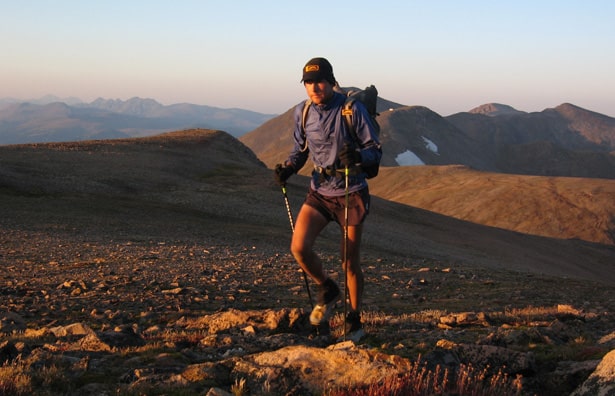
Hiking “fast” in the Indian Peaks Wilderness-still cranking at Hour 14, just before sunset.
There is only one way to hike faster:
1. Go light, of course. A lighter load is the only way to increase Miles_Hiked_Per_Hour (and, therefore, Rate), besides the more obvious technique of increasing energy expenditure. This means: more miles without additional hours or output. It’s likely, however, that you’ll hike additional hours anyway because you will still be fairly fresh at the end of a traditional day. There are three areas in which you can lighten up: your gear, your consumables (food, water, fuel, TP, etc.), and your body. To lighten your pack: educate yourself on the matter with printed and online resources, research the environmental conditions you will encounter, develop a set of appropriate lightweight gear lists for those conditions, and have the gear kits mailed to you at designated points along your route. To lighten your consumables: keep the average caloric density of your food to around 125 calories/ounce, hydrate more at water sources so you can carry less water between them while still staying hydrated, and try to never pack “contingency food” that will weigh you down and not motivate you to hurry up like the prospect of an empty stomach will. The benefits of reducing your body weight are not so clearly advantageous: you’ll have less natural insulation, you might not be able to carry as much weight if you lose muscle mass, and you may have to carry more food if your body fat percentage gets too low. Nevertheless, being leaner will generally lead to greater comfort and more miles.
But there are at least six ways to hike more hours:
2. Expect to challenge yourself. All thru-hikes are challenging, without a doubt. But fast hikes are even more physically taxing and mentally exhausting—they entail longer days, more miles, fewer breaks, shorter town stops, less companionship, more limited scheduling flexibility, and greater scrutiny by other hikers. Fast hikes are definitely not “vacations”; words like “rewarding” and “satisfying” more accurately describe the experience than “fun” (unless you’re a full-blown masochist). Be prepared for the additional difficulties you will bring on yourself; and embrace them as an integral part of your trip, as much as the wildlife encounters and scenic vistas.
3. Hit the ground running. Many hikers get in shape “on the trail” by starting with 5-10 miles per day and slowly building up. Do not take this approach—instead, train beforehand and be ready to put in long days immediately. There is no better training for a backpacking trip than by going backpacking—it’s the only activity that will work the right muscles, help you develop the necessary skills, and get you familiar with your gear. If your training is limited by your lack of access or free time (e.g. if you live in a city or among cornfields, or if you have commitments to work, family, and trip planning), I would recommend that you: increase the intensity of your workouts (e.g. run for 30 minutes instead of walking for 2 hours), be resourceful with what you do have (e.g. stadium stairs, indoor treadmills, your backyard), and simulate the “real thing” whenever you can (i.e. during a free weekend go backpacking in a nearby park).
4. Be a tortoise, not a hare. The more influential variable in determining Rate is Hours_Hiked, not Hours_Hiked_Per_Hour. A fast rate of travel leads to faster fatigue, more discomfort (because it’s not as natural a stride), and increased stress and strain; plus, time savings can be easily offset by the need to take longer and more frequent breaks. I will hike fast when I really want to get somewhere—like a campsite before dark or a PO before 4pm—but I avoid it otherwise. When I need to put in a long day, I find it more effective to walk at a comfortable, controlled, constant speed—simply for more hours. If you routinely hike 15+ hours per day you may find the limitation of this approach, as sleep deprivation can become an issue.
5. Minimize the number and length of town stops. Those who have failed a class can probably attest to the damage it does to a GPA, regardless of their other grades. It’s no different for a thru-hike, where Modern Civilization 101 is the class that can destroy your chances of making magna cum laude. When you’re in town, you’re not hiking; and when you’re not hiking, you’re not getting to your destination—and, sorry, you don’t get “bonus miles” for staying in hostels, drinking beer, or hanging out on the town green. Some tips to avoid these time-sucking vortexes: try to only stop at towns that are on or close to the trail, and that have all vital services; set a limit beforehand on how much time you will allow yourself to stay in town; and develop a list of “to do” items beforehand, accomplish them quickly, and then leave. That said, do not discount the mental boost that you can gain from a restaurant meal or motel room, which may leave you refreshed and reenergized.
6. Increase the efficiency with which you do routine tasks. Nearly every day you will brush your teeth, break down your camp, pack your pack, go to the bathroom, collect and purify water, eat, make journal entries, take photos, set up your campsite, stretch, and prepare dinner. Every few days you will head into town, where you’ll resupply, call family and friends, do your laundry, and enjoy a “real” meal. If you can find ways to minimize the time it takes you to perform these tasks, or the frequency with which you do them, you will have more time for actually hiking. A sampling of my techniques: I use a digital voice recorder so that I can journal on-the-go; I receive maildrops so I can avoid the grocery store; I store my water bottles in the side pockets for easy access, and I don’t purify my water if I am confident in the source; and I even urinate while walking. Individually, these techniques save a marginal amount of time; but cumulatively they can save an hour or more every day.
7. Optimize the morning hoursa. On the trail most days seem like a Saturday—you do not really need to be anywhere, and you have all day to cut the lawn or rake the leaves. So you hit ‘snooze’ and roll back over, enjoying another hour or two of Z’s. Admittedly, I do this every now and then. But usually experience prevails: I know that if I don’t seize the morning hours, then I’ll be playing catch-up all day (which makes the day feel rushed and not enjoyable) and I’ll be hiking past bedtime, thus cutting into that night’s sleep. Everyday I have targets for myself—ideally “20 (miles) by 12 (pm),” at least “12 by 10″—with the goal of completing a chunk of miles early in the day, so that I have the option of either enjoying the evening hours or putting in a big day.
Hi! I just had a couple of questions. I am planning to do a thru hike of the AT summer 2013, but because of school I will only have about 100 days to complete it, including 4-5 days of rest. I know you completed the AT in 95 days and I was just wondering what were the amount of hours you typically put in per day and how often did you stop in towns to resupply, and how long did each resupply take?
I think a 100-day thru-hike is very possible, but you will need to hit the ground running by having your gear and systems dialed in, and by being in decent shape before you get out there.
The trail is 2,175 miles long, so to do it in 100 days you need to average “just” 21.75 miles per day. If you can walk at 3mph, you only need to hike for 7.3 hours per day. Of course, you’ll want to take breaks during the day and you’ll need to stop in town, but 10-12 hour days are still pretty comfortable.
I would recommend only stopping in towns that are right on the trail, if you have the choice. There are many opportunities to resupply, and I would stick the ones that are easiest, since it’s unlikely that you’ll make up for losing 3-5 hours to a resupply as opposed to carrying an extra few pounds of food in order to skip it.
for someone on a thru hike what gear would you suggest? Hammock or Tent? Also, is it possible to supplement much food with things on the trail like berries?
Re hammock or “shelter,” it totally depends on the trail. For a trail in the East — where “good” campsites can often be hard to come by — there’s a good argument for a hammock. For a trail in the West, great campsites abound.
I suppose it is possible to supplement your diets by foraging, but my hunter & gatherer skills are not developed enough to justify the time, versus just carrying all of my food.
I’d suggest a tent unless you know for sure you’ll have good trees everywhere on the trail. If you’re just looking for ultralight, try a tarp-tent or bivvy sack instead. Hammocks are quite cozy but you don’t want to be out of luck if you can’t find a good set of trees!
As for food supplements – well, no, not really. In order to collect enough food to make a difference, you need to have the time to scout rabbit trails, set snares, and go far off the trail to look for vegetation. That’s not really something you can do when you have to keep moving from place to place every day. (Plus, Leave No Trace! Look it up if you’re not familiar with it.)
Don’t knock hammock camping until you actually try it. If you can move 5 miles on any section on the entire AT without finding two suitable trees, I’ll eat a tent. Even the PCT has abundant trees. “Good” trees are anything thicker than your ankle.
Max: you can go 5 miles without suitable trees in the Presidential Range. But, your point is still reasonable, since you can’t camp up there and have to huck all the way through to find a legal site.
Good read, great article – thanks!
Thanks for the tips, I found this really useful!! I’m also planning on doing a thru-hike in summer 2013 and was hoping four months is enough time.
Inspiring article. I would love to find 100 days and hit the ground running. I am finding 14 days soon for the TRT and will keeo these principles in mind. Many thanks.
Mr. Skurka, well-stated and very useful. I’m an older hiker/packer living right along the GET, here in New Mexico, by the Manzanos. Haven’t you zoomed through them?
Your suggestions will be applied to best of my ability.
Only thing I’m fuzzy on is the advantage and the technique of peeing while pacing. Don’t that get a wee-bit messy?
Or is that just a part of the hiker trash etiquette?
Great website! Esposa y jo enjoyed the national geographic live presentation!
Great article! I’m looking to do a fast hike as well (though I’m thinking more towards 120-140 days). The only technique I doubt is that of urinating while walking :P.
If I may ask, what was your favorite point on the trail?
Derek: I know you weren’t asking for my opinion, but you get to have it anyway. Franconia Ridge in NH. Hit that section on a clear day and you’ll be stunned.
Hello Andrew! Thanks for writing such a great article. I’m preparing for a trip where I will cover over 10,000 miles in 407 day. As someone that has covered long distance in short amounts of time do you think it is possible? I will leave from Seattle Wa and head South to Brazil for the 2014 World Cup. It wont be on a trail but I will be kicking a soccer ball. Thanks for your insight.
Cheers,
Richard Swanson
That would be 24 miles per day. Seems reasonable but you will need to spend 8-10 hours walking each day.
Just to let people know. Richard Swanson was struck and killed by a car along the highway as he was starting this journey south to brazil in May, 2013.
http://www.huffingtonpost.com/2013/05/14/richard-swanson-dribbling-soccer-ball-brazil-dies_n_3276415.html
Wow… The above three posts are really depressing to read in succession.
https://www.facebook.com/BreakawayBrazil/
Very sad.
[…] Today I found this article, confirming my thoughts that it’s possible for a young, fit guy like me to be able to do the whole thing in 100 days. […]
Hi,
I’m planning on walking approx 200 miles over nine days this August. The distances vary from 19 miles to 27 miles per day. An average of 22 Miles per day. I’m a reasonably fit male, forty years old and I walk 12 miles per day comfortably in about three hours. I’ve walked 20, 24, and 27 miles on some days without to much difficulty but I’m a little worried about doing an average of 22 miles a day for nine days in a row!!.
Any tips or suggestions for training would be much appreciated. I plan on doing this in about eight weeks time from August 9th to 17th.
I’m looking forward to your reply.
John Maher,
Kilkenny,
Ireland.
Doing the mileage on a day-hike is much easier than doing it day after day. A few suggestions:
1. You need to keep your feet healthy.
2. Be patient. You can afford to do mid- or high-10’s through the first few days, because as your pack gets lighter and after you work through some of those initial aches and pains, you should feel really strong and be able to hoof it home.
3. Be diligent when you’re supposed to be hiking, and walk steadily until a designated rest time/spot. Hiking is a tortise’s game, not a hare’s.
Great article. I am planning on a 2200 mile cross-Europe hike starting next March, going from London to Athens. There will be plenty of resupply opportunities and I plan on going as light as possible, but I’m considering doing it in 100 days. I’ve never done anything like this before, and don’t really have a lot of time other than weekends to train, but plan on doing as many 2-day walks as I can. My main concern is my feet and legs…I don’t want blisters, strained tendons etc. to put an early end to my efforts. Are there any tips you could give me, or websites you could direct me to that will help me with those all important make-or-break first weeks?
I don’t think more time online is going to help you. I think you need to start getting fit by hiking as often and as much as you can under similar conditions you’ll encounter during your actual trip, e.g. footwear, clothing, footing, vertical gain/loss, maps, etc.
I would also recommend that you be patient in the early part of the trip. You can easily offset an early 14-mile day later in the trip by busting out a 30-miler, which might become really easy for you after your body breaks in.
Do you have any preference of footwear for long hikes like this? I’ve done trips up to 12 days/120 miles over moderately rocky terrain in sneakers, and everything was great (I liked them much more than giant clunky boots), but I’m wondering if the strain on your feet builds up more on longer trips and leads to cumulative bruising if you don’t have more rigid shoes. Also, since they’re heavy, are boots a good place to cut weight? Will a much lighter pack lessen the strain on your soles enough that thicker shoes aren’t needed? Thanks.
Try to find running shoes that have more underfoot protection, as bruising may result from prolonged and extensive use of protection-less shoes. Look for a thicker outdoor, generous cushioning, and/or a forefoot plate.
Hey man,
I hiked the Appalachian Trail – with no training and no goal in mind – in 115 days. Would you consider that a ‘fast’ thru-hike, or would a sub 100 day thru-hike be more appropriate of that definition?
“Fast” is subjective and I do not think I will try to define it in terms of specific MPD.
Hey Andrew, my daughter, Kelsey, and I are training for a thru hike of the AT from May 1st – July 31st (92 days) 2015. My husband will be joining us as our “pit crew” so to speak. I couldn’t agree more with and also appreciate the great advice!! Kelsey and I get along great. She’s 23, rock climber and in sick shape!! She can do the miles if she makes her mind up to do them!! I however am 48, Miss Tennessee bodybuilder 2008, and of the two of us because of life and age I’m probably tougher mentally!! I’m training hard to be able to hang physically!!:) How do you feel about longer fast thru hikes with partners the whole way?! Or our age and physical difference? Any advice or tips on how we help each other? God Bless and thanks for your hard work and time!!!!
I suggest you need to plan, plan, plan. As well as miles, you need to know the elevation changes along the route, where to pick up supplies (planned and unplanned), and the hours of daylight – hint, your trip should be symmetric around June 21 when daylight is longest.
With a hammock, you can camp almost anywhere along the AT, and even if no big trees, you can rig a tarp with your hiking poles.
As for food, plan 4-7000 calories an active day depending on your size.
Great article! I am considering doing the same type of hike (between college graduation and starting work), but Southbound. I’m hoping to finish around 140-150 days. Do you know if it’s any easier/hard to finish a SOBO hike quickly?
It’s easier to start in the south, since the northern miles are the hardest and it’s best to reach them in peak fitness. That said, it’s possible either way, and mental fortitude has a much greater role in your success than physical fitness.
Ahhh the infamous peeing while walking. I specifically pick shorts short enough now to be able to do this easier. Thanks for the tips!
[…] more about this concept is from the best athlete in the category: Andrew Skurka. In 2006 he wrote a post that I still find relevant and useful about how to be a tortoise, and I recommend any long distance […]
Skurka, you have always been an idol to me. I have 100 days to complete the PCT this summer between college semester. At 19, I am in decent shape, and have a 10lb baseweight; I have no doubt that I am physically capable of 27 miles per day. However, I am worried about the mental aspect. Is there any advice you can give me how to prepare mentally for this summer?
1. If you can, try to get in some long weekends before you go so that you can work on your hiking efficiency, e.g. pacing, quickly setting up and breaking down camp, making dinner, etc. If these trips go well, this will give you some confidence.
2. Don’t try to average 27 miles per day from the very start. You have lots of time to make up any lost time. For example, you could hike 22 miles for the first two weeks, and offset that 5-mile daily deficit by hiking 32 miles during the last two weeks. If you’ve hiked 2000 miles to tee you up for this final push, 32 miles per day is going to feel fairly easy. In short, be patient! It’s a long trail!
3. Plan to spend most of your time hiking. You will not be able to enjoy the off-the-trail experience as much as other hikers seem to be. That’s okay, you are having a different experience.
4. Realize that your original goal may need to be thrown out, if it’s not working for you. Maybe you decide that you like the off-the-trail experience more. Or maybe you are not even close to hiking your daily mileage. Oh well, change your goals and enjoy the pursuit of those.
I’m planning to hike the Appalachian Trail sobo starting in early June and I have 70 days to complete it befor I have to go to college. I am confident in my ability to put up many consecutive days in the low 20’s but do you have any tips on how to get those days to the mid thirties also my pace is about 3.25 miles an hour and I can go up to 3.75 miles an hour if I am rushing. So should I try to speed things up or do I simply need to hike longer. My base weight is 11 pounds
You need to hike more, everyday, including town days.
A 70-day pace is pretty stout, especially if you have not done a thru hike before. I will not say you cannot do it, but I would encourage you not to beat yourself up if your goal needs to be adjusted mid-trip.
Maybe, I’m crazy, maybe I won’t finish, maybe I will. Who knows. Anyways, I’ve got exactly 97 days to hike the PCT before I have to get back to school. I’ve read everywhere to hit hte ground running but being in NYC that’s harder so I’ve been running and doing stairs a lot – I run the bridges a lot – great variation in incline and stuff. Anyways, am I crazy or is it actually possible? I also won’t be hiking the canadian portion b/c I’m hiking sb. So my actual “expected” mileage is closer to 2600 but shit happens and detours so who knows really.
Hi Taylor, you need to get on the trail with a backpack and get used to walking with some weight. Do as many overnighters as you can before you start, get used to your gear.
What I’m trying to figure out is how to set daily distance goals, that take into account that not everything might go to plan.
Behind your desk it’s easy: For instance (numbers used for ease, not to reflect my ability): The distance between 2 resupply points is 90 miles, there’s 12 hours of daylight 6-18h), I expect to effectively hike for 10 hours a day and I know I can sustainably hike 3mph, so that is 30 miles/day. So I then also know where my campsites will roughly be. That’s nice, but then I go out in the field.
On the first day I get up early and start hiking at 6, and by 12 I’ve done 20 (3,333 mph). So I can do 10 easy miles. Or… (as you say) make it a big day and hike until sunset and keep breaks really short. I might even do 40 miles that day, as I still have 6 hours of daylight. Let’s assume I do 40 miles indeed. And I’m able to do the same for the next 2 days. That brings me to the resupply point somewhere at the start of day 3, instead of at the end: I’m almost 1 day ahead of schedule.
Problems: Locations of campsites will have to be determined during the day, I need to re-plan the rest of my trip and I will reach the supply point with 1 day of food in my backpack. I have no idea how valid my pace assumptions are. I’d think that ’sustainable pace’ is a range, not a specific number, and that +/-10% would probably still be sustainable. Or would you you say that the range is much smaller, and if you’re 10% off with your expected pace, then you’ve simply not done your homework?
This is of course a nice scenario, but what happens when you lag behind your planning? Or would it be best to always set your goals on the cautious side?
1. The more hiking you do, the more accurate your expectations will be. If you don’t have the data to be certain, be conservative; and if you get ahead of schedule, do a side-trip to a summit, lake, or look-out.
2. Unless a land manager is forcing you to select campsites beforehand as part of your backcountry permit (e.g. as is done in Rocky Mtn and Glacier National Parks), don’t settle on campsites in advance. You might put together an estimated itinerary, but let the events and conditions on the ground inform your actual itinerary. I normally don’t settle on a camping zone until mid- or late-afternoon. More reading on campsite selection, https://andrewskurka.com/tag/five-star-campsite-selection/.
3. It’s always better to have too much food than too little. If you get ahead of schedule, dedicate that extra food to side trips as mentioned above, or eat it as a reward for doing more miles than you thought you were going to, or simply pack it out.
Thanks for your answer, much appreciated.
1. If I had committed myself to hiking a trail, I would probably not want to do any side-trips. So learning to make a better estimate of my expected daily mileage is necessary. What confused me a bit in your post, is that it seemed that estimate and actual mileage were only loosely connected: 20 by 12 and then either some easy miles or a big day. In my example the difference was 10 miles. Or do you already know that in such a case you will always go for a big day? 🙂
2. Here in mainland Europe most of the trails are on private lands, so if you stick to the rules, you have to camp on predetermined campsites. Which often means you hike less or more distance than you would do if you could freely choose. In this case side-trips would actually be an option. I can imagine that to be the strategy in Rocky Mtn and Glacier National Parks as well.
I hate to ask…but need to ask…”urinate while walking.” Do we assume that you just let it run down your legs? I’m aware that urine is sanitary…not necessarily grossed out. Just morbidly curious.
If you’re wearing running shorts, you can let it hang out the bottom of the liner brief, then aim (away from your legs).
Interesting. I’m considering doing the AT next summer and I’d only have about four months to do it in. All my life I’ve been a minimalist. On camping trips I never cook, rarely build a fire, and sleep either in a hammock or on the open ground without a tent. So, breaking or setting up camp wouldn’t take time away from that. I’m going to see how little I can carry with me in terms of gear. One question about food, though….when hiking on a grueling schedule like that does anyone know how many calories one would need to consume per day to keep up the strength and stamina? I want to spend as little money on food as possible, but definitely don’t intend to starve myself.
I normally recommend 18-22 oz of food per person per day. This is based on extensive experience guiding people in the backcountry. After 10-14 days you may find that you need more, in which case you can bump it up by a snack or two, or make some of your rations bigger.
Another consideration: On the AT there are multiple places to get off the trail and get a meal. You won’t starve out there.
Good point….thanks. 🙂
Hi there! I’m planning a 720 miles thru-hike, but I have a different kind of health concern. I’m quite fit in terms of muscle strength, but my lungs give in a lot faster than my legs on up-slopes. Do you have any suggestions on how to improve lung capacity or even aquire a healthier heart rate?
I’m not an exercise expert, but it sounds like you might need to do more cardio work, e.g. running, that forces your respiratory system to work harder.
…Says the UTMB finisher!
Hi Mr Skurka,
thx for so many tipps!
But one Thing: you even urinate while walking!
Can you please explain that technique?
thx
ANdY
Hi Mr Skurka,
sorry I´ve seen you already answered my question above to Gary.
thx a lot.
ANdY
Thank you so much for this timeless advice. I’m relatively new to backpacking but have always been a hill runner and found the transition fairly easy. Wish I had read this before my first trip though. The excitement and a bit of hill runner arrogance led me to take off way too fast with a heavy pack; I did a ton of miles but damaged myself in the process. Trying to figure out what went wrong I came across this article and it really grabbed me. So this time around, I had two and a half days to experience the TRT and my goal was to see as much as possible including Desolation. I took your advice and got moving before dawn each day with a deliberate slow pace for the first hour or two, and didn’t stop until dusk. I’m a little sore but not at all damaged. With more time I could have finished it at the same pace. Thanks again, your writings are excellent.
Quick question: how do you know which water sources don’t require filtering? I drink water mostly right at the source through a Sawyer but lordy it gets old. Like sucking water through a cocktail straw while squeezing the bottle hard as you can. Would be great to be able to guzzle water out of the stream confidently.