Our Brooks Range trips start next week, so both clients and guides are in the final stages of their preparations. One question that hit my inbox this morning was:
What is your recommended method of carrying bear spray?
When to decide how to carry bear spray
Do NOT wait until you’re at the trailhead to decide how you’ll carry your bear spray. By this point, your options may be limited or sub-optimal.
Instead, plan it out beforehand, at the same time that you’re selecting gear. Read through this article, think about your own circumstance, and determine what options are even available to you based on the design of your backpack. If you need an aftermarket pocket, holster, or tether, know how and when you’ll get it.
Objectives
Methods to properly carry bear spray should (in order of priority):
- Reduce or eliminate the risk of the spray being dropped and lost;
- Keep the spray easily accessible;
- Not interfere with basic mechanics, like walking, buckling your hipbelt, and moving your head.
Considerations
I don’t think there is a single best way to carry bear spray, as it depends on factors like:
- The design, size, and features of your backpack (e.g. daypack versus multi-day pack, traditional shoulder pack versus waist pack);
- The chances of you needing it, which is a factor of where you are (i.e. bear density, visibility) and whether you are solo or in a group.
So select a method that works for you.
Recommended methods of carrying bear spray
I recommend carrying your bear spray using one of these methods:
- On a shoulder strap,
- On a hipbelt, or
- In a side pocket.
Method 1: Shoulder strap
On a shoulder strap, bear spray is easy to keep track of and easy to access, with some variability in performance related to the pocket design (e.g. heigh and volume, and closure system). On the shoulder strap, bear spray is more “in the way” here than other options, but it’s not intolerable.
To carry bear spray on a shoulder strap, your backpack will need either:
- Good: Fixed elasticized loops with cinch locks, which will work but which are fiddly;
- Better: Aftermarket pocket, which tend to fit sloppily;
- Best: Permanently attached pocket.


If your backpack does not have elasticized loops or a permanently attached shoulder strap pocket, or if it lacks the connection points for an aftermarket pocket, consider the Bear Tac holster. It’s purpose-built for this job; it stays put; and it has a solid hold with a clean draw.
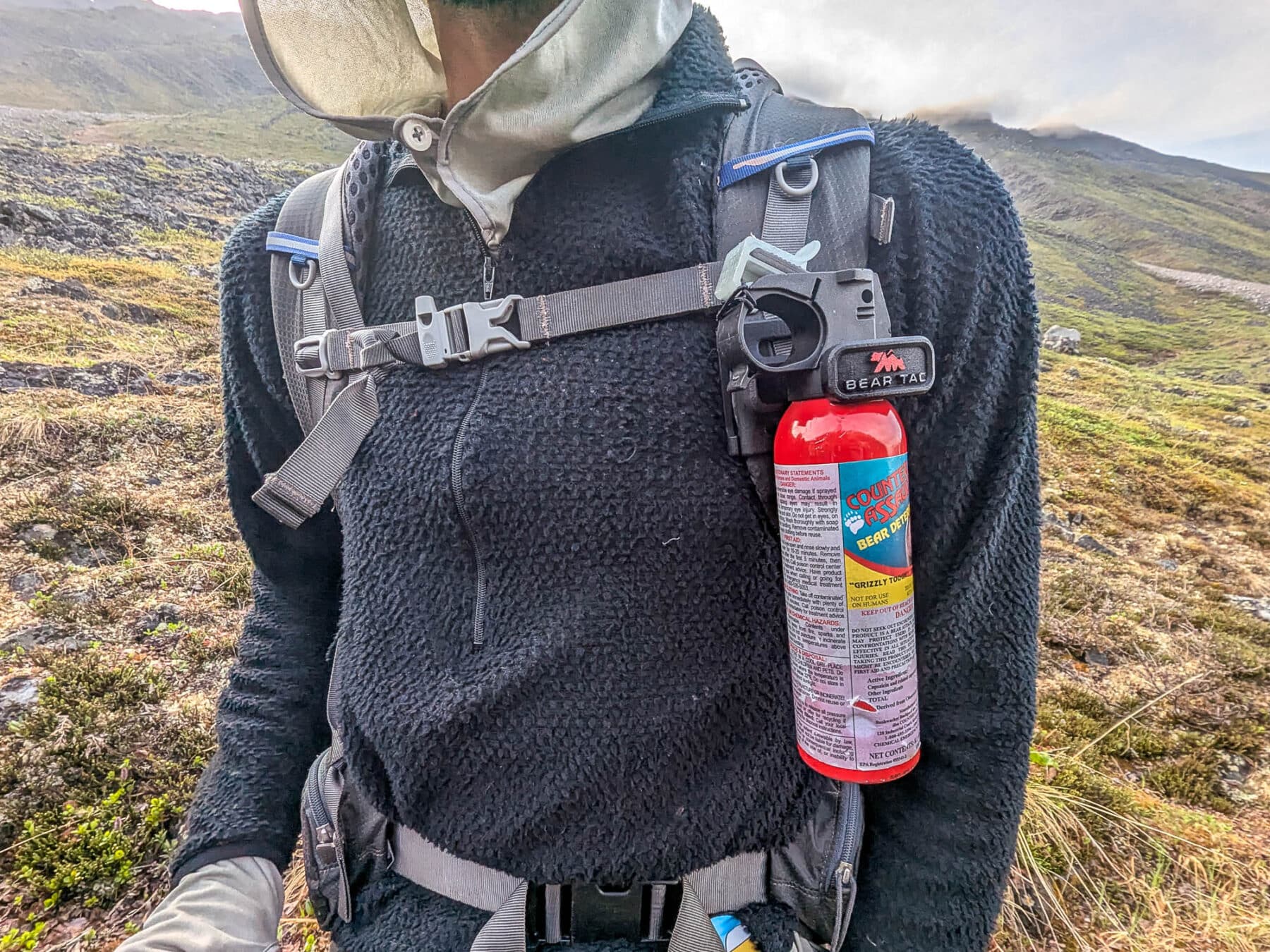
Method 2: Hipbelt
Some brands of bear spray include a holster that can be threaded through the hipbelt. Elasticized holsters are best; the plastic holsters that UDAP started to include in 2024-ish are unreliable — they are prone to cracking due to material fatigue, impact, and cold temperatures.
Like with the shoulder strap, in this location the spray is easy to keep track of and easy to access.
If you select this position, it’s best to lock it in place, like in the niche between the hipbelt pocket and pack body (as can be done on HMG packs). If it sits adjacent to the hipbelt buckle, it may interfere with your stride and it may slide off the hipbelt when you’re putting on or taking off your backpack.
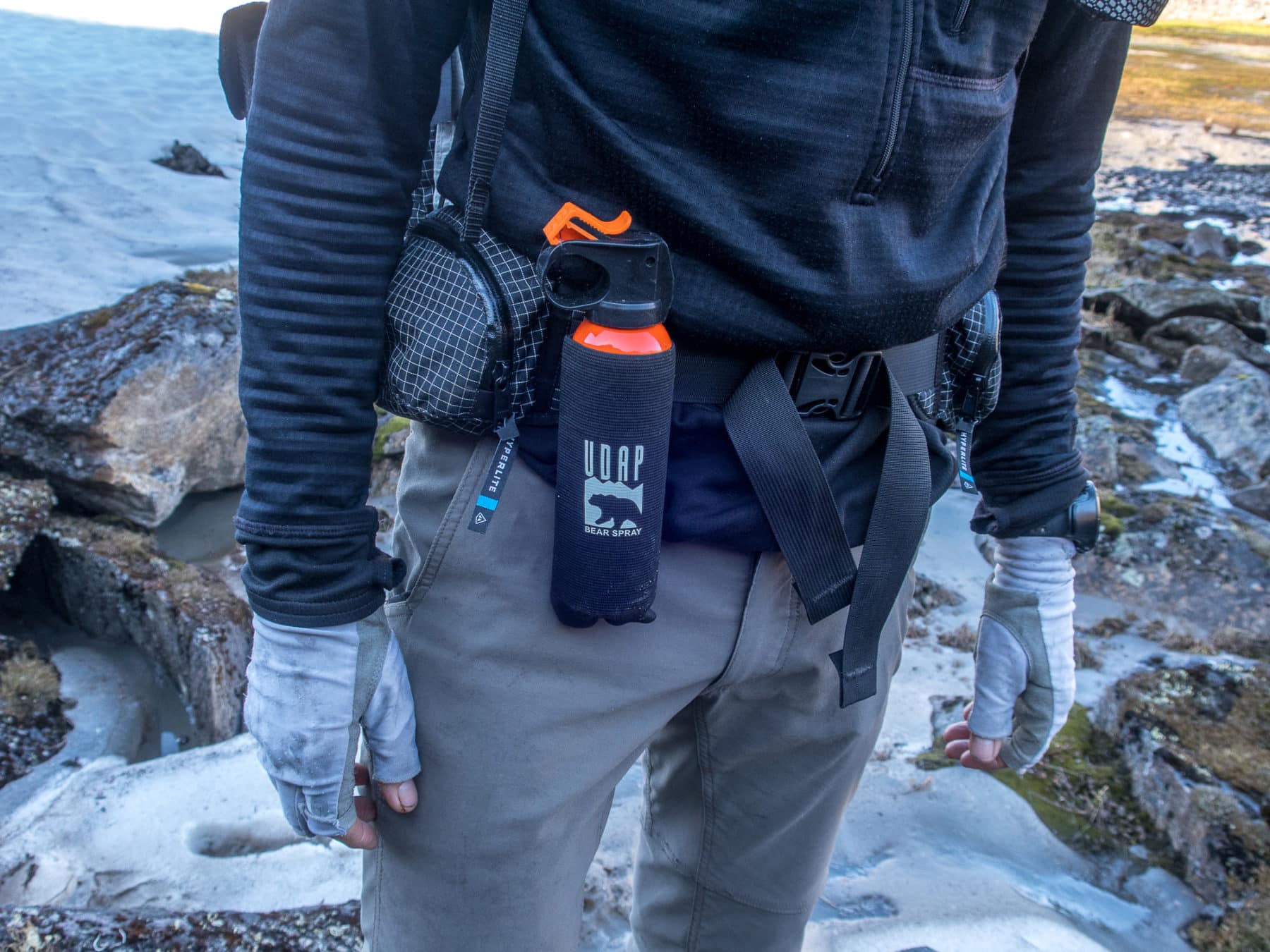
Method 3: Side pocket
The side pocket can be a poor choice for carrying bear spray:
- Many backpackers lack the dexterity to easily access these pockets, and
- Many side pockets are poorly designed and inherently difficult to access.
Moreover, it’s difficult to keep track of the bear spray when it’s in a side pocket — if it were “stolen” by brush or if it slipped out while scrambling or crawling, you might not notice that it’s gone until it’s too late. So, if you use this method, I highly recommend installing a tether using accessory cord. Attach this tether to the spray using a bowline or figure-8, and to your shoulder strap using a girth hitch.
The chief benefit of storing bear spray in a side pocket is that it’s completely out of the way. If you’re not in prime grizzly habitat, if you have expansive views, or if you’re in a large group, it’s reasonable to let your guard down some.

Cold weather considerations
Reader Bill offered some tips about carrying spray in colder temperatures:
Tom Smith and colleagues published results of experiments in “An Investigation of Factors Influencing Bear Spray Performance” (free from ResearchGate). They document canister pressure-head vs. temperature. Bear spray functions at low temperatures but with diminishing effectiveness as temperature cools.
I live and recreate in occupied grizzly range and when temperatures are below 50 deg F, I transport the canister next to my skin, either in a pants pocket or from a holster attached to a short paracord lanyard inside the front of shirt or jacket, sized so that the canister is easily reachable (above pack sternum strap). Carrying in pants pocket makes it really handy to grab when I want to carry in my hand as when vision is limited such as in timber or brush, crest of hill, or bend in trail.
And I always carry a spare canister in a holster attached to the front of my pack, adhering to the oft heard principal (at least in the GYE) of “one for the bear and one to get back to the car”.
I usually place holster on pants belt or waistpack belt, on left left side for right handed draw.
Very useful, esp. since I was hunted down by a bear once. No fun for sure.
Is there a particular type or brand of bear spray you can recommend?
Thanks,
Ray
The best bear spray is the one that’s in your hands!
Thankfully I’ve never had to use it, and definitely not twice so I could commpare. I think you’ll have to rely on manufacturer specs, but I’m uncertain how valuable they are or if they’re apples-to-apples.
Haw! I thought that when I met the bear. Fortunately a log sized branch was near me so I held it above my head and firmly suggested the bear leave. It was a stand off for a few minutes so I was very fortunate it changed its mind. One of the scariest moments of my life!
Thanks for all your tips and such — I bought your new book yesterday and am looking forward to diving into it.
Hike on!
Ray
When I carry bear spray, besides how easy it is to access (and lose/drop), the other thing I worry about is how likely it is I would fall onto it and either break the head off the container or rupture it.
Not directly related to your post, but do you and your clients carry something to wash your hands etc if you use the spray? That stuff is a mess to deal with post spray, some from backspray & drips get on my hands the few times I have used it.
I’ve had one accidental discharge, for a split-second, and it ruined his pants. Even after letting the pants sit in soapy water for a night, he couldn’t get that chemical out of them.
We don’t bring anything specific for post-use. I think the hope is that we don’t need to use it. And if we do, you’ll be happy that you’re still alive afterwards and need to clean up somehow.
yes…i am throwing a 160$ backpack away today (new)..the spray deployed and it is not coming out. What a mess!
On the HMG packs I’ve found that the UDAP holster fits perfectly, almost too perfectly, between the belt pockets and the bag itself. It’s easy to grab from there and doesn’t interfere with anything. And while it’s out of the way you still feel it a little to know that it’s still there.
When using the hip belt, use a small piece of string to tie the holster to something on the body of the pack (like the bottom of the shoulder strap) so it can’t slide forwards while walking or fall off the hip belt when removing the pack.
I do this and never have any problems with my spray–I don’t even really notice it is there as keeping it far back prevents it from interfering with your stride.
Works best with packs that don’t have hipbelt pockets though–I try to avoid packs like the one in your “Method 2” picture that don’t let you attach spray further back. For the pack on your “Method 3” picture, I would consider trying to undo the adjuster behind the hipbelt pocket and thread the bear spray holster in there. Keeps it more accessible than the side pocket and won’t move around (no piece of string required!)