High Route Tent
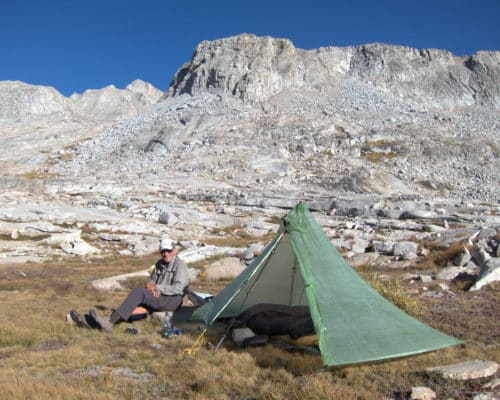
I’m biased about the Sierra Designs High Route Tent 1FL: I drew its first sketches, field-tested extensively each prototype, and assured that the final version achieved my original objectives, which was to create a one-shelter quiver for all of my solo backpacking trips. In these pages, I’ve tried to create and compile information to help you determine if it’s truly the best shelter for you.
The double-wall HR1 excels in challenging 3-season conditions — when it’s stormy, hot and humid, and/or buggy — as well as moderate winter weather. But at 2 lbs 4 ounces (1.02 kg) for the fly and inner tent, it’s acceptably light for milder trips. Its components can be used interchangeably; for example, use only the fly with a groundsheet before or after the bug season; or use only the inner tent on dry and and warm summer nights.
The interior is palatial, with a footprint that is comparable to many ultralight 2-person tents. It measures 4′ x 9′ x 4′ (width x length x maximum peak height). In fact, it can reasonably sleep two when only the fly is used. Its ventilation is superb: it features two 6-inch peak awning vents and two porch-able side doors to increase airflow through the shelter.
It’s one true drawback is its weight: it’s a few ounces heavier than “ultralight” 1-person tents, and about twice as heavy as a tarp/bivy system or a single-wall shelter made of Dyneema Composite Fabric. But are those shelters worth the tradeoffs (e.g. less living space, less storm-resistance, less ventilation, less durability, or higher cost)? That’s for you to decide.
If you have questions about the HR1, leave a comment in the appropriate post, or contact me.
The backpacking shelters that I presented in this series — a modular tent, tarp & bivy, and hammock — are middle-of-the-road systems. They are not ultralight or excessively heavy, not cheap or prohibitively expensive, and not benchmark-setting or under-performers. This was intentional on my part. While they reflect what I personally use (in most cases,…

Over at the Sierra Designs blog I just published a design history of the High Route Tent 1FL. From my initial primitive sketch, it took four major prototypes to get it right. If you are interested in shelter design or want to better understand how the High Route Tent came to be, have a read.

Update (Feb 26): The High Route is currently back in stock. For about a month the Sierra Designs High Route Tent has been unavailable: The gearing-up season has already started, and I’ve received a few direct inquiries about when it will become available again, which means that probably a few more people are wondering the same.…

First off, the High Route Tent is back in stock, as of Friday. If we sell through this inventory, we have a bigger batch arriving in early-April. Next, Sierra Designs is clearing out their inventory in advance of new arrivals. The High Route Tent and Flex Capacitor 40-60 Pack are among the few items that…

This post was prompted by an email from reader Jim that started with, Jim was deliberating between the purchase of a High Route and a more traditional pyramid-shaped shelter (“mid”), and he hoped that I would shed insight on the differences. While I have discussed them in multiple places, I have not yet written a dedicated…

A question from reader Caspar R: I generally do not recommend using a footprint with the Sierra Designs High Route Tent 1Fl. A custom-sized footprint for it is intentionally not available, and there are no plans to offer one. The inner tent of the High Route features a waterproof floor made of medium-duty 30d nylon coated…

The Sierra Designs High Route 1FL was launched in fall 2016, and a second-generation will arrive in spring 2019. Its name will not change (i.e. not High Route 2.0 or High Route II), and the existing design will be phased out. MSRP remains $300. Most notably, the updated High Route is smaller than the original. Instead of being…
- « Previous
- 1
- 2